Bertram H. Kornfeld, 94, Holocaust survivor, World War II Army veteran, and educator
Mr. Kornfeld, his mother, and sister fled Austria for the United States after the Nazis occupied the country in 1938. He wasn't done with the Nazi regime, however. Drafted into the U.S. Army, he was held prisoner of war in the notorious Stalag IV-B prison during the Battle of the Bulge.
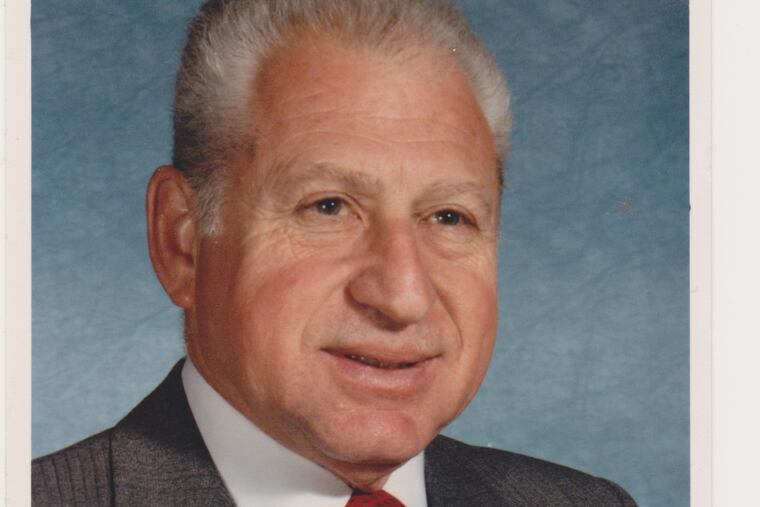
Bertram H. Kornfeld, 94, of Philadelphia, a Holocaust survivor and World War II Army veteran who later became a longtime educator in the Philadelphia public schools, died Thursday, Feb. 21, of complications of Parkinson’s disease at his home.
In August 1938, when Mr. Kornfeld was 13, he and his mother and sister fled their native Vienna, Austria. Six months before, in March 1938, Nazi Germany had annexed Austria in what became known as the Anschluss.
In a chilling oral history that he gave to the Leo Baeck Institute of the Center for Jewish History in New York, Mr. Kornfeld revealed how anti-Semitism first appeared in his world.
“I recall seeing local Jewish merchants forced to scrub the street,” he said. “My mother worked for an attorney who shared his office with a Dr. Ehrlich, who was president of an important Jewish organization. I believe on March 16 he was forcibly removed from his office, and his ashes were sent to his wife.”
Mr. Kornfeld’s mother, a widow, quickly contacted her brother in the United States to get a visa so that the three could leave Austria. “It did take some time, and I recall many very anxious days,” he said. On Aug. 15, the three took a train and then an ocean liner to freedom.
Other members of Mr. Kornfeld’s family died in Nazi concentration camps, including an uncle, two aunts, and several great-aunts and great-uncles.
Mr. Kornfeld had not seen the last of the Nazi regime, however. In 1944, at the age of 19, he joined the Army. In October, he was deployed to Europe with the 106th Infantry Division. He was captured by German soldiers in the Ardennes during the Battle of the Bulge, and forcibly marched to a railroad, where he and his comrades were crammed into cattle cars.
After two weeks on the train, the troops were imprisoned at the notorious Stalag IV-B near Mühlberg, Germany, in December 1944. The bitter cold, scant food, and disregard for the sick caused many casualties. By the time that he and other prisoners were liberated by Russian troops in April 1945, Mr. Kornfeld had lost 50 pounds.
They rejoined American forces in June, and were sent home and discharged on Dec. 22, 1945.
After a period of recovery, Mr. Kornfeld enrolled in Temple University and graduated with a bachelor’s degree in 1950 and a master’s degree in 1953. He moved from Philadelphia to Willow Grove in 1956 and then moved back to the city in 1986.
He joined the Philadelphia School District in 1950, and worked first as a history teacher and later a counselor, vice principal, and principal. He retired from Samuel Fels Junior High School in 1989.
“While an administrator, he treated the staff like family,” said Fredda Segal, his sister-in-law, who was a teacher on Mr. Kornfeld’s staff at Fels. “He would give chocolates on Valentine’s Day, and bring coffee and doughnuts to staff on strike in front of the building. He was always there, giving positive support to teachers having problems with students. “
Mr. Kornfeld married Adele Levin in 1953. The couple had three children. His life was “surrounded by music and family,” his relatives said. He sang in the chorus with local opera companies.
Friend Mary Ann Tancredi and he shared a love of opera. “He had such a happy spirit,” she said. “I never saw Bert angry. He had the sweetest temperament. He always saw the good in things.”
In addition to his wife, Adele, he is survived by children David, Robert, and Anne Westrom, and six grandchildren.
Funeral services will be held at 1 p.m. Wednesday, Feb. 27, at Joseph Levine & Sons, 4737 Street Rd., Trevose. Interment is in Washington Crossing National Cemetery, Newtown.
Contributions may be made to the Michael J. Fox Foundation for Parkinson’s Research via https://www.michaeljfox.org, or the Philadelphia Orchestra via https://www.philorch.org/support.