HATS OFF!
Lorina Marshall-Blake talks with Jenice Armstrong about her 35 years at IBX, her West Philly upbringing, and her take on what the world needs from the next generation of professionals.
During the early 1990s, back when I was a business reporter for the Daily News and brand-new to Philly, one of my first challenges was to figure out who the local players in corporate and political circles were. It didn’t take long before I came across Lorina Marshall-Blake.
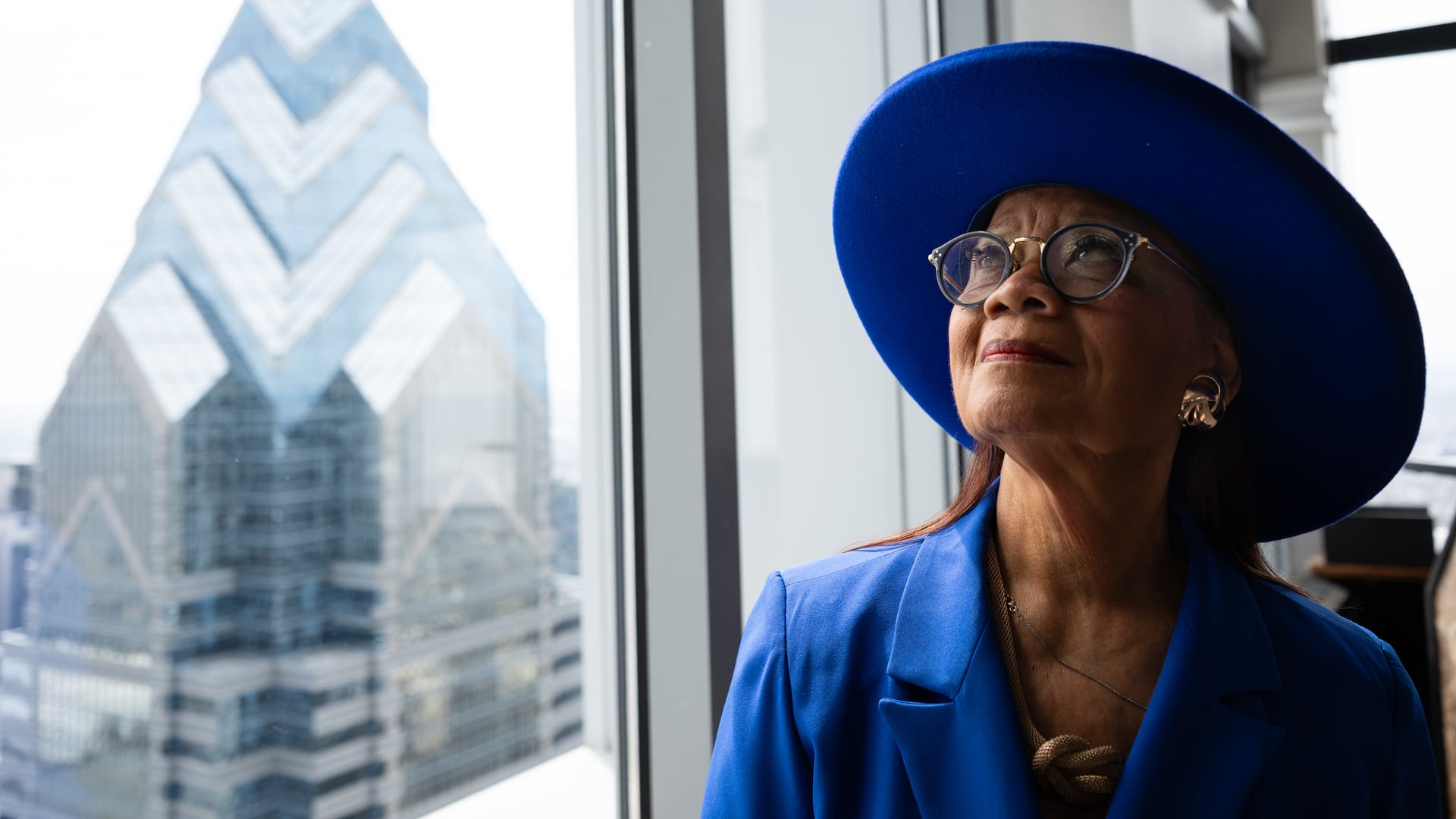
She stood out partly because of her penchant for wearing exquisite hats. But it was also because Marshall-Blake was the newly installed vice president of government relations at Independence Blue Cross. I would see her at meetings and events across the city. She seemingly knew everybody in business and at City Hall — and could work a room like no other. Not only was Marshall-Blake a mover and shaker, but it was clear she was well-liked and respected, as well.
“Lorina Marshall-Blake has a way of making people feel seen and supported the minute she walks into a room,” Kelly Munson, president and CEO of Independence Blue Cross, said. Marshall-Blake, she added, is an example of “how you lead matters just as much as what you lead.”
Watching Marshall-Blake’s career trajectory from afar, I was in awe. There aren’t many women — much less Black female executives — who have experienced the kind of success she has, especially during the early 1990s. The proverbial glass ceiling that blocks qualified women and people of color from advancing in the workplace is stubbornly thick, but Marshall-Blake was somehow able to break through it.
“It may not happen right this moment, but you just have to keep at it. Doors will be slammed in your face [and] sometimes you’ve got to course correct.”
In 2011, she was named president of the Independence Blue Cross Foundation, the company’s philanthropic arm, which has distributed more than $90 million in grants to various local causes — including a program that provides scholarships for Philly-area high school students to attend nursing school.
When I learned earlier this year that Marshall-Blake intended to hang up her fancy hats after 35 years at Independence Blue Cross, I felt a little sad, because it marked the end of an era.
“She’s an iconic person given what she achieved during that period of time,” said A. Bruce Crawley, the public relations guru who met Marshall-Blake when they were both students at the now-defunct Charles Morris Price School of Advertising and Journalism.
Crawley, who founded the African American Chamber of Commerce, watched her career over the years, and “was amazed at the progress she was able to make because she was always just a nice person.”
Back then, he believed that to succeed in corporate America, “it required a certain toughness.” Crawley added, “I thought that she maybe would be challenged by having to be tough, but she was able to do that in a way that didn’t grate on people, and she was a very productive executive.”
When I reached out to Marshall-Blake earlier this year about doing an exit interview, she informed me she will continue working with IBX — just not in a full-time capacity.
But I still wanted to meet with her to talk about her next chapter, as well as to glean some wisdom about succeeding in corporate America. We agreed to meet at the Pyramid Club on a chilly, overcast day. When she walked in, Marshall-Blake lit up the room in an electric blue pantsuit with, of course, a crisp matching chapeau.
She told me she has an entire room in her home filled with hats, many of which were given to her as gifts over the years.
“We all have a brand. You have a brand. I have a brand. Make sure that your brand makes a difference and your brand is consistently consistent.”
Listening to Marshall-Blake talk about growing up as a middle child in a family of five children in a modest, four-room house on the 600 block of North Yewdall Street in West Philadelphia, I thought about the considerable challenges she faced along the way. Her mother was a homemaker; her father was a welder until he was injured on the job.
“I didn’t know I was poor until somebody told me I was poor,” she said.
After graduating from Overbrook High School in 1968, where she was a cheerleader and class treasurer, Marshall-Blake won a scholarship to attend Temple University. But her college dreams were put on hold because she couldn’t afford books.
She went on to hold a series of low-level jobs at Philadelphia Gas Works, Cigna, and a local law firm, and took undergraduate classes before finally graduating from Antioch University in 1983.
“I say, you are chief executive of your life. You pick and choose who is going to be in there.”
Marshall-Blake got her first big career break in 1980, when PGW named her vice president of government relations and urban affairs — a role she fully embraced. She said she worked to learn everything she could about the organization from the ground up — literally.
“I donned my meter reader outfit and read meters,” she told authors of the 2020 book, They Carried Us: the Social Impact of Philadelphia’s Black Women Leaders. “I climbed underneath buildings and got in ditches with the guys. I got on the phones. I wanted to know the people that really carried PGW. If there was a gas explosion, I was there. It was more than just showing up. I was present.”
In 1990, she completed her master’s degree in government relations at the University of Pennsylvania. The following year, she moved to Independence Blue Cross, where she had been named vice president of government relations.
“I’ll always remember the first day I walked into Independence Blue Cross on June 1, 1991,” Marshall-Blake said during a retirement reception in her honor at the company’s headquarters earlier this spring. “This work for me was more than a job. For me, it was ministry.”
“I’m the volunteer’s volunteer. For all of those things that I didn’t get on the job, I did on volunteer boards.”
March 31 marked her last official day as a full-time employee at Blue Cross, but her consulting agreement with the insurance giant began immediately. She said she welcomes the slower pace of her new role. She’s 75. It’s time. She’s ready.
Still, stepping into her next act will be a major adjustment. Marshall-Blake is working on letting go of her usual “got-to-do-this” mindset. The 20 unpacked boxes in the middle of her living room can stay where they are. She’ll get to them when she gets to them.
Marshall-Blake, who is also an associate minister at Vine Memorial Baptist Church in West Philly, said she recently offered up a simple prayer: “Lord, let me accept retirement with grace.”
She accomplished so much during her time in corporate America; I’m sure she will do the same during this season in her life, too.
My hats off to her.
“Lord, surprise me today.”