Trump administration wants to give Afghans who helped U.S. forces a choice between death and disaster
The government is trying to send up to 1,100 Afghan refugees to the Democratic Republic of Congo, an African nation enmeshed in brutal civil wars that have killed and displaced millions.
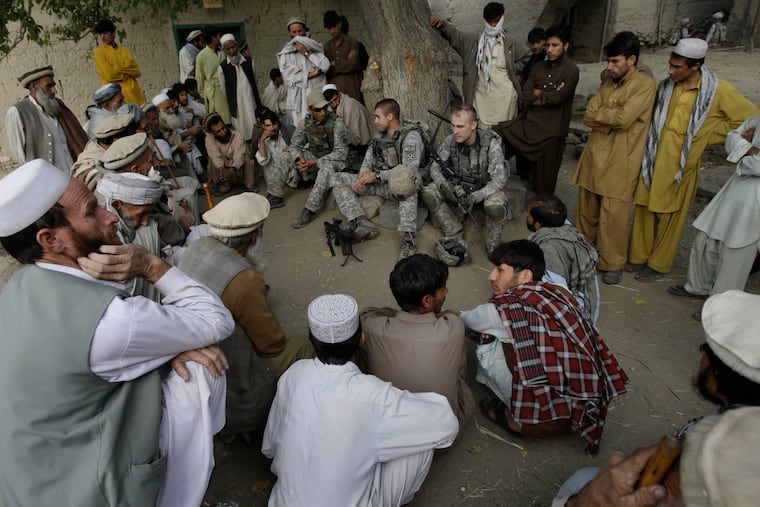
Just when you think the White House policy toward refugees can’t get any uglier, it sinks to new depths that should infuriate Americans of all political persuasions.
After the suspension in November of a resettlement program for Afghans who helped U.S. soldiers and civilians, the Trump administration is now trying to send up to 1,100 of such Afghan refugees to the Democratic Republic of Congo. These include former interpreters for the U.S. military, former members of the Afghan Special Operations forces who worked alongside their U.S. counterparts, and families of U.S. service members — including about 400 children.
These Afghans are trapped in limbo at a former U.S. military base in the Gulf emirate of Qatar (amidst the U.S.-Iran war), where they were taken in late 2024 for a short stay while they completed the resettlement process.
Now, the U.S. Department of State wants to rid itself of the problem, and these refugees may soon be given a brutal choice between death and disaster.
One option will be to return to Afghanistan, where many are on the Taliban death list for aiding Americans. The other choice would be the Democratic Republic of Congo (also known as the DRC), a country in central Africa enmeshed in bloody civil wars that have killed and displaced millions.
Why would U.S. officials choose the DRC? A State Department spokesperson told the New York Times the focus is on “voluntary resettlement.” Refugee organizations beg to differ.
“They have been trying to wash their hands of these Afghans,” I was told by Shawn Van Diver, president of the aid group AfghanEvac. “The DRC may be the only ones who will play ball with them. So the DRC is rising to the top.”
Other refugee aid groups are equally horrified, as we all should be.
“It is horrific and absurd to think of it as a viable option to send persecuted people to a country in the midst of active conflict and listed as Do Not Travel by the State Department,” said Jennifer Patota, deputy director of U.S. legal services at the International Refugee Assistance Program.
“This is a complete betrayal of our promise to Afghans who stood by us. Any future partners will be watching,” she said.
But concepts like honor and loyalty or even simple human decency don’t move the White House officials who devise U.S. refugee policy. They should, however, move every citizen and U.S. legislator who cares about the future safety of our military, and the immorality of U.S. leaders eager to sell out allies.
This latest disgrace sent my mind racing back to President Joe Biden’s shameful and botched withdrawal from Afghanistan (following on Trump’s equally shameful first-term pullout accord with the Taliban). After many trips to Afghanistan, I tried, as did so many U.S. journalists, former U.S. military, and U.S. officials who had served there, to get friends and comrades out.
One of those, whom I wrote about, was a judge who had worked with U.S. officials and had stellar recommendations for the special immigrant visa, known as an SIV, for those who helped Americans. After harrowing months hiding outside Kabul with the Taliban on his heels, and then waiting a year in Pakistan for an SIV, he finally had to return to with his ill wife to Afghanistan when their Pakistani visas expired. I can’t use the judge’s name because he is in hiding.
Although he had completed essential parts of the application process, the Trumpers froze the program at the end of 2025. The supposed reason was a murder in Washington, D.C., by an Afghan refugee (not an SIV holder). Absolutely no excuse for rejecting Afghans who risked their lives to help U.S. personnel.
I spoke about this latest Afghan tragedy to Najib Bakhshinda, a former journalist, who, with his human rights lawyer wife, now heads a nongovernmental organization (NGO) in Canada called GCARR-CANADA that works to help refugees facing danger. Along with their four sons, they made it from Kabul to Ottowa.
I asked Bakhshinda what would happen if the Afghans in Doha returned to Afghanistan.
“They will simply get killed,” he replied. “The Taliban have an official office in Doha, Qatar, and they know who is in Camp As Saylihah [where the Afghans are held]. They even visited the camp and tried to ask about the residents, but people don’t trust them.”
So let me repeat: The White House wants our Afghan allies trapped in Doha to choose between terrible danger and likely death.
What makes this story even darker is the Kafkaesque process that doomed many of these refugees after they reached Doha. “There had been pre-vetting before they reached the camp,” I was told by Andrew Sullivan, a military veteran who served in both Iraq and Afghanistan, and now heads No One Left Behind, an organization that helps Afghans resettle here.
But many of the 1,100 couldn’t qualify for SIVs because of arcane regulations, so they had to apply as refugees.
For example, Afghan Special Forces operators who fought side-by-side with and supported U.S. troops were disqualified if the Afghan government paid them rather than the U.S. military. Yet, the Taliban wants them dead just the same.
There are cases where a child of an SIV applicant aged out at 21 while the family waited years for their visa, and thus was no longer eligible. Or interpreters for U.S. units — prime targets of the Taliban — who didn’t work the required 365 days.
“Absolutely, exceptions should be made if they pass final security clearance,” insisted Sullivan, whose organization helped resettle 3,300 Afghan and Iraqi SIV holders. And, if the U.S. is still unwilling, said Sullivan, then officials should ensure they are going to a safe country where they can survive.
Once upon a time, a bipartisan movement of veterans in Congress promoted laws to enable Afghans who helped us to get visas. But as time passed, and foreign policy crises multiplied, the issue faded from view.
“There is still strong bipartisan support, but the issue has fallen out of sight,” Sullivan said. “Congress needs to act. It can change the law any time.” Or, I’d add, it can press to revive the SIV program the White House froze. Pressure can also be brought on the State Department to drop the two despicable options it is trying to impose on the Afghans in Doha.
This is a refugee issue that all Americans should be able to unite behind.