Trump didn’t bring impunity to immigration enforcement
As border residents can tell you, what’s playing out in places like Chicago and Minneapolis is, in many ways, nothing new.
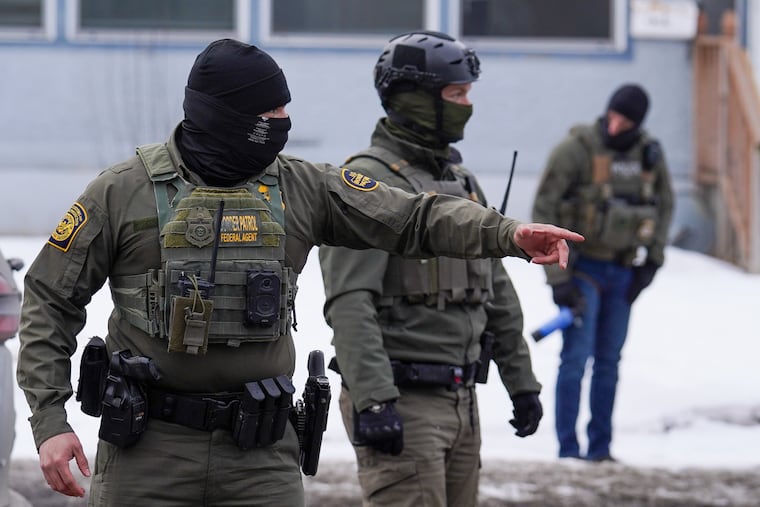
Many Americans were shocked by the killings of Renee Good and Alex Pretti at the hands of federal immigration agents. Many more were repulsed by the federal government’s lack of transparency, victim blaming, and obfuscation of the facts regarding the shootings.
But as border residents can tell you, what’s playing out in places like Chicago and Minneapolis is, in many ways, nothing new.
Although the administration has taken that lack of accountability to a nauseating low — interfering in federal and local investigations — impunity around immigration enforcement did not begin when Donald Trump took office.
Since 2010, more than 300 people have been killed in incidents involving on-duty Border Patrol agents, according to a tally kept by the Southern Border Communities Coalition. Out of that number, 74 have been killed by agents using force.
Those figures are likely an undercount, as the agency has a history of failing to report deaths its agents are involved in. It also consistently fails to seriously discipline agents who face abuse complaints. A 2017 report by the American Immigration Council found a host of problems with the complaint system and investigation process, resulting in little accountability.
Focusing on the use-of-force killings, I am not saying that all 74 were unjustified. As Gil Kerlikowske, who led U.S. Customs and Border Protection from 2014 to 2017, told me, agents often work by themselves in rural border stretches and can run into dangerous smugglers.
But as Kerlikowske also told me, when he arrived at CBP, the agency had an outdated use-of-force policy that wasn’t available publicly, had no internal affairs division, and the only tools available to agents were firearms.
» READ MORE: Trump’s immigration crackdown also threatens Americans’ pocketbooks | Luis F. Carrasco
“They’ve always had a culture that’s distinct, you know, going back to their early days,” he said. “They did have that kind of Wild West kind of culture.”
That’s putting it mildly. While Kerlikowske instituted a series of important reforms around use of force, which he said his successors continued and improved upon, deep lasting change is slow and difficult.
As a 2021 report detailed, the agency “has been steeped in institutional racism and has committed violent acts with near impunity” since its creation in 1924. Lest you think that attitude got left behind last century, in 2019, a Facebook group that included around 9,500 current and former agents was found to be littered with racism and misogyny.
While I’ve known Border Patrol agents who zealously enforce the law while never losing sight of their humanity, who would hand over their lunch to a hungry migrant they just detained, current and former CBP agents were involved in the killings in Minnesota.
The men who shot Pretti were identified by ProPublica as Border Patrol agent Jesus Ochoa and CBP officer Raymundo Gutierrez. Jonathan Ross, the U.S. Immigration and Customs Enforcement agent who killed Good, began his law enforcement career in 2007 as part of the Border Patrol.
I hate to be cynical, but if past is prologue, President Trump and administration officials needn’t have bothered putting their thumb on the scale after the shootings. The few times agents are held to account, the result is rarely justice.
In the last 35 years, only three Border Patrol agents have been charged and tried for killing someone in the line of duty. In all three cases, juries failed to convict.
» READ MORE: Alex Pretti is the latest victim in the Trump administration’s drive for dominance | Luis F. Carrasco
Michael Elmer was charged with second-degree murder after the 1992 shooting of Dario Miranda Valenzuela in Nogales, Ariz. Elmer fired 12 shots, hitting Valenzuela twice in the back. He then moved the body and didn’t immediately report the incident, according to the Arizona Daily Star. He was acquitted.
Nicholas Corbett was charged with murder for killing Francisco Javier Domingo Rivera near Douglas, Ariz., in 2007. The agent’s account did not match up with eyewitness testimony or the physical evidence. The Cochise County Attorney’s Office eventually declined to prosecute after two trials ended in hung juries.
Lonnie Swartz was tried twice, once for second-degree murder and later for involuntary manslaughter, in the 2012 shooting death of 16-year-old Jose Antonio Elena Rodriguez. I was an opinion writer at the Daily Star in Tucson, Ariz., when this case went to trial in 2018. The facts were undeniable: Swartz shot across the Nogales border fence into Mexico a total of 16 times. He stopped and reloaded. He hit the unarmed Elena Rodriguez eight times in the back and twice in the head from an elevation of around 14 feet.
That two juries found Swartz not guilty is unconscionable.
Taken in total, the message that federal immigration agents keep receiving — from the government and from juries — is that they can continue to operate with impunity.
Those who have long advocated for reform in these agencies say perhaps things will begin to change as a result of the deaths of Good and Pretti because they were white Americans. But this isn’t about race or immigration status, it’s about unchecked power.
Kerlikowske, at least, is optimistic about what happens once Trump is out of the White House.
“The Border Patrol isn’t trained to work in cities. That’s not why they hired on. They didn’t hire on to go work in Chicago or Minneapolis,” he said. “I think the vast majority of these folks will be happy to be back doing what they were doing.”
Let’s hope that when they do, they do so with a renewed commitment by the government to transparency and accountability. Otherwise, it may be back to business as usual.