The fraught politics behind the creation of Black History Month
By promoting the teaching of Black history, the scholar Carter G. Woodson sought to counter prevailing educational narratives that ignored the role of racism and wove a tapestry of whiteness.
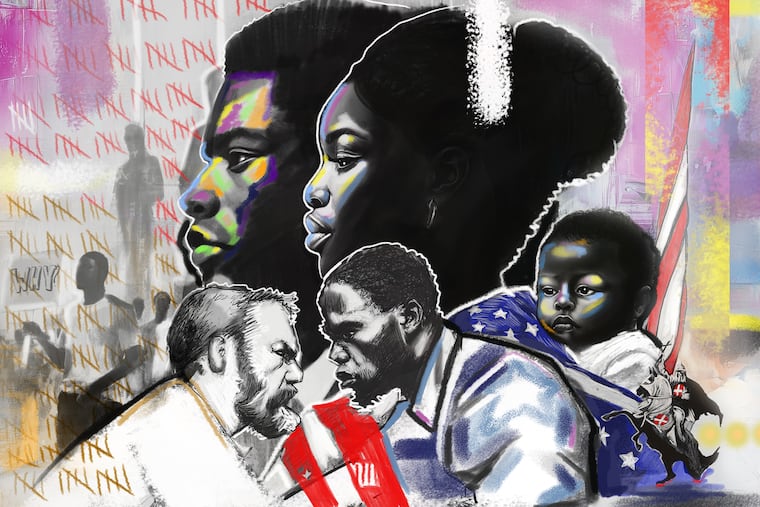
In 1926, when historian Carter G. Woodson created Negro History Week, racism was firmly entrenched in American politics.
In a country whose economy was built on the free labor of enslaved Africans, Woodson — just the second Black man to earn a doctorate from Harvard — believed the educational system sought to enslave Black minds.
The racism in education worked through politics. After all, schools were run by the government and funded by tax dollars, and while the students were segregated by race, the lessons were unified in their promotion of white supremacy.
America’s economic rise ignored the role of racism.
As Woodson would later write in his book, The Mis-Education Of The Negro: “It is strange, then, that the friends of truth and the promoters of freedom have not risen up against the present propaganda in the schools and crushed it. This crusade is much more important than the anti-lynching movement, because there would be no lynching if it did not start in the schoolroom. Why not exploit, enslave, or exterminate a class that everybody is taught to regard as inferior?”
Woodson had a point. The politics of American education meant the stories of America’s wars were told from a Eurocentric perspective. America’s economic rise ignored the role of racism. The country’s cultural norms formed a tapestry of whiteness, and at the root of it all was an underlying theme that Black people were something less than human.
That was the prevailing attitude, but Black Americans kept proving their own nation wrong.
Nearly 180,000 Black men served in the Union Army during the Civil War, but only after petitioning the government to remove the political barrier of a 1792 law that forbade Black Americans from bearing arms for the U.S. Army.
After emancipation, Black property owners acquired an estimated 16 million acres of farmland by 1910. The backlash against that achievement was not only driven by acts of violence. It played out politically, as local governments seized Black land through eminent domain, and the U.S. Department of Agriculture pushed Black people off their land through lending discrimination.
Sharing such history is inconvenient because it unravels the narrative that white America acquired everything through hard work and sacrifice, while Black America lost everything through laziness and incompetence.
Maintaining such historical lies requires political will and a story people want to believe. In 1915, America got both.
D.W. Griffith released a film called The Birth of a Nation. Its racist narrative portrayed Black men as savages, while depicting the Ku Klux Klan as heroes.
President Woodrow Wilson, who screened the film in the White House, said The Birth of a Nation was “like writing history with lightning.”
In truth, the film was not history. It was racist propaganda, and it helped to fuel the resurgence of the Ku Klux Klan. By 1921, African Americans were facing a full-on assault. In Tulsa, Okla., they endured what the U.S. Department of Justice later called a “coordinated, military-style attack” on a prosperous Black community. It was an assault that destroyed property worth millions of dollars, and it happened with the cooperation of the police and National Guard.
In 1923, the political leadership changed. Republican President Calvin Coolidge, in his first congressional address, said that under the Constitution, Black people’s rights “are just as sacred as those of any other citizen,” while calling on Congress “to exercise all its powers of prevention and punishment against the hideous crime of lynching.”
However, the president was only willing to go so far. He said racial issues should be worked out locally, and ultimately chose not to endorse an anti-lynching bill because he feared that in doing so, he would jeopardize tax legislation he was trying to push through the Senate. Black people weren’t his priority.
It was against that political backdrop that Woodson founded Negro History Week — a celebration that wasn’t officially sanctioned by the federal government until 1976, when President Gerald Ford recognized Black History Month. A decade later, Congress passed it into law.
Between then and now, as political winds have shifted, we are once again facing backlash against Black progress.
In this moment, when the weight of Black history both strengthens and comforts us, I am reminded that Woodson, in his seminal work, The Mis-Education of the Negro, warned Black people against staking our hopes solely on politics.
“History does not show that any race, especially a minority group, has ever solved an important problem by relying altogether on one thing, certainly not by parking its political strength on one side of the fence because of empty promises,” he wrote.
In other words, if the past has taught Black people anything, it has shown us how to look beyond the rhetoric of politics and seek out each other for strength.

This essay is part of a series exploring the 100th anniversary of the creation of Black History Month.
- How Black History Month endures | Rann Miller
- The fraught politics behind the creation of Black History Month | Solomon Jones
- Black media: Our voice is our most potent weapon and our most sacred sanctuary | Sara Lomax
- Despite Trump’s disdain, Black History Month matters | Harold Jackson
- African American personal faith and organized traditions have had historic impact | Anthea Butler
- Democracy, engineered in the Black metropolis | Michiko Quinones
- Preserving Black history must start in the classroom | Sharif El-Mekki

Inquirer Opinion Newsletter