Will Trump sell out Taiwan at Beijing summit for a mess of soybeans?
China’s Xi Jinping has the upper hand as a weakened U.S. president seeks flashy trade deals and help with ending his war of choice in Iran.
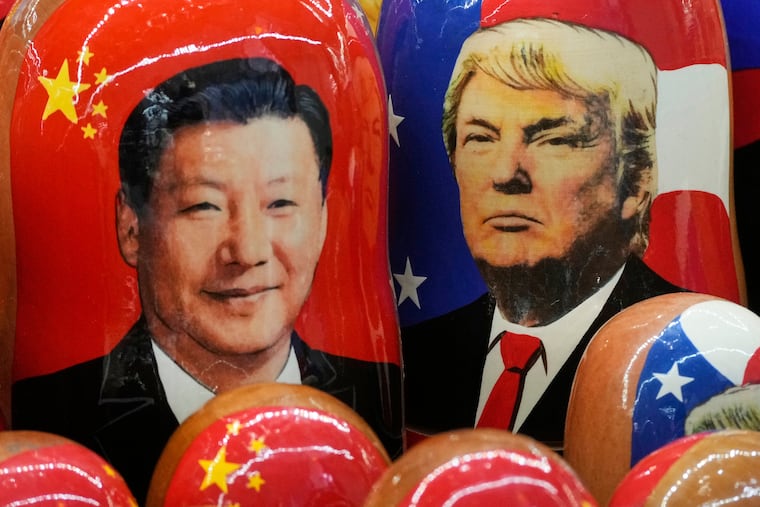
On the day of departure for a summit with a skilled adversary, a U.S. president might have been prepping with senior advisers for crucial meetings.
Not Donald Trump.
In the early hours of Tuesday, the president was madly posting on social media about irrelevancies, denigrating Democratic opponents (along with Britain’s Prime Minister Keir Starmer), pushing bizarre conspiracy theories, and praising the repainted Lincoln Memorial Reflecting Pool. And, oh yes, promoting AI-generated pictures of Iranian ships sunk by U.S. missiles in the still-blocked Strait of Hormuz.
It was a sad effort by a weakened POTUS to proclaim his greatness as he heads to China, weighed down by an inflated ego and dogged by a flailing economy and the failed Iran war.
What a change since Trump’s glamorous state visit to Beijing in November 2017, when he and Melania Trump were honored with a private tour of the Forbidden City, and an opulent state dinner at which Trump openly praised Xi Jinping as a “very special man.”
This time, Melania is staying home, perhaps aware that the glamour has been tarnished. While Trump can expect a lavish banquet, the balance of power between Trump and his self-proclaimed friend, Xi, has shifted dramatically. Although the United States is still the world’s richest country, China has advanced substantially as a military and technological and industrial superpower, despite current economic problems.
Meanwhile, Trump has degraded America’s critical alliances, squandered its soft power in science, education, and foreign assistance, and failed badly in his self-touted efforts to bring peace to the Mideast and Ukraine.
Most disturbing, the president’s self-delusion that he alone can do “great deals” with dictators has been proven false, repeatedly, and will be tested again in Beijing. This fantasy leaves him unprepared for dealings with tough men like Xi or Russia’s Vladimir Putin, who have learned how to manipulate him.
Xi knows Trump wants and needs China’s help on several fronts. The president is eager to achieve a flashy economic deal to offset his troubles at home and provide bragging rights to midterm voters. And he will no doubt seek Xi’s help in pressing Tehran to open the Strait of Hormuz.
The big question: What will POTUS be willing to give up in return for the assistance, and will he even be aware of the cost?
One cannot overestimate the lessons China has learned from Trump’s blunders in the Iran war. True, the conflict has provided a strong picture of U.S. military air power. But Trump’s incomprehensible unpreparedness for Iranian retaliation in the Strait of Hormuz has underlined the lack of strategic planning from the White House.
Beijing has undoubtedly taken note.
The slapdash war has also revealed the lack of forward thinking in the Pentagon. China now knows the United States lacks the current production capacity to replace the enormous number of offensive and defensive missiles used up against Iranian targets. The war has also laid bare the Pentagon’s pathetically slow entry into the new world of drones, having refused, for the past year, Ukraine’s offer to share its unique knowledge and capacity.
Moreover, the war has provided Beijing with a valuable example of how it might use control of critical international waterways like the Taiwan Strait or South China Sea to squeeze opponents, including Japan, Taiwan, and the U.S., in a crisis.
Although Beijing imports almost all of Iran’s oil, it has amassed enough energy surplus in storage, along with renewables, to enable it to survive the Hormuz closure for months. Meantime, energy-poor and desperate Southeast Asian nations have been forced to go begging to China to survive a disaster of America’s making. European allies are also suffering, while Russia reaps the benefit of skyrocketing energy costs.
Xi can sit back and watch America’s reputation plummet around the world.
There is little incentive, then, for China to pressure Iran to open the strait — nor would Tehran likely oblige. However, Xi might offer to make a (no doubt useless) request if a desperate Trump acknowledged the debt.
When it comes to trade, again, Trump is on the back foot. His early second-term attempt to bludgeon China into fairer trading practices with massive tariffs badly misfired. A confident Xi retaliated by restricting exports of rare-earth minerals. Again, Trump failed to anticipate an adversary’s response and had to back down. And now the U.S. Supreme Court and the Court of International Trade have ruled against the framework Trump used for imposing tariffs.
China has backed off its rare-earth ban, for now, and both sides are expected to maintain the wobbly trade status quo in Beijing.
But Xi will probably gift Trump with large purchases of airplanes and soybeans to help U.S. farmers who were devastated by POTUS’s tariffs. (Mercifully, talks on a massive Chinese investment in building plants in the United States have been postponed. This is a bizarre idea that would undercut the American auto industry and make U.S. consumers more dependent on China.)
Yet, Beijing will no doubt ask a price from Trump in return for “soybean” diplomacy. Most likely a reduction in weapons sales to, and reduced support for, Taiwan.
Asked by reporters whether the U.S. should continue weapons sales to Taiwan, Trump replied: “I’m going to have that discussion with President Xi. [He] would like us not to.” Even that careless remark violates long-standing U.S. policy since the government pledged to Taiwan in 1982 that it wouldn’t consult with Beijing on selling defensive weapons to the self-governing island.
The White House claims there has been no change in U.S. policy regarding Taiwan, and any change would rouse strong bipartisan opposition in Congress. Yet, Trump has already frozen a large Taiwan arms deal for weeks, so as not to anger China.
As Xi has learned, Trump is more concerned with flashy headlines — say on massive Chinese purchases of beans — than in keeping pledges to allies. In phone calls to Taiwan this week, I heard intense worry. If that worry bears fruit, respect for U.S. power will plunge in Asia.
We’ll soon see if POTUS kowtows to Xi in Beijing.