If anti-Jewish hate goes unchecked, it will probably be deployed against other marginalized groups next
Surging antisemitic animus ripples across our entire democracy.
Passover begins Wednesday, which means we are approaching the one-year anniversary of the arson attack on Gov. Josh Shapiro’s residence a few hours after his family’s Seder.
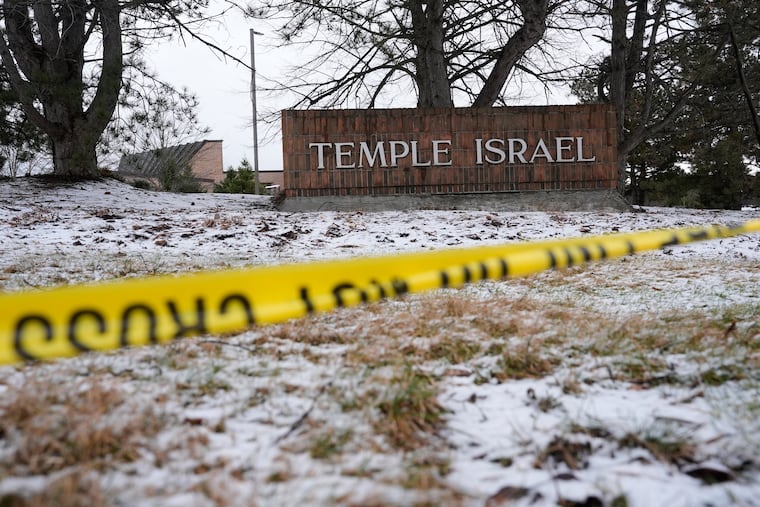
In the months that followed, so, too, did continued anti-Jewish violence. Young Jews were fatally shot leaving the Capital Jewish Museum in Washington, D.C. Older Jews were firebombed, and one was killed, at a hostage vigil in Colorado. And, most recently, Jewish preschoolers at a Michigan synagogue were the target of a narrowly averted rampage.
Recent news coverage has fixated on financial impact, with synagogue security costs now estimated to exceed $765 million annually. But the true costs of surging anti-Jewish animus go beyond those wages of worship. They can’t be measured in dollars or solved by fortifying synagogues. Instead, they ripple across our entire democracy.
We write as both proud Liberal Jews and proud defenders of the rule of law. In our professional work as a legal scholar and civil rights lawyer, respectively, we have decried efforts to demonize and subordinate immigrants, Black Americans, women, and LGBTQ+ persons.
» READ MORE: In these already tense times, the government’s request for a list of Jews at Penn is especially alarming | Opinion
And in our personal lives, we now see Jews being demonized and subordinated. We therefore understand violence against Jews from two perspectives: as both an immediate threat to our own Jewish American community, and among the most potent of threats to the ailing democracy we’ve long championed.
Let’s start with synagogues. Even when security deters or thwarts attacks, violence imposes significant and unquantifiable costs. In this new era, congregants are forced to run TSA-like gauntlets of scans and searches. They receive the message loud and clear: People want them scared, if not dead.
In theory, Jews can participate in the political process, as can all Americans, to reassert their equal rights and standing. But, crucially, harassment and violence are also impairing political participation.
As the attacks in Pennsylvania and elsewhere demonstrate, anti-Jewish violence doesn’t begin, or end, at the synagogue doors. In fact, FBI statistics reveal not only that 69% of religiously motivated hate crimes target Jews (who are just 2% of the U.S. population), but also that over 90% of anti-Jewish crimes do not occur at houses of worship.
Consequently, Jews who exercise their political rights — to assemble, to speak, and to petition their government — must consider safety at every turn. This includes limiting access and publicity.
We regularly grapple with these considerations ourselves. Jewish-themed conferences and advocacy aren’t promoted, times and locations are kept close to the chest, and security is stifling (and demoralizing). The threats and precautions inevitably limit attendance and impede efforts to counter anti-Jewish violence and intimidation. In effect, they tax Jewish citizenship.
Those seeking to stoke anti-Jewish hatred don’t have these problems. These days, it seems like every podcaster, politician, and social media poster has found the same new way to gain popularity and clout — except it’s the oldest way.
Harassment and violence also work in tandem with broader movements to delegitimize Jewish participation in American democracy. These movements tell Jews that they will be safe only if they renounce Zionism and disavow their connection to their ancestral homeland.
When they don’t (and sometimes even when they do), Jews are falsely accused of harboring dual loyalties, controlling the U.S. government, or supporting genocide. Such libels depict Jews as blameworthy, as undeserving of equal rights and dignity, and, implicitly, as acceptable targets for those intent on hurting them.
Harassment and violence also work in tandem with broader movements to delegitimize Jewish participation in American democracy.
Now, after each attack — from the governor’s mansion in Harrisburg to Bondi Beach in Australia — it’s become an open question whether the Jews deserved it. Grosser yet, these debates often imply that bad Jews, apparently including Michigan preschoolers, are ruining things for the good ones, defined as those who loudly denounce Israel.
The violence and concomitant messaging are thus targeting not just Jewish safety but Jewish citizenship. They send a message: No barricade, no fortress will guarantee Jews their full and free exercise of rights as Americans. And if these tactics succeed against Jews, we fear they will next be deployed against other marginalized groups.
Before these bullying campaigns progress any further, let’s recognize them for what they are: a blueprint to debase disfavored minorities and subvert our already teetering democracy. In other words, a republic that won’t protect its Jews cannot safeguard itself.
Jon D. Michaels is a professor of law at the University of California, Los Angeles School of Law. Matthew Segal is a professor of the practice in the department of political science at Tufts University.