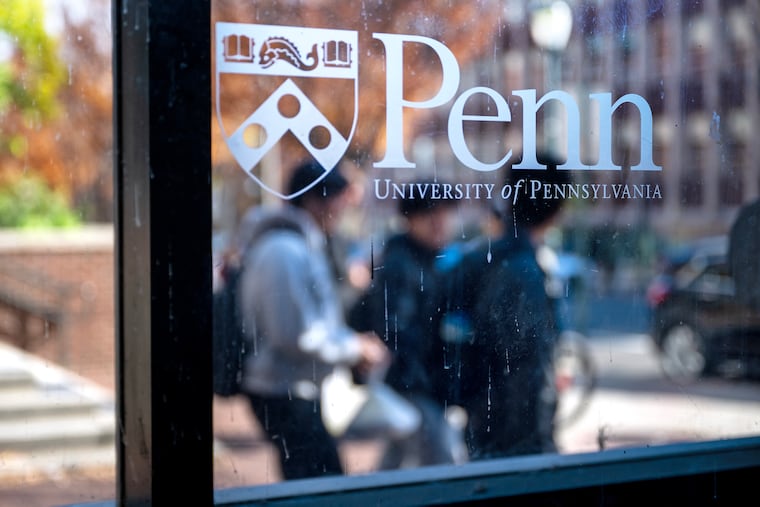
In these already tense times, the government’s request for a list of Jews at Penn is especially alarming
As a rabbi, I am concerned that if Penn were forced to share that information, Jewish students around the country would be wary of participating in any Jewish or Jewish-adjacent program.
On March 7, two Bucks County Islamists who pledged allegiance to ISIS were arrested and accused of throwing a homemade bomb in New York City at an anti-Muslim protest. The next day, a Jew was shot outside his Teaneck synagogue with a pellet gun.
On March 9, two American-Israeli men, speaking Hebrew, were assaulted on the streets of San Jose, Calif.
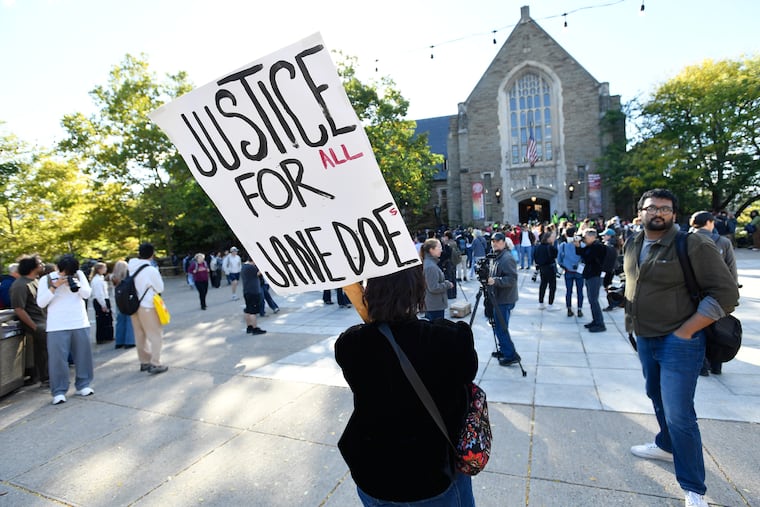
And the federal government is demanding a list of Jews at the University of Pennsylvania?
What a chilling sequence of events.
It’s also confusing because the government’s Equal Employment Opportunity Commission (EEOC), the administrative body that filed suit to compel the university to release the list, claims to be investigating antisemitism to protect Jewish students and faculty.
Penn’s administration had initially cooperated with the commission’s investigation into antisemitism. Penn recognized its problems were endemic and, even before the departure of their past president, was moving in the right direction to address the concerns of Jews who felt threatened on campus.
But the all-too-real problems of antisemitism on campus should not be addressed by divulging the identities and personal information of Jews who gave no consent for that information to be disclosed.
As a rabbi, I am concerned that if Penn were forced to share that information, Jewish students around the country would be wary of participating in any Jewish or Jewish-adjacent program, club, group, or organization.
» READ MORE: Penn and Trump administration spar in court over subpoena seeking names of Jewish faculty and students
As a student of Jewish history, I am also suspicious of why a federal commission designated to protect employees, which at a university would be faculty and staff, is demanding the names of Jewish students.
The attorney for the federal agency who subpoenaed Penn for the names and contact information of these students, staff, and faculty, disingenuously described the subpoena as a “garden-variety” request. Requests from the government for personal information are not generally made based on religious affiliation. It is precisely this anomaly that is so unnerving because it echoes the beginning of the Third Reich.
Many Americans, including American Jews, are reflexively offended by the comparisons of Trump administration policies to Nazi policies. Their indignation is misplaced. Not all comparisons require us to focus on the death camps. Auschwitz was not the opening scene of the Nazi horror. Just weeks after the Nazis came to power in January 1933, Vicco von Bülow-Schwante, a low-level employee in the German Section of the Foreign Office, and the state secretary’s nephew, was tasked with compiling names and statistics of German Jews.
There’s no reason to suspect that Von Bülow-Schwante, or anyone else for that matter, anticipated the systematic extermination of Europe’s Jews. But a decade later, 15 members of the Nazi party and their SS (the Nazi paramilitary corps) convened in a villa in a Berlin suburb called Wannsee. The Wannsee Conference, as it came to be known, was the epitome of the banality of evil — a meeting of apparatchiks to coordinate the complicated logistics of “the Final Solution.” At Wannsee, the systematic extermination of 6 million Jews came to a bureaucratic crescendo — with lists.
As a student of Jewish history, I am also suspicious of why a federal commission designated to protect employees, which at a university would be faculty and staff, is demanding the names of Jewish students.
Von Bülow-Schwante did not know in 1933 how those lists he initiated would be used. But we know.
The district judge hearing the case against Penn, Gerald Pappert, suggested that if the information requested by the government was relevant to the investigation, he did not see why the information should be withheld.
Relevance should certainly be one criterion — in which case the necessity for student information in an investigation dealing with employees should be addressed. But shouldn’t the First Amendment’s guarantees for freedom of religion and assembly also be relevant?
Given the recent precedent of regimes using personal information to track down and execute people they have identified as enemies of the state and the current spike in antisemitic activity, some Jews may prefer to keep their religious identity discrete.
It took 10 years between the beginning of the compilation of Jewish lists by the Nazis and the Wannsee Conference. What makes anyone so confident that if such lists are compiled today they would be immune from malign actors, governmental or otherwise, in the future?
Pappert was not wrong when he dismissed a suggestion by Penn’s attorney, stating, “Since when does the employer have the right to step in and dictate the terms of the investigation?”
My question, to both the judge and the EEOC would be, “Since when does the government have the right to demand the disclosure of private information about its citizens’ religion and associations?”
The Germans have an expression, “Beware the beginnings.” We Americans have an expression, too: “Eternal vigilance is the price of liberty.” Investigating antisemitism without endangering Jews, now or in the future, may be more challenging if we insist on our right to privacy.
If so, the price of liberty may become even more dear.
Shai Cherry is the rabbi of Congregation Adath Jeshurun in Elkins Park and was previously on the faculties of Vanderbilt University, the University of California, Los Angeles, and the University of San Diego.