For LGBTQ+ young people, the Attic Youth Center provides what some say they need most: a sense of community | Philly Gives
“The issue isn’t that they are an LGBTQ+,” says the program’s chief. “It’s that they don’t have acceptance in most environments.” The center is committed to changing that.

Help uplift 10 nonprofits tackling Philly’s most pressing needs by making a donation today.
Whitney Houston’s soaring anthem to a love that can never be fulfilled breaks hearts with every phrase. But when Natalie Rivera, 21, smiling, leaned into the microphone and nailed the high notes in Houston’s “I Will Always Love You” during the Attic Youth Center’s weekly karaoke session, joy soared.
Hands raised in involuntary “Amens,” applause, smiles, singing along — the happiness was palpable for the 20 people gathered, as they do each Wednesday for karaoke in the Attic, founded in 1993 to support queer youth.
And yet.
And yet. Statistically speaking, at least half of the LGBTQ+ people in the building had either thought seriously about suicide or had actually tried to kill themselves.
Rivera, too. And Jasper Liem, the executive director. And Madelyn Morrison, the director of programming. And Rosko Scott, Phresh coordinator.
And nearly every single person interviewed for this article.
“It’s a form of suicide prevention,” said Scarlet Sionus, who sang “When You Believe,” a song by Houston and Mariah Carey about miracles in a place where miracles happen. “It gives people community. It gives hope, and those are things people desperately need.”
What young people desperately need, explained Liem, is support — role models as they navigate toward adulthood in a world that may be foreign to them. After all, most children grow up modeling themselves after their parents and relatives, but the majority of LGBTQ+ youth may not have LGBTQ+ adults who are close to them.
“The issue isn’t that they are an LGBTQ+,” Liem said. “It’s that they don’t have acceptance in most environments. Using a person’s chosen name and pronouns go a long way to making them feel accepted.”
The psychological struggles these young people have reconciling the difference between their physical bodies and their gender or sexual orientation are daunting, and there may be no one trusted enough to help. In fact, those they should trust the most may be the ones causing the most pain, physically and mentally. It can be overwhelming, just too much to imagine — and sometimes easier to imagine suicide.
Family tensions ensue. Many young people lose their homes. Even if they aren’t sleeping on the street and are couch surfing, shelter seems tenuous — and dangerous. Some trade sex for housing, Liem said. At least there’s a warm bed for a few nights. Hunger is an issue.
But above all, it’s lonely — and scary.
What the people who come to Attic most need, Morrison explained, is what she found when she first discovered the Attic in high school. Community.
“I remember taking this huge exhale. There was a whole room of people I had never seen before, but I knew I was among friends,” she said.
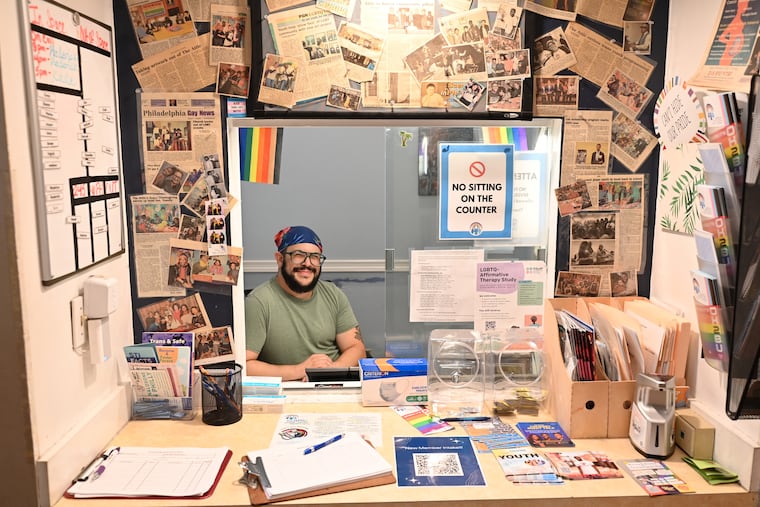
The Attic offers a range of services for the roughly 400 people, aged 14 to 23, it helps. There’s psychological counseling, disease prevention education, career guidance, lessons in finding housing, and leadership training.
And all of that is on top of a packed schedule of social activities, including karaoke, voguing, and theater, or just plain hanging out with friends.
“When young people first come here, they don’t smile for a while,” Liem said. “Then something shifts, and the smile comes out. Seeing that is one of the most rewarding parts of my job.”
Morrison experienced that smile shift when she first discovered Attic back in 1994, when she was 14.
She was born a boy, but she confided in letters she wrote to a friend that she knew she was a girl. One day, her mother found a letter. Morrison was “outed.”
It wasn’t pretty. Yelling, curses, slurs. “I remember running out of the door and kept running. My family tried to beat it out of me. I had to wear long pants to hide the welts on my legs. I couldn’t even wear my gym shorts.”
Bullied at school, she told a guidance counselor she couldn’t take it any longer. The counselor asked if she was planning to leave school. “`No,’” Morrison said she replied. “`I’m going to leave this planet.’”
One day, at home in the kitchen, she grabbed a knife and tried to slice her wrists. “I thought, `If I’m lucky, my mother will find me after I’m dead, and she’ll have one less child to be embarrassed about.’”
Her mother found her, took away the knife, and didn’t talk to Morrison for days. Eventually, through counselors at middle school, Morrison found her way to the Attic. She and her mother have since reconciled.
Starting in 1994, she began to come every day. The Attic supported her as she transitioned.
“Places like the Attic Youth Center were a saving grace,” she said. “If it weren’t for that space and that support, I wouldn’t be alive today.”
Attic’s support comes from a mixture of donations from individuals, foundations, and corporations, as well as government contracts, mostly with the city. The Attic’s Bryson Institute also offers trainings to organizations that want to create safer spaces for their queer coworkers or neighbors.
Help uplift 10 nonprofits tackling Philly’s most pressing needs by making a donation today.
“If you asked me in January what my biggest fear was, I would have said that LGBTQ+ organizations would lose their 501c-3 nonprofit tax status,” Liem said. “There was a bill known as the nonprofit kill-bill, couched in terms of anti-terrorism — anything they’d consider non-American.”
But it’s different now — and worse.
“Homophobia is getting politicized in a very real way. I don’t think it’s far-fetched for the LQBTQ+ to be next in the murder line, under the name of protecting parents’ rights or protecting children,” Liem said.
Already, he said, healthcare plans for federal workers no longer cover transition-related medical expenses, putting those in the middle of their transitions in danger. In the summer, the U.S. Department of Justice issued subpoenas to hospitals doing transition-related care, seeking identifiable health-related information that would ordinarily be considered private.
Places like the Attic Youth Center were a saving grace.
“We are ensuring that our youth are educated about what is happening” in trainings that are as much about how government works as about current issues, Liem said.
Attic selects young people to join its youth leadership council. “The idea is that they are being trained to organize communities. They are being taught the skills they need to be leaders in the community,” Liem said.
Exactly, Morrison said, agreeing.
“A lot of times we forget that the icons who were trailblazers were young at the time,” she said. “Now these are the trailblazers.”
Or, as Scarlet Sionus sang, in a voice deep, mellow, and full of yearning:
“And it’s easy to give in to your fears/ But when you’re blinded by your pain/ Can’t see your way clear through the rain/ A small, but still, resilient voice/ Says help is very near/ There can be miracles/ When you believe.”
This article is part of a series about Philly Gives — a community fund to support nonprofits through end-of-year giving. To learn more about Philly Gives, including how to donate, visit phillygives.org.
About Attic Youth Center
Mission: The Attic Youth Center creates opportunities for lesbian, gay, bisexual, transgender, queer, and questioning (LGBTQ+) youth to develop into healthy, independent, civic-minded adults within a safe and supportive community, and promotes the acceptance of LGBTQ+ youth in society.
People served: 400 youth
Annual spend: $2,192,028
Point of pride: Founded in 1993, the Attic remains Philadelphia’s only organization exclusively serving LGBTQ+ youth ages 14 to 23, and proudly continues best practices in youth-informed and youth-led programming. All programs and services are free.
Support: phillygives.org
What your donation can do:
$10 provides a hot, homemade dinner and transportation support for an Attic youth
$20 provides a week of shelf-stable, nutritious food and groceries from our pantry
$100 covers the first month of utilities for an Attic youth getting their own housing
$250 covers the initial intake and evaluation sessions for therapy with an Attic master’s level, licensed clinician
$1,000 provides a month of stipends for our youth leadership council