Preserving Black history must start in the classroom
We must not only create the temporal and physical space for Black inclusion throughout the school year and across all disciplines, but also adopt a new mentality.
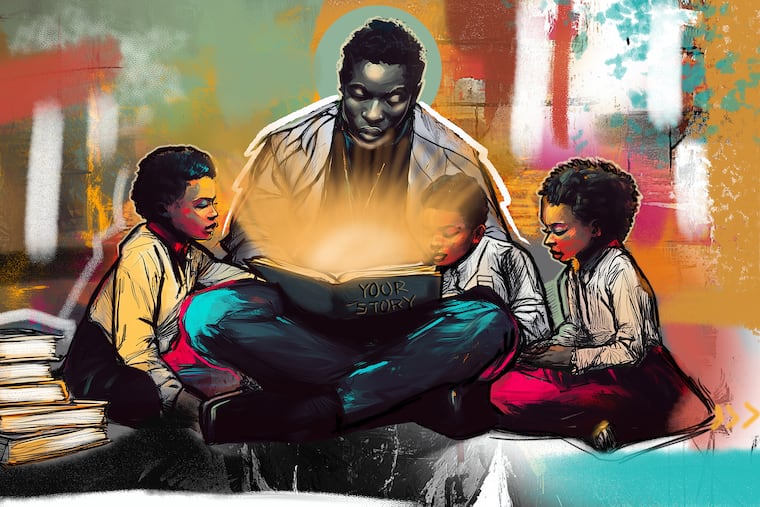
James Baldwin liked to remind us: “History is not the past. It is the present. We carry our history with us. We are our history. If we pretend otherwise, we are literally criminals.”
Any teaching of our collective story that erases the genius, the contributions, the struggles, and the successes of Black people isn’t history at all. It is indoctrination. Propaganda. The criminal theft of an entire people’s existence.
Ours is a story that should not — cannot — be confined. Nor segregated within a designated month, select classrooms, or special curricula.
To build on the words of Malcolm X, America has tried to destroy Black people by denying and obliterating the nation’s collective understanding of Black history through lies and gross omissions, or by flattening the full contours of our story into one of only oppression and resistance. The renewed burial of the previously buried history of the President’s House that the Avenging the Ancestors Coalition and others worked so hard to have mounted is a prime and recent example of these attempts to erase.
Through multiple generations (up to this very day), students of all backgrounds have missed out on learning and benefiting from the full humanity of the Black experience where they rightfully should have expected it: in their schools.
That our history has survived and even been enriched over the years is itself a testament to the power of our intergenerational communities. In our grandparents’ living rooms, through family lore and handed-down traditions, photos and treasures, we have resisted the robbing of our past and appropriation of our identity.
Any teaching of our collective story that erases the genius, the contributions, the struggles, and the successes of Black people isn’t history at all.
But despite this resistance, there have been lasting impacts of this ongoing, systemic exclusion. One of them is that our teaching force (including Black educators) feels ill-equipped to share the story of Black people, continuing the cycle of misinformation and diminished returns not just for students, but for us all.
We can change this. As Makinya Sibeko-Kouate once said, “Education should be a maker of a virgin future rather than a slave to an unjust and shopworn past.”
Living up to this requires not only the creation of temporal and physical space for Black inclusion throughout the school year and across all disciplines, but also the adoption of a new mentality.
And educators, it starts with us.
To realize Black history’s potential of shaping the academic experience as a praxis in liberation — where the American story includes everyone and excludes nothing, from the soul-searing to the inspirational — we must be willing to learn along with our students. Embarking on this journey together with our students, however, requires seeing ourselves as students, the lead learners in the classroom.
Share with your students what you’re curious about. What you’re thinking, feeling, and learning — including what they are teaching you.
With this kind of demonstrated humility, we educators can present not just windows but mirrors to brighter futures, reflecting for our students the change and growth possible in the learning enterprise that is so essential to a liberatory education.
Beyond abstractions and idealisms, here is more practical guidance for all educators who strive for excellence.
Honor your students. Let them know you’re eager to learn about them, where they come from, their intergenerational stories, and their neighborhood champions, along with their dreams and aspirations.
Show them how their families and communities offer rich entry points to telling the larger American story. Explore how their families got here.
Are they multigenerational Philadelphians or recent arrivals? Who was the first to migrate from the South or immigrate from overseas? How did they overcome unjust challenges? What were their contributions to community and society? How did they bring joy and love? What broke their hearts, but not their spirits? What type of ancestors and descendants do they strive to be?
That our students are here is proof that those who came before them persevered. Do more than just tell them that. Expand the idea and reality of history through student agency. The impact is immeasurable, as are the consequences for not doing this.
Show them images of the Ishango bone, a 25,000-year-old Paleolithic artifact discovered in Congo, considered to be one of humanity’s oldest mathematical tools, carefully engraved for tallying, doubling, prime numbers, even calendaring — giving lie once and for all to the blasphemy that scientific advancement is somehow the province of only one culture or continent.
By allowing for the learning of Black history in shaping the academic experience as a praxis in liberation for students and educators alike, we can imagine a very different future.
One where every student would gain the critical thinking skills necessary to avoid the repetition of unjust history. Armed with a more complete context and meaningful perspectives, each of us is better able to recognize patterns and make better decisions for our society.
All that’s required is for us all to have the humanity to realize that history isn’t truly history unless everyone’s history is included. And for the rest of society not to criminally pretend otherwise.
Sharif El-Mekki, a former principal and teacher, is the founder/CEO of the Center for Black Educator Development and a co-organizer of the upcoming “Still We Teach. Still We Rise.” summit, a national convening for advancing Black history and the Black teacher pipeline.

This essay is part of a series exploring the 100th anniversary of the creation of Black History Month.
- How Black History Month endures | Rann Miller
- The fraught politics behind the creation of Black History Month | Solomon Jones
- Black media: Our voice is our most potent weapon and our most sacred sanctuary | Sara Lomax
- Despite Trump’s disdain, Black History Month matters | Harold Jackson
- African American personal faith and organized traditions have had historic impact | Anthea Butler
- Democracy, engineered in the Black metropolis | Michiko Quinones
- Preserving Black history must start in the classroom | Sharif El-Mekki

Inquirer Opinion Newsletter