At a time when ‘everything goes up but the paycheck,’ Philabundance steps in to feed the city’s hungry | Philly Gives
The combination of government cuts and rising costs are putting a strain on the food bank that has served Philadelphians for nearly four decades. “I’m worried,” says the group's head.

Help uplift 10 nonprofits tackling Philly’s most pressing needs by making a donation today.
If next Friday is like most Fridays, it will still be dark when Kevin Bailey and Arthur Spain vie for the first spot in Allegheny West Foundation’s weekly food distribution line.
The sun will rise at 6:30 a.m., but Bailey and Spain will rise earlier, in time to say goodbye to the fading light of a waning moon — Bailey perched on his plastic milk crate at the corner of Fox Street and Allegheny Avenue and Spain next to him on his motorized wheelchair.
They’re there by 6 a.m. at the latest. Food distribution starts about 9.
“I run out of food during the month,” Spain said, in line one Friday morning earlier this year. “It’s terrible. When you don’t have anything to eat, you don’t have any motivation to do anything.”
As Bailey, Spain, and dozens of other people waited in a line that stretched farther down the block as the minutes passed, a truck from Philabundance, one of the region’s largest food-distribution nonprofits, pulled up.
Driver Rudy Gray unloaded a pallet of canned goods and other staples, like rice and beans, and boxes of macaroni and cheese as Elizabeth Bishop watched from her place in line.
“If it weren’t for Philabundance, I wouldn’t eat,” Bishop, a retired railroad worker, said. She has a pension, but “by the middle of the month, I’m broke.”
At Allegheny West, a social service agency, it’s one food bag at a time, feeding one family for a few days.
But the numbers from Philabundance are staggering: 44 million — yes, million — pounds of food distributed, with 975,000 pounds of it sorted by volunteers, 17 million pounds of unsold food rescued from 300 retail partners, 422,000 meals prepared (with 218,000 of them going to children), 34,450 boxes of food packed for older adults, and 135,000 people a week served through Philabundance’s 350 community partner organizations, such as Allegheny West.
Allegheny West distributes 150 bags every Friday, receiving 50% of its food from Philabundance.
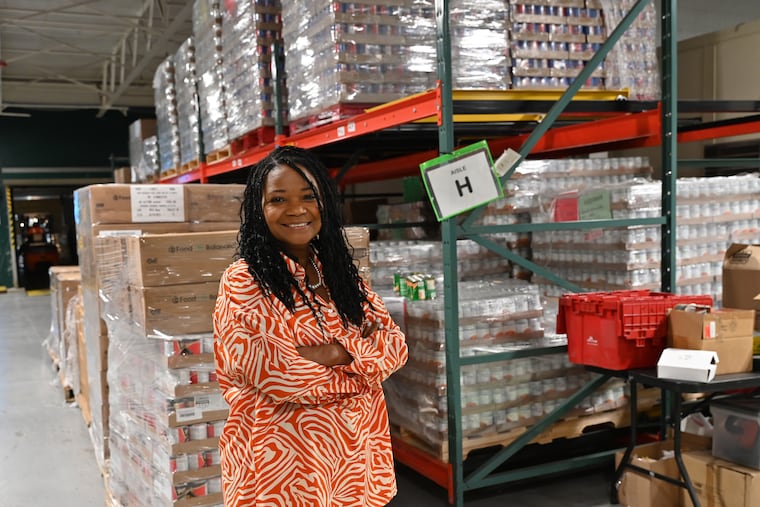
“I feel the pressure of trying to meet the needs of the people,” said Loree D. Jones Brown, Philabundance’s chief executive officer.
And the pressure is building.
“I have to be careful what I say politically,” Jones Brown said, “but I have a lot of strong, negative emotions about what’s going on. And I’m worried.
“At 44 million pounds, we’re barely meeting the current need, and we’re going to see increased need with the cuts in Medicaid and SNAP,” the Supplemental Nutrition Assistance Program, the government’s biggest anti-hunger food program.
The situation has worsened. Across the nation, food programs like Philabundance are bracing for a surge in demand as the federal government shutdown stretches into its fourth week.
In March, the U.S. Department of Agriculture announced it would eliminate the $470 million Local Food Purchase Assistance program — a program that allowed food organizations like Philabundance to source fresh foods from local farmers. It amounts to $13 million statewide and $1.5 million for Philabundance — or 18% of last year’s $8.6 million annual purchased food budget.
At the same time, Philabundance needs to raise more money to buy food wholesale from major suppliers as tariffs impact pricing. Rising costs are already a problem; the 44 million pounds of food Philabundance now distributes is down from 52 million pounds the prior fiscal year.
As volunteers worked with Allegheny West chief executive Ronald E. Hinton Jr. to set up the food line, a Philabundance truck pulled up. The driver delivered a single pallet of food. It used to be two.
“And even with all that — and even with as much pressure that we feel — my heart breaks for the families out there,” Jones Brown said. “I think about the mom who feeds her kid and then goes to bed hungry, because that’s what mothers do.
“That’s what breaks my heart,” she said, and what motivates her to work harder to raise enough funds and in-kind donations to make up the difference.
As Jones Brown spoke, a couple dozen volunteers were busy packing birthday boxes in Philabundance’s South Philadelphia warehouse. (Philabundance has 250,000 square feet of space in four locations.) Families will receive a box with cake mix, oil, cupcake holders, and icing.
Given the impact of hunger, it may seem trivial to offer what amounts to a party box, but Jones Brown said it’s a matter of dignity and respect.
She recalls asking one mother receiving government food benefits for her reaction to the birthday box program. “I remember seeing her eyes light up,” Jones Brown said.
Help uplift 10 nonprofits tackling Philly’s most pressing needs by making a donation today.
The woman’s child’s birthday was on a Thursday, but the mother wouldn’t receive her benefits in time to send cupcakes to school with her son. A birthday box would allow her child to be like the other children, and the mom to be like the other moms.
“I knew we were on the right path,” Jones Brown said.
The right path, she said, also includes urging community partners to set up their food-distribution systems to resemble stores, so people can choose the foods their families want or need. Allegheny West is planning just such a center when it completes renovations of a nearby building.
Jones Brown said that Philabundance wants to do more than simply tide families over, meal to meal. The goal, she said, is to end hunger and food insecurity for good.
Part of the plan is advocacy — sending its government relations people to lobby for more help, not less, and to oppose stricter regulations, such as work requirements, which make it more difficult for people to obtain food.
Philabundance needs to raise more money to buy food wholesale from major suppliers as tariffs impact pricing.
Another part of the plan is to reduce the need for Philabundance’s food by helping people with low incomes get training for better-paying jobs through its community kitchens program. Students spend 16 weeks in training, including an internship. Most, Jones Brown said, are hired right out of the program, with 1,000 graduating since the program began.
The community kitchen, located in a building near Temple University, prepared 422,000 meals for distribution to shelters, community centers, and summer programs for children not getting lunch at school. The kitchens also bring in revenue when hired to cater events.
Over the years, Jones Brown said, she’s been seeing a change in the people needing help from Philabundance.
“The face of hunger isn’t what you’d expect. We’re seeing more dual-income families coming into the pantries,” she said. “Housing costs are going up, wages are low, and people are underemployed.”
She could have been describing Clara Perkins, a grandmother waiting in line for food at Allegheny West.
“Between the rent, paying the utilities, washing clothes, something has to give, and it seems as if it’s my food table,” said Perkins, of Germantown. Perkins, who works full time as a certified nursing assistant, supports a daughter with medical issues and two teenage grandchildren.
“Everything goes up but the paycheck,” she said.
That’s why, Perkins said, those who have money should donate to Philabundance “because it helps people.”
“When you are hungry, you are not motivated,” she said. “But when you have a full stomach and you know where your next meal is coming from, it gives you hope.”
This article is part of a series about Philly Gives — a community fund to support nonprofits through end-of-year giving. To learn more about Philly Gives, including how to donate, visit phillygives.org.
Editor’s note
By Richard G. Jones
For a second successive year, The Philadelphia Inquirer is proud to join with other local media partners participating in Philly Gives, a campaign to raise money for nonprofit organizations that are committed to serving those in need throughout our region.
Beginning today and continuing weekly through the end of the year, The Inquirer will feature a series of articles about 10 local nonprofits. The organizations were selected by the Willliam Penn Foundation, which funds Philly Gives. The nonprofit groups were vetted by the Philadelphia Foundation. The Inquirer is owned by the Lenfest Institute for Journalism LLC, which is part of the Philadelphia Foundation.
The Inquirer maintains editorial control of the articles in the series, which are assigned and edited by Opinion editors. Because there are no administrative fees associated with Philly Gives, 100% of the donations are distributed to the nonprofits.
The inaugural Philly Gives campaign, which began last November and continued for nine weeks, raised $200,000. That sum was later combined with $450,000 in seed funding to provide a total of $650,000 in direct support to nine nonprofit organizations.
Philly Gives is the brainchild of Janet Haas, who drew inspiration for the campaign from the New York Times Communities Fund, a philanthropic effort once known as the Neediest Cases Fund that was started by that news organization in 1911.
Haas, a philanthropist and member of the board of the William Penn Foundation, collaborated with Elizabeth H. Hughes, The Inquirer’s publisher and chief executive officer, to produce Philly Gives.
The series that begins today is a window into how organizations that rely on the generosity of others work to effect meaningful and lasting change for the most vulnerable members of our community. We look forward to sharing their stories.
Richard G. Jones is The Inquirer’s managing editor of Opinion coverage.
About Philabundance
Mission: To drive hunger from our communities today and end hunger for good
Impact: 44 million pounds of food distributed through its 350 community partners in Philadelphia, Montgomery, Bucks, Delaware, and Chester Counties in fiscal year 2025
Annual spending: $107.2 million, offset by $74.2 million in donated food
Points of pride:
25 years of Philabundance Community Kitchen (PCK): PCK’s culinary training and workforce development program provides those who qualify for public benefits with the opportunity to attend a 16-week program to prepare them for careers in the service industry. The program has more than 1,000 graduates to date and produced 422,000 meals for area seniors, shelters, and community centers in fiscal year 2025.
Retail Rescue Program: Philabundance partners with dozens of retailers and grocers to redirect perfectly good food headed for landfills, distributing it to our community partners for our neighbors.
Support: phillygives.org
What your Philabundance donation can do:
Every $1 provides 2 meals to our neighbors facing hunger.