Philadelphia’s $5B shipyard dream may hit an immigration iceberg
ICE crackdowns on skilled guest workers threaten foreign investments.
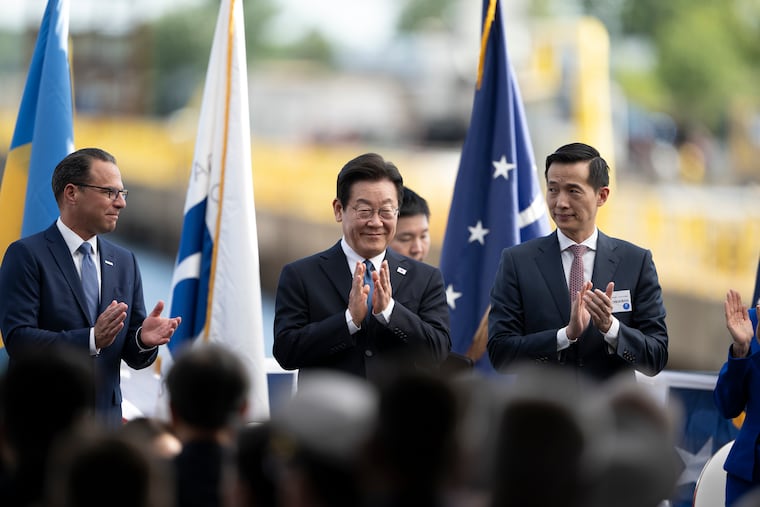
Last month’s christening of the training ship State of Maine at the Navy Yard was supposed to mark this city’s industrial renaissance. When South Korean President Lee Jae Myung joined Gov. Josh Shapiro at Hanwha Philly Shipyard, they announced a staggering $5 billion infrastructure investment that would transform Philadelphia into an American shipbuilding capital.
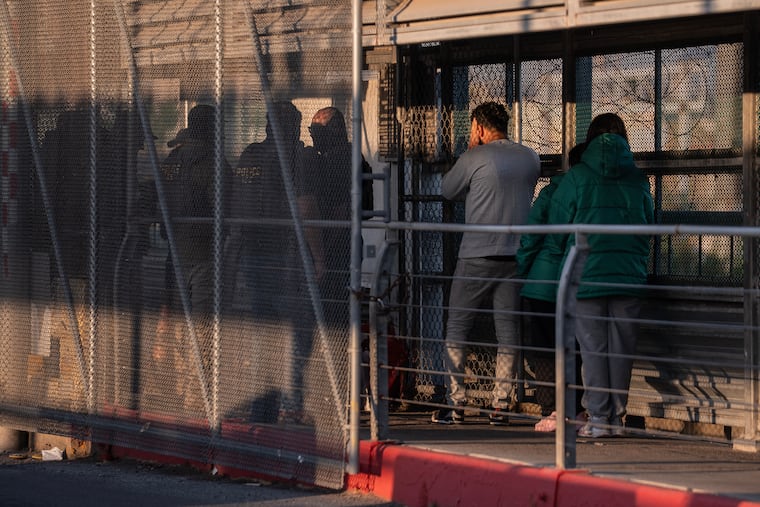
But a recent reality check hit hard. U.S. Immigration and Customs Enforcement agents arrested 475 people at one of Hyundai’s Georgia plants in what officials called the largest single-site immigration raid of the current administration. A majority of the detainees — about 300 — were South Korean nationals working to set up the new facility near Savannah.
The diplomatic fallout is escalating. Lee said Koreans were “baffled” by the raid, and that companies would be “very hesitant” to expand in the U.S. without a workable visa channel. On Sept. 12, a chartered Korean Air flight with many of the detained workers returned to Incheon International Airport, outside Seoul. It was reported that only one South Korean national opted to stay behind in the U.S. to seek residency.
The incident risks seriously damaging U.S.-South Korea relations at precisely the moment Seoul has committed to massive American investment plans.
The timing couldn’t be worse. Hanwha’s expansion plan would boost Philadelphia’s shipyard production from fewer than two vessels to 20 annually — a transformation that depends on leveraging Korean technical expertise and skilled workers. The $5 billion commitment is just Philadelphia’s slice of South Korea’s massive $150 billion U.S. shipbuilding investment, part of what Korean diplomats dubbed “Make American Shipbuilding Great Again.”
Now that initiative faces a critical test. A survey of over a dozen major South Korean companies found that the majority may adjust ongoing U.S. projects, while many others are reviewing plans for U.S. investment entirely. The companies cite difficulties dispatching Korean specialists as the main reason for reassessing their American operations.
The numbers tell the story. Among surveyed companies, 64.3% have suspended business travel using standard visa programs, implementing internal guidelines requiring more complex L-1 visas for trips longer than one month. Companies project cost increases of at least 10%, with some expecting increases to approach 30%.
Philadelphia’s transformation depends on the same kind of engineering and technical support that just got raided in Georgia. Hanwha Ocean is preparing to scale operations at Philly Shipyard alongside domestic supply-chain partners. The program will install two additional docks and three new quays with world-class automation and smart yard systems that require specialized Korean expertise.
The symbolism is crushing. When Philadelphia launched the 32-gun frigate USS Randolph on July 10, 1776, it established America’s blueprint for naval power. The city’s first naval shipyard began construction that same year in what is now Pennsport. For more than two centuries, Philadelphia has built America’s maritime strength through immigrant expertise and international partnerships.
Now uncertainty threatens to undermine exactly the kind of allied cooperation that built American strength. Korean companies’ top request to the U.S. government is creating a separate visa quota for skilled Korean professionals, followed by expanding the L-1 visa program. Without predictable access to engineers and technical specialists, multibillion-dollar industrial partnerships become increasingly difficult to execute.
The stakes extend beyond Philadelphia. America’s shipbuilding crisis is real — fewer than 200 U.S.-flagged oceangoing vessels remain active, with only around 80 in international trade. South Korea produces more than a quarter of global shipbuilding tonnage through efficient yards backed by robust supplier networks. Korean capital, American workers, and Philadelphia infrastructure represent a winning combination that other cities should replicate.
But immigration policy may now threaten industrial policy. Korean firms significantly contribute to local communities, yet face what one observer called “no safe zone,” even for allies. The ICE raid has left many Koreans feeling betrayed after investing billions in American communities.
Congress has concrete solutions available. The Partner with Korea Act would authorize 15,000 visas annually for South Koreans with specialized skills — quadrupling the current 3,500 H-1B allocation. Research shows this approach works: high-skilled immigrants create five to seven more jobs than standard market conditions predict, while a 1% increase in the foreign STEM share of a city’s workforce is associated with 7% to 8% higher wages for college-educated Americans, and smaller but still meaningful gains across the rest of the workforce.
The United States once built more ships than any country on earth. Today, China dominates global shipbuilding, while America struggles to maintain a modest capacity. Philadelphia’s $5 billion transformation could change that equation, but only with predictable access to Korean technical specialists who complement American workers rather than replace them.
President Donald Trump said on Sept. 7 that foreign companies need to hire and train U.S. workers and respect immigration laws. That’s exactly right. But respecting immigration laws requires immigration laws that actually work for industrial partnerships. Korean shipbuilders want to create American jobs using American steel and American infrastructure — if immigration policy lets them.
The question isn’t whether Philadelphia’s investment will succeed. The question is whether the looming uncertainty under our current immigration policy will let it happen at all. Philadelphia will likely become a primary test case for whether we can rebuild industrial strength through allied cooperation or whether enforcement priorities will sink our own economic interests.
The experiment begins now, if skilled workers can get visas and actually get to work.
Jeffrey M. Voth is an engineering and technology executive focused on strengthening the U.S. defense industrial base and allied cooperation. For over two decades, he has worked on U.S.-South Korean partnerships, including the Korean Experimental Destroyer program.