Choose transparency, deliberation, and investment over closure
The city and school district need to slow down their march toward closing schools and repurposing buildings, and foster more public engagement and dialogue.
Superintendent Tony B. Watlington Sr. and the Philadelphia School District have proposed 18 school closures, six colocations, and a vague, insufficiently transparent plan to reconfigure grade levels across numerous other schools, citing the need for “more efficient use of all of our resources” to deliver high-quality academic and extracurricular programming districtwide.
The Inquirer Editorial Board has endorsed the plan, pending adjustments to several sites, including Lankenau Environmental Science Magnet High School.
The district is right to pursue a comprehensive facilities plan that addresses toxic building conditions, overcrowding, and underutilization. But it is going about it the wrong way. Facilities planning should be an annual, longitudinal process grounded in sustained community engagement, not a punctuated moment of 24 mass closures that disrupt neighborhoods and sidestep the thoughtful incorporation of public input that only time and intention can provide.
Mistakes of 2013
Without such care, the district will repeat the mistakes of the 2013 closures, which led to students disappearing from school rolls in September, overcrowded receiving schools, and the racialized erasure of neighborhood histories and place-based educational traditions.
First, significant questions remain about implementation and transparency. Ten properties are slated to be “conveyed” to the city, reportedly tied to Mayor Cherelle L. Parker’s H.O.M.E. plan. Amid speculation about a 20-year tax abatement connected to redevelopment, it is unclear what mechanisms will ensure the benefits of these transfers accrue to the communities that have borne the brunt of closure, rather than to private developers. A two-decade tax abatement would symbolically and materially reinscribe the racialized disinvestment, neglect, and manufactured crisis that have too often paved the way for school closures in the first place.
Second, the data used to inform the closures have been called into question by many, and do not take into account the nuance of mixing school populations via colocation. For example, parents at Childs Elementary have cited the district’s plan to colocate a new Academy at Palumbo based on a building capacity of 1,000. However, a significant portion of the building’s classrooms is dedicated to special-education students. A colocation would displace SPED students from these classrooms while reinforcing a bifurcated culture among the catchment-based middle school students and Palumbo students in an already rapidly gentrifying neighborhood of Point Breeze.
Third, closure and conveyance to the city for resale do not guarantee public-serving outcomes. With my collaborators — Ariel Bierbaum, Amy Bach, and Elaine Simon — I have studied how thoughtful reuse, rooted in restoring community access and public control, can begin to repair the racially inequitable legacy of past closures.
Yet, private redevelopment has repeatedly failed to stabilize these properties. Selling off public assets does not guarantee revitalization; it often perpetuates stagnation or displacement. Developers frequently “flip” former school buildings, speculating on value rather than advancing community use.
Take the former Germantown High School and Robert Fulton Elementary, for example. Concordia Group bought them in 2014, only to abandon its plans and resell the buildings three years later to local developer Jack Azran, whose opaque redevelopment has sparked concern.
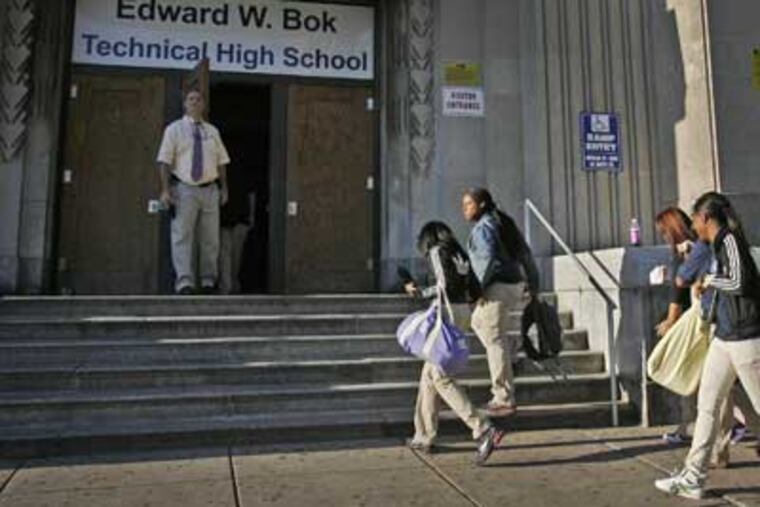
Moreover, once schools are sold to private entities, they are effectively lost to some communities and public education forever. South Philadelphia’s experience is a cautionary tale. As nearby elementary schools became overcrowded following the 2013 closures, the former Edward W. Bok Technical High School, once a public citywide admissions school, was transformed into a workspace for small-business owners, artists, and nonprofit organizations, closing classrooms forever.
What options remain when demographic shifts create new demand for neighborhood schools that no longer exist?
This reuse no longer serves the same community of students and families as when it was a high school, and raises important questions: What does it mean for a community’s future when former schools become symbols of gentrification rather than centers of education? And what options remain when demographic shifts create new demand for neighborhood schools that no longer exist?
Had Bok remained in public hands, it could have flexibly adapted to those needs. Instead, it serves a much different population: South Philadelphia working artists, small-business owners, and local refugee-serving nonprofits, but also patrons who can afford $14 cocktails.
Slow down
Rather than defaulting to closure, the Board of Education should consider how underenrolled buildings might be repurposed for public-serving uses that retain community control. Could redevelopment proceed gradually, with clear commitments that investments in existing buildings benefit both local families and those who have chosen these schools?
Such an approach would require genuine public engagement and sustained dialogue. It would require slowing down and rejecting a disruptive, thinly deliberated plan shaped by speculative capital and instead committing to participatory, long-term facilities planning.
The district and the city face a choice. They can repeat a cycle of disinvestment and dispossession, or they can chart a more deliberative, community-rooted path. The question is whether they have the will to do so.
Julia McWilliams is the codirector of the Urban Studies Program at the University of Pennsylvania and a member of Stand Up for Philly Schools. She coauthored the forthcoming book, “Schools for Sale: Disinvestment, Dispossession, and School Building Reuse in Philadelphia,” from the University of Chicago Press.