Many Pa. schools don’t have enough money. A simple fix could change that — without raising taxes.
There is quite a lot of education funding in Pennsylvania — it’s just in the wrong places.
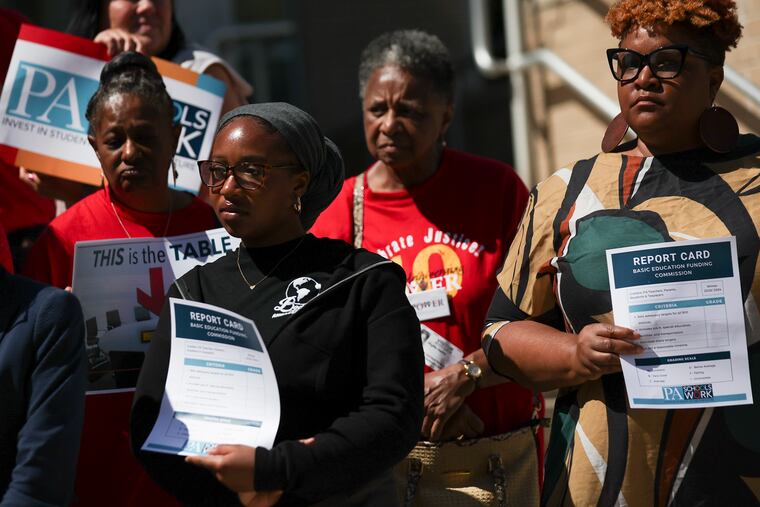
After a recent ruling declaring that the funding Pennsylvania gives to local school districts is unconstitutional, the commonwealth is reevaluating its school funding policy. The Basic Education Funding Commission — a group of lawmakers charged with recommending reforms — is holding hearings now.
The commission recently experienced sticker shock when one expert estimated that it would take an additional $6.2 billion for Pennsylvania schools to meet state standards — a figure exceeding even the huge $4.6 billion shortfall already recognized in state policy. This led multiple public officials to wonder if addressing the problem is even possible without heavy tax increases. There were rumblings about whether increased education budgets actually produce better outcomes, given that Pennsylvania already has fairly high average school spending levels compared with other states.
These are the wrong questions. The fact is, there is quite a lot of education funding in Pennsylvania — it’s just in the wrong places.
» READ MORE: Pa. school funding is ‘unconstitutional.’ Here are four steps to fix it. | Opinion
Take two neighboring districts right outside Philadelphia: Upper Darby and Haverford Township, just a few minutes drive apart. The border between these school districts marks steep segregation. Haverford is 82% white, and 3% of students live in poverty; Upper Darby is 48% Black, and nearly 21% of students live in poverty. Upper Darby also serves many more English learners than Haverford.
Upper Darby’s much higher level of student need should be met with more resources — yet The Inquirer’s new school funding tool shows that the district spends $6,400 less per pupil than what’s required. Based on our calculations using federal data on total revenue divided by student enrollment for each district, Haverford — with its whiter, wealthier student body — has $1,900 more per pupil than Upper Darby.
Hearing this, members of the Basic Education Funding Commission might feel stymied: Do they really have to find thousands of dollars for every student in Upper Darby, and all districts like it? But that question assumes that new money is the only way to solve this problem.
Let’s take a closer look at the funding divide. Haverford doesn’t have more state money than Upper Darby; the state’s funding distribution properly recognizes that Upper Darby students need more support, and provides more per student than it does to Haverford. But Haverford raises more money locally, largely via property taxes — according to our calculations, over $7,200 more per pupil than Upper Darby, which completely swamps the state’s investment. This is possible because the district border that outlines Haverford — which defines not only the area of the school system but also its property taxing jurisdiction — contains much higher-priced houses. The median home price in Haverford is $360,000; in Upper Darby, it’s less than half that.
Property value disparities like this drive huge school funding gaps between neighboring districts all over Pennsylvania, rewarding wealth and leaving out the kids on the wrong side of the line.
In 2020, the school finance organization EdBuild proposed a way to bridge this divide. Instead of keeping property tax dollars trapped within narrow school district borders, EdBuild proposed that states collect that money at the county level. Some states with school districts that take up an entire county are already doing this.
EdBuild calculated how this new funding system would impact Pennsylvania, and found that 53% of all students — and 67% of students from low-income backgrounds — would get equal or greater funding. Both Haverford and Upper Darby are part of Delaware County, and if that county pooled all its school districts’ local property taxes, Upper Darby would see almost $5,000 more per student.
That’s how much money is trapped in the wrong places in Pennsylvania: by borders gerrymandered to advantage a privileged minority.
Here’s another example, right in the legislature’s backyard. Carved out of Central Dauphin, a school district of nearly 12,000 kids next to Harrisburg, is a tiny strip of territory: Steelton-Highspire School District, which has an average width of roughly 3,000 feet. According to The Inquirer’s school funding tool, its per-pupil funding levels are $6,847 below what’s needed. It has more than double the school-aged poverty rate of Central Dauphin, with a significantly higher percentage of students of color. Does anyone think this border was drawn to better serve students?
There is lots of money for public education.
The recent court ruling has focused our attention on the state’s most underserved districts. But there aren’t just many Upper Darbys out there that can’t raise enough from property taxes. There are also a lot of Haverfords, which can raise more than enough. This is the hidden catch behind Pennsylvania’s “high” levels of education spending: Wealthy districts push up the average spending level with their local dollars, without getting any more money to the kids who need the most help.
Within the boundaries of these districts, there is lots of money for public education. By rethinking the lines that fence the well-off away from everyone else, the state can achieve more equitable school funding before trying to raise a single new tax dollar.
Zahava Stadler is project director for the Education Funding Equity Initiative at New America.