A vision for Philadelphia 250 years from now
A new vision statement for the city’s 500th anniversary — 250 years from now — includes a principle we need today: Honor no tool before the people it serves.
Last fall, the Elfreth’s Alley Museum commemorated the assassination of a robot.
A decade earlier, a cheeky Canadian research project called hitchBOT captured the world’s imagination. The solar-powered automaton hitchhiked across Canada, then Germany, then the Netherlands — a cheerful symbol of the optimistic technological age we were still living in.
Then it arrived in Philadelphia.
Security footage shows a man in a football jersey inspecting the colorful robot in Old City’s predawn stillness before pummeling it with repeated kicks, then walking away with nothing.
Back then, in 2015, when technology seemed to many Americans more inspiring than dreaded, this robot vandalism was laughed off as another example of Philadelphia’s famous boorishness.
Today, the hitchBOT attack is better understood as the way Philadelphia gave the world a warning about how many of us feel about automation and technology built without us.
To reach the Philadelphia I want for my children, and for all of our descendants 250 years from now, we need to heed this warning about the future. This year, commemorating our country’s Semiquincentennial is a necessary moment to not only interpret the past, but to embark on that future.
With the help of nearly 1,000 Philadelphians and support from the Philadelphia Funder Collaborative for the Semiquincentennial and the city’s Department of Commerce, the news organization Technical.ly has developed a vision statement for our city’s 500th anniversary — 250 years from now.
The very point of truly long-term thinking is to get outside the confines of today.
Like our city, it is plain-spoken, pluralistic, and distinctive — a place capable of a robot homicide on a carefully preserved, colonial-era residential block. It is the place I love more than any other.
A letter to 2276
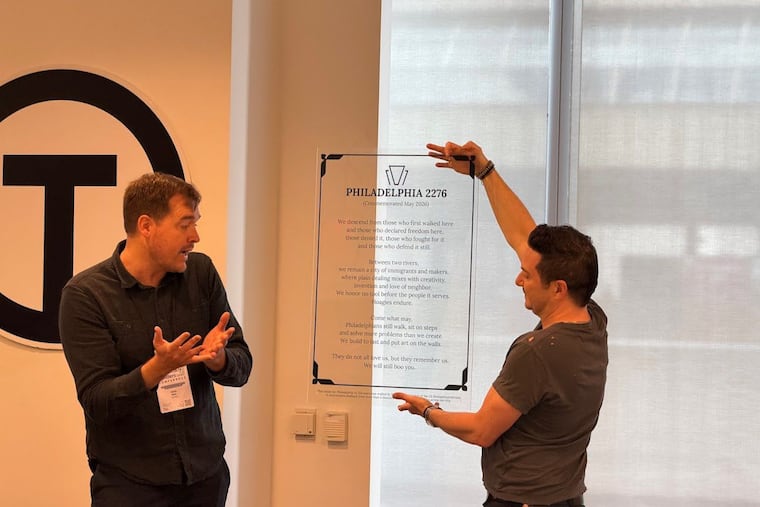
Here it is, in full — 96 words meant to read as true in 2276 as in 2026:
“We descend from those who first walked here and those who declared freedom here, those denied it, those who fought for it and those who defend it still.
Between two rivers, we remain a city of immigrants and makers, where plain dealing mixes with creativity, invention and love of neighbor. We honor no tool before the people it serves. Hoagies endure.
Come what may, Philadelphians still walk, sit on steps and solve more problems than we create. We build to last and put art on the walls.
They do not all love us, but they remember us. We will still boo you.”
The statement opens with Indigenous peoples and the contradictions of the founding, nodding to Quaker tradition through “plain dealing” and insisting on geographic permanence — “between two rivers.” It ends with unapologetic directness. At its center sits one line I hope echoes across centuries: We honor no tool before the people it serves.
The process
After a year of attending street festivals and community events across the city, cohosting focus groups and salons, we introduced an early version of this vision statement in these pages last fall, calling for feedback.
We also dispatched comedian Tata Sherise to interview more Philadelphians on their vision for the long future.
We received feedback highlighting considerable angst about today’s biggest changes — artificial intelligence, climate change, and political rancor — alongside remarkable optimism for well-maintained transit and parks, safe neighborhoods, and shared prosperity.
At a senior fair in a Fishtown church basement, I was told twice that Philadelphia’s primary ambition for 250 years from now should be easier parking.
These big issues of the day struck our team, too. Our very first community events on this vision, and our earliest drafts, tried to address these all. While important, this felt like it missed the mark. The very point of truly long-term thinking is to get outside the confines of today.
To create something that has the chance to endure a quarter millennium, we needed to assemble the spirit of what we heard into something more timeless.
For this, we relied heavily on generational thinking, drawing on ideas like the Haudenosaunee “seventh generation principle” — that decisions should consider their impact on descendants seven generations hence. We asked: What if Philadelphia planned with centuries-long horizons instead of election cycles?
Our answer: Not a prediction or a policy platform — just a set of values we might hold ourselves to, written plainly enough that they might still make sense when the city turns 500.
Art on the walls
This month, the vision began taking physical form. Artist Sean Martorana, in partnership with Mural Arts Philadelphia, is painting a mural overlooking Elfreth’s Alley on a building owned by a local software company with a people focus.
Martorana’s design incorporates products from generations of inventors while symbolizing the people who make our creations possible — an artistic interpretation of “honor no tool before the people it serves.”
The vision of Philadelphia’s long future will be placed on the mural, at the site of hitchBOT’s demise, overlooking one of our country’s oldest residential streets — a powerful reminder to keep people at the center of a technical age.
We’re also working to include a version of the vision in an upcoming time capsule destined for 250 years in the future. The full statement — along with other documentation from the project — lives at Ph.ly.
The warning and the wager
Because of my 20-year career reporting on and organizing around technology, the sciences, and entrepreneurship, people often assume I’m a technophile. That’s not quite right. My interest is in tools that serve people, and the people who build them.
Elfreth’s Alley’s origins were not wealthy; it was a place of working people — blacksmiths, shoemakers, seamstresses — who might be suspicious of an increasingly automated age that seems designed without them in mind.
I keep thinking about the man who kicked hitchBOT. He didn’t destroy a cute robot out of nowhere. He destroyed a symbol of a future that had no place for him — or at least, that’s how it must have felt at 6 a.m. on a Philadelphia sidewalk. The world called us savages. I saw someone who had been left behind, taking it out on a machine that traveled farther than he ever would.
That’s the warning Philadelphia gave the world in 2015. Technology built without people at the center will meet resistance — sometimes absurd, sometimes violent, sometimes justified. The question is whether we learn from it.
Technology built without people at the center will meet resistance.
Anyone visiting the Elfreth’s Alley Museum hitchBOT anniversary event last fall would have heard this message that Philadelphia gave the world first: We honor no tool before the people it serves.
I hope that carries meaning today, and 50 years from now, 250 years, and farther still. It’s a wager that the values worth keeping are the ones that put people first — plain dealing, love of neighbor, building to last, putting art on the walls. If we get that right, the tools will follow.
They do not all love us, but they remember us.
Christopher Wink is the publisher and cofounder of the news organization Technical.ly.