Trans students and faculty are under attack. Higher education must respond.
Amid cuts to federal funding for research that centers trans populations, and bans on gender-affirming care for young people, Philadelphia’s universities can — and must — lead by example.
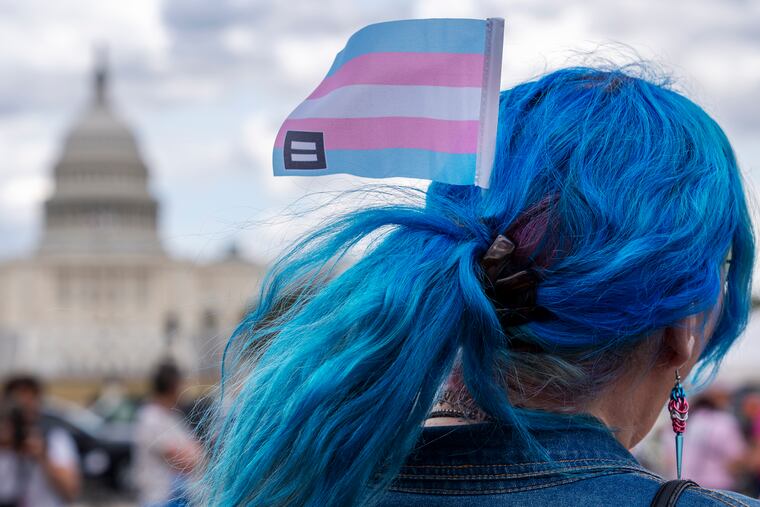
As anti-trans policies and rhetoric rise across the country, colleges and universities must take concrete steps to support and protect their trans students, staff, and faculty. Campus communities must show up — not just in words, but in action.
Philadelphia is home to some of the nation’s most respected institutions of higher learning. These institutions often claim to value diversity, equity, inclusion, and belonging, but in a time of increasing hostility toward transgender, nonbinary, and gender expansive people, these values are being tested. And our universities and colleges are falling short.
For example, the University of Pennsylvania has been targeted by the Trump administration and other former collegiate swimmers for allowing Lia Thomas, a trans swimmer, to compete on the women’s team in the 2021-22 season. In the face of recent attacks, Penn has remained silent rather than publicly standing by Thomas.

Under a regime hostile to academia, educators must walk an ideological tightrope.
College professors and administrators from across Greater Philadelphia share nine essays on the tectonic shifts in higher education through the first six months of President Donald Trump’s second term.
Read more in Inquirer Opinion:
It’s getting harder to champion diverse learning, but we must persevere. | David W. Brown
It’s time to put politics in STEM. | Philip T. Gressman
I worry for children with Trump’s attacks on public media. | Amy Jordan
Professors need to keep standing up for democracy. | Daniel Laurison
What it’s like to run an academic department in 2025. | Jessa Lingel
Community colleges can be pivotal to fighting attacks on higher education. | Marissa Johnson Valenzuela
Trans students are under attack. Universities must respond. | A. Tai Simpson and Stephanie M. Hernandez
How student journalists can help save their universities — and journalism. | Barbie Zelizer
Trump’s executive orders put reliable science at risk. | Matt Zucker and Kendra Albert
As of late May, Penn Medicine stopped providing gender-affirming surgery to patients under the age of 19, even before the devastating decision in United States v. Skrmetti in late June.
Eliminating this care will have catastrophic impacts on the mental and physical health of trans youth. It is imperative that academic medical centers in states without bans continue to provide gender-affirming care for those most at risk of losing access.
In addition, faculty members whose work centers trans populations have also lost millions in federal funding. Not only does this impact critical research, but it also affects career advancement, professional development, and the training of the next generation of public health scholars.
Temple, Penn, Drexel, and Jefferson are powerful institutions that influence local policy, setting the tone for how marginalized communities are treated. When they fail to act, they send the message that trans rights are expendable.
But it doesn’t have to be this way. Philadelphia’s universities can — and must — lead by example. Here’s what that leadership should look like:
Publicly oppose anti-trans legislation and affirm that it has no place in higher education.
Provide tangible support for trans students, staff, and faculty through expanded mental health services and peer support networks by partnering with community organizations.
Create spaces for trans students, faculty, and staff to celebrate and build community, such as holding a lavender graduation to honor LGBTQ students’ accomplishments.
Implement regular training for all faculty and staff on trans inclusion to ensure curriculums reflect gender-diverse experiences.
Offer bridge funding for faculty whose trans-focused research was cut so their important work can continue.
Reaffirm and publicly commit to providing gender-affirming healthcare, particularly at institutions like Penn, Temple, and Jefferson that run large health systems.
Resist preemptive censorship or elimination of affirming resources based on preliminary threats from executive orders. Doing so only furthers the Trump administration’s agenda, which harms our communities.
Demand action that situates trans lives within the wider fight against structural inequity that shows up in healthcare, housing, immigration, and beyond. True support for trans rights must be embedded in broader social justice efforts that address multiple and interlocking forms of oppression.
In a time of increasing hostility toward transgender, nonbinary, and gender expansive people, these values are being tested.
The stakes are high. Trans students, staff, and faculty are not just statistics or talking points — they are members of our community. They are scholars, educators, athletes, artists, and leaders. And they should feel safe, seen, and supported.
Philadelphia has long prided itself on being a city of revolution, resistance, and progress. Our universities should reflect that spirit. They should be places where trans students, staff, and faculty are not just tolerated, but celebrated. Where they are not just protected, but empowered.
We ask that Philadelphia’s colleges and universities act now — boldly and decisively — to uphold the dignity, personhood, and value of trans community members. The time for passive allyship is over.
A. Tai Simpson is a graduate student studying in Philadelphia. Stephanie M. Hernandez is an educator in the Greater Philadelphia area.