We can’t give in to the Trump administration’s attempts to make the history of slavery invisible in Philadelphia
The National Park Service touts a “Jim Crow” version of history that desecrates the memory of the people enslaved by President George Washington.
Earlier this month, the National Park Service unveiled interpretative panels it developed internally to replace the materials removed in January from the President’s House in Independence National Historical Park. And while a federal appeals court has ruled that the original panels, which depicted the historic role of enslavement when George Washington lived there, must be restored, the Trump administration is appealing that decision.
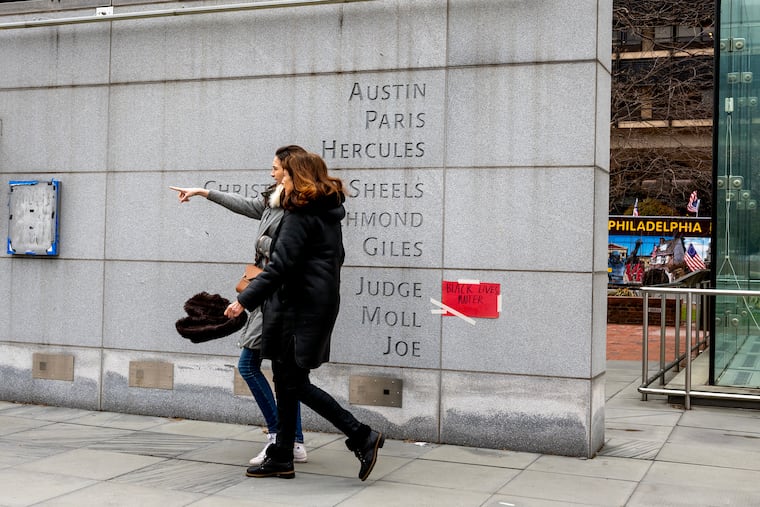
The digital images posted on the park service’s website make it clear that, under Donald Trump, the first priority of the park service seems to be to make enslaved people and slavery itself as invisible as possible. Panels that discussed the lives of urban enslaved people, Philadelphia’s free Black community, the Washingtons’ enslaved “family,” fugitives from enslavement (and the laws Washington signed to reclaim them) have all disappeared. The rich biographies of Christopher Sheels, Hercules, Richmond, Austin, Giles, Ona Judge, Joe Richardson, Moll, and Paris have shrunk to single sentences.
Judge’s fierce, multiyear campaign and bold negotiations to stay out of slavery’s clutches even after the Washingtons tracked her to New Hampshire are gone from the new signs. This woman of courage and determination gave herself the freedom Washington had fought for, with African American soldiers, on North American battlefields. She embodies the very American freedom story that Trump’s park service seeks to erase.
The park service has embraced sentimental claims that Washington, Thomas Jefferson, and James Madison all “had their doubts” about slavery from the beginning.
So what stories are they telling? George and Martha’s determination to flout Pennsylvania’s six-month limit on holding people in slavery is reframed as a lovely gift of theater tickets rather than their cynical move to get enslaved people across the river to New Jersey, thus restarting the six-month residential countdown. I’m surprised the park service left out the Washingtons’ “kind” willingness to let enslaved workers visit their families left behind in Virginia, which worked the same trick.
The park service is also fascinated by other residents of the house before the Washingtons moved in, and we get a lot of pious details about Mary Masters Penn, Robert Morris, British Gen. William Howe, and U.S. Gen. Benedict Arnold. If the park service wants to argue for their relevance as former owners and residents of the building, note that all of them were included in the original panels.
If park service bureaucrats value relevance, I challenge them to explain the transformation of the story about 18th-century slavery at the President’s House into a puzzling evocation of the Emancipation Proclamation of the 19th century and the Civil Rights Movement of the 20th century. Is it that, to them, all stories having to do with African Americans belong in the same place? They must think so, because they have randomly added completely irrelevant references to Frederick Douglass, the Civil War, the Rev. Dr. Martin Luther King Jr., the Underground Railroad, and Abraham Lincoln to the history of the President’s House.
Worse, the park service has embraced sentimental claims that Washington, Thomas Jefferson, and James Madison all “had their doubts” about slavery from the beginning.
None of those “doubts” persuaded the founders to end slavery when they could have, either in our founding documents or in their own personal lives. None of the 19th- and 20th-century stories that the park service has shoehorned into its new panels ever involved the President’s House at all. The only “emancipation” relevant to this site was Judge’s own self-liberation — the very story the park service has all but erased.
Speaking of irrelevance, the opening panels are even more laughable. Park service interpreters have decided to feature discussions of the 1876 Centennial, the 1926 Sesquicentennial, and the 1976 Bicentennial, all of which happened long after the President’s House had been remodeled into oblivion or entirely demolished.
Public release of these spurious interpretative efforts now gives the appellate judges weighing the ongoing suit a clear choice.
The history of the President’s House is available to them, compiled by actual scholars and engaged members of the community, debated over years to get details right and stories accurately told.
They should rule definitively for the original panels to be reinstalled by June 15 at the latest.
Otherwise, they capitulate to an embarrassingly weak rewrite of history that falsely ascribes kindness and troubled consciences to the founders, and diminishes the lives of the nine enslaved people while blathering about events entirely disconnected from the historical reality of the President’s House.
If the judges choose these new panels to replace the ones taken down earlier this year, they will disparage millions of Americans who have struggled since 1776 to improve on the shaky foundations the founders laid. The President’s House should honor those struggles, alongside the nine people enslaved there by George and Martha Washington.
These are the real heroes. In 2010, Philadelphia chose to stand up for them. We will keep defending them today, tomorrow, and always.
Sharon Ann Holt is a historian and public historian, recently retired from Penn State Abington.