Federal judge orders Trump administration to restore slavery exhibits to the President’s House
“As if the Ministry of Truth in George Orwell’s ’1984′ now existed ... this Court is now asked to determine whether the federal government has the power it claims,” Rufe wrote. “It does not.”
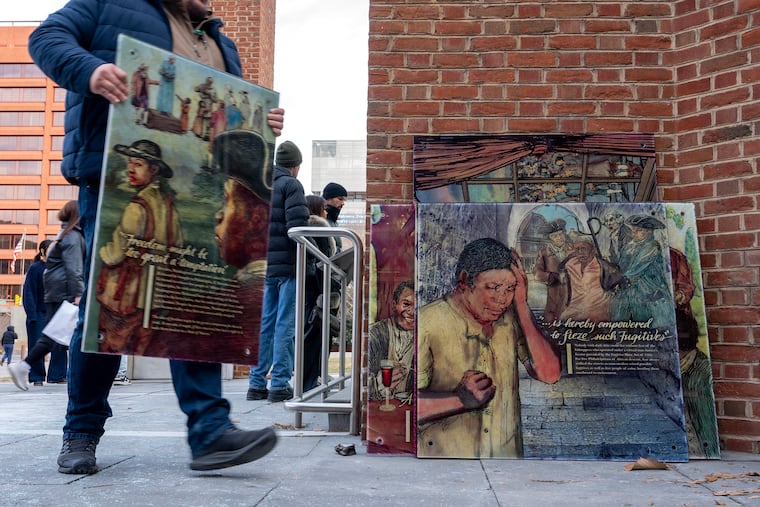
A federal judge ordered President Donald Trump’s administration to restore the slavery exhibits that the National Park Service removed from the President’s House last month.
U.S. District Judge Cynthia M. Rufe issued a ruling Monday requiring the federal government to “restore the President’s House Site to its physical status as of January 21, 2026,” which is the day before the exhibits were removed.
The order does not give the government a deadline for the restoration of the site. It does require that the National Park Service take steps to maintain the site and ensure the safety of the exhibits, which memorialize the enslaved people who lived in George Washington’s Philadelphia home during his presidency. The exhibits were abruptly removed in January following months of scrutiny by the Trump administration.
Rufe, a George W. Bush appointee, compares the federal government’s argument that it can unilaterally control the exhibits in national parks to the Ministry of Truth in George Orwell’s 1984, a novel about a dystopian totalitarian regime.
“As if the Ministry of Truth in George Orwell’s 1984 now existed ... this Court is now asked to determine whether the federal government has the power it claims — to dissemble and disassemble historical truths when it has some domain over historical facts," Rufe wrote. “It does not.”
Mayor Cherelle L. Parker’s administration filed a federal lawsuit against Interior Secretary Doug Burgum and acting National Park Service Director Jessica Bowron, and their respective agencies, the day the exhibits were dismantled. The complaint argued dismantling the exhibits was an “arbitrary and capricious” act that violated a 2006 cooperative agreement between the city and the federal government.
The federal government has the option to appeal the judge’s order. The Interior Department and National Park Service did not immediately comment on the ruling, which fell on Presidents’ Day, a federal holiday. The U.S. Attorney’s Office for the Eastern District of Pennsylvania declined to comment.
During a hearing last month, Rufe called the federal government’s argument that a president could unilaterally change the exhibits displayed in national parks “horrifying” and “dangerous.” She ordered the federal government to ensure the panels’ safekeeping after an inspection and a visit to the President’s House earlier this month.
Monday’s ruling follows an updated injunction request from the city that asked for the full restoration of the site — not merely that the exhibits be maintained safely — and a brief from the federal government arguing the National Park Service has discretion over the exhibits and that the city’s lawsuit should be dismissed on procedural grounds.
The federal government’s brief also argued there could be no irreparable harm from the removal of the exhibits because they are documented online and replacement panels would cost $20,000.
But the judge found the city is likely to prove its case that the removal was unlawful, and the panels should be restored while the litigation continues.
“If the President’s House is left dismembered throughout this dispute, so too is the history it recounts, and the City’s relationship to that history,” Rufe wrote.
The judge also found that the cooperative agreement between Philadelphia and the National Park Service remains in “full force,” even though the contract is technically expired.
Rufe’s memo named the nine enslaved Africans owned by Washington, and noted that two — Oney Judge and Hercules Posey — escaped. The removed displays recognize their struggles and the nation’s “progress away from the horrors of slavery,” the judge wrote.
“Each person who visits the President’s House and does not learn of the realities of founding-era slavery receives a false account of this country’s history,” the judge wrote.
The injunction does not resolve the underlying lawsuit, and is in effect for the duration of the litigation. In a January hearing, Rufe said she wouldn’t let the case drag into the summer, recognizing the 250th anniversary celebration being planned for Independence Mall.
The timing of the ruling underscored its significance to the Philadelphians pushing for the exhibits’ return.
Avenging the Ancestors Coalition, the main advocacy organization leading the fight to protect the President’s House, was less than an hour into its Presidents’ Day event at the site when leaders got wind of their victory.
The group’s leaders, excited and completely in shock, congregated behind the site’s Memorial Wall to soak in the news before announcing it.
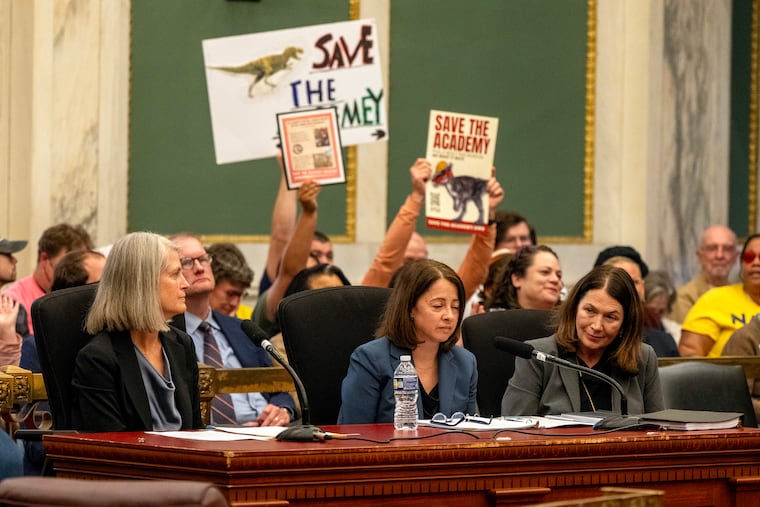
Moments later, Michael Coard, an attorney and the coalition’s leader, emerged before the crowd of about 100 people and told them: “Thanks to you all, your presence and your activism, I have great news: We just won in federal court.”
The crowd erupted in cheers and chants of “When we fight, we win!” and “We have won!”
Coard told reporters there was “no other blessing that we could have gotten today.”
The coalition has led dozens of rallies and town halls meant to energize the public in opposing the Trump administration’s ongoing scrutiny of the President’s House. The Black-led advocacy group helped develop the site in the early 2000s before it opened in 2010.
Dana Carter, the group’s head organizer, said she was in disbelief when she heard about the ruling.
“After we figured out that it really was the truth, I am just moved. My heart is overflowing with love for the judge who made the ruling, as well as the people who have been with us since the beginning … and also the people who have joined us in this fight to restore the President’s House,” Carter said.
But the fight is not over, advocates said, with Coard expecting the Trump administration to appeal or ignore rulings.
“This is a lawless administration. The people are going to have to take over to force them to do the right thing,” Coard said.
The Trump administration’s attempt to alter the President’s House was part of a wider initiative to remove content from national parks that “inappropriately disparage Americans past or living,” following an executive order from Trump. For instance, Park Service employees removed signage about the mistreatment of Native Americans from the Grand Canyon.
The fate of the President’s House exhibits was in limbo for months until they were removed by Park Service employees with wrenches and crowbars on Jan. 22. Meanwhile, advocacy groups and creatives behind the President’s House cultivated support for their cause to protect the site. Philadelphia City Council issued a resolution condemning the censorship of the exhibit.
“Judge Cynthia Rufe made it clear that historical truth cannot be dismantled or rewritten, and that the federal government does not have the authority to erase or alter facts simply because it has control over a national site. … We can not let President Donald Trump whitewash African-American history. Black history is American history,” City Council President Kenyatta Johnson said in a statement Monday.
Attendees at Monday’s event were invigorated by the ruling.
Mijuel Johnson, a tour guide leader with the Black Journey who led Rufe through the site earlier this month, said he was “enjoying the moment for now” but then he would be back to work.
“This is a great win for this movement,” Johnson said.