Trump attacks Venezuela, drops drug war excuse, and focuses on oil
All of Latin America is now watching to see how the invasion and ongoing transition strategy will play out.
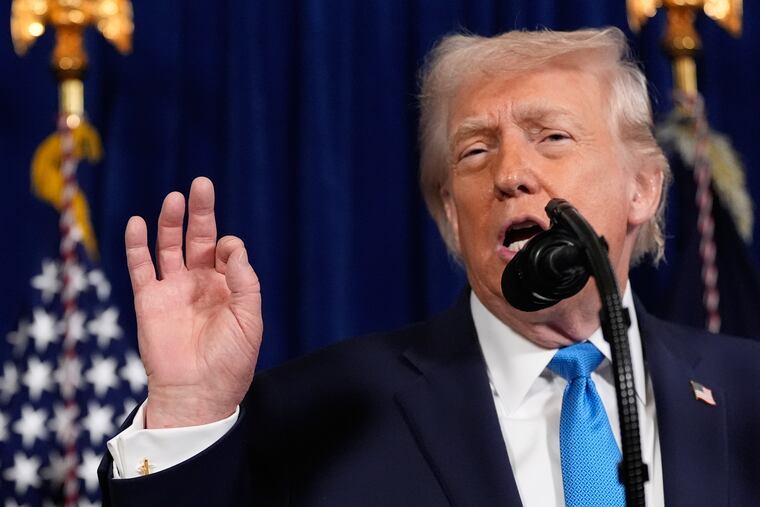
BOGOTÁ, Colombia — Even after a headlong U.S. military assault on Venezuela to topple strongman President Nicolás Maduro, President Donald Trump, in his news conference Saturday morning, offered few details about how U.S. leaders would stop drugs coming from Venezuela.
For more than four months, that has been the justification for the U.S. armada in the Caribbean and the extrajudicial killing, without evidence of wrongdoing, of 115 people in boat strikes.
» READ MORE: Trump’s attack on Venezuela further flouts the Constitution he swore to uphold | Editorial
The invasion of Venezuela this weekend is the largest U.S. military operation in Latin America since the 1989 invasion of Panama, when the U.S. seized that nation’s leader, Manuel Noriega. Noriega was convicted in U.S. courts of drug trafficking in 1992 and, after facing additional charges in France and Panama, died in 2017.
As with Noriega, the justification now is the war on drugs, which, since the 1980s, has cost over a trillion dollars with virtually no effect on stopping the flow of illicit drugs.
The “narco-terrorist” charge against Maduro has been a shaky pretext for his ouster, measured by the naked assertion that drugs from Venezuela pose a threat to the U.S. and its citizens. Venezuela isn’t mentioned as a source of cocaine in reports by the United Nations Office on Drugs and Crime. And deadly fentanyl isn’t produced in Venezuela.
It’s noteworthy that protecting democracy has hardly been mentioned as an issue.
Front and center, President Trump’s focus, post-Maduro, is on the U.S. winning the easy-to-describe prize: U.S. control of Venezuela’s oil reserves, the largest in the world. And that is why Trump’s imperial declaration was straightforward: “We are going to run the country until such time as we can do a safe, proper, and judicious transition.”
No matter who the next president of Venezuela is, it’s already clear that Trump will choose someone willing to hand over petroleum to U.S. oil companies.
Current estimates are that Venezuela has around 300 billion barrels of oil in reserves. By comparison, the U.S. has the equivalent of about 55 billion barrels in reserve. Most U.S. refineries, especially Gulf Coast refineries built years ago, are designed to process Venezuela’s heavy, high-sulfur sour-quality feedstock, which makes them more efficient, with better profit margins than when running lighter, domestic crude.
And Venezuela, in fact, is not an underdeveloped commodities country, but sits on a wellspring for both today’s energy markets and tomorrow’s green-tech supply chains — with plenty of bauxite, aluminum, gold, copper, nickel, coltan, and cassiterite — all of it too valuable in Trump’s transactional view to be locked out by growing Russian and Chinese influence.
» READ MORE: How and why Trump’s Caribbean Sea operation is being conducted has endangered trust | Opinion
All of Latin America is now watching to see how the invasion and ongoing transition strategy will play out. Early condemnations have come from Brazil, Mexico, Chile, and especially neighboring Colombia, whose president, Gustavo Petro, has often been critical of President Trump.
On Saturday, President Trump was asked about U.S. relations with Colombia. And the president — who charged in early December that, after Maduro, Petro “might be next” — stated that Petro “has cocaine mills. He has factories where he makes cocaine. So he does have to watch his ass.”
Facts about Latin America, in this case Colombia, don’t interest Trump. While the country contends with coca harvesting and with a decades-long internal conflict, pitting government forces against a variety of criminal networks, there is no evidence of Petro’s involvement in the cocaine trade.
There are arguments among analysts about hectares of coca under harvest and cocaine production potential from various species, and even total hectares under cultivation, but interdictions disrupting cocaine production and trafficking are at record levels. And Petro has said he can offer evidence that as many as 18,000 narcotics laboratories have been dismantled during his time in office.
In early December, Petro invited Trump to come witness the destruction of cocaine laboratories “to prevent cocaine from reaching the U.S.”
Trump should also come here to witness, as I have, Colombia’s innovative efforts with modern chemistry detection of illicit drugs at seaports, which is beyond easy description.
T. Nelson Thompson was a Woodrow Wilson Fellow in international relations at Johns Hopkins University. Before recently retiring, he was a senior adviser in the Office of International Activities at the U.S. Maritime Administration (MARAD) in Washington.