Wilmington’s homeless problem isn’t Philadelphia’s fault
While it may be politically expedient to blame his neighbor to the north for his city’s unhoused population, Mayor John Carney’s assertion is factually wrong and has produced bad policy.
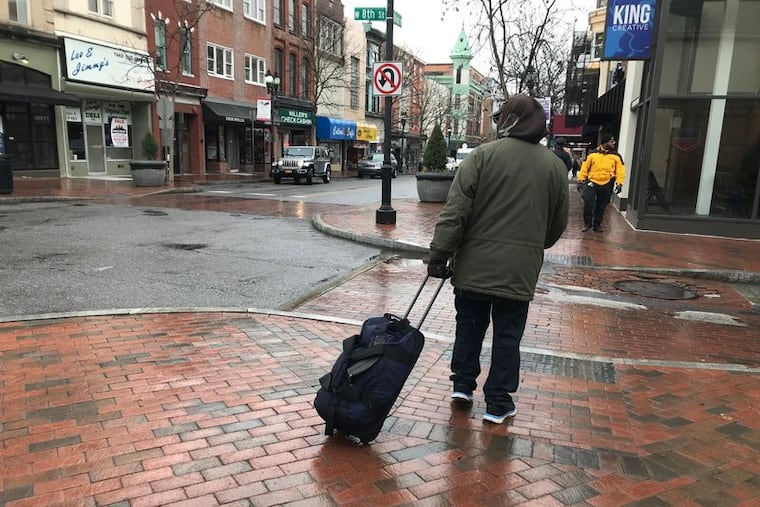
Where most people see homelessness, Wilmington Mayor John Carney sees Philadelphians. He reduces a complex issue to the claim that if only homeless people stayed in Philadelphia, Wilmington wouldn’t have a homelessness problem. As politically expedient as this is, it is factually wrong and has produced bad policy.
Carney has leaned so far into this narrative that last fall, he wrote to Philadelphia Mayor Cherelle L. Parker, urging her to ensure “improvements in Philadelphia do not come at the expense of the City of Wilmington.” In doing so, he reframed homelessness as a competition between cities rather than a responsibility within his own, casting Wilmington’s homeless population as outsiders whose presence is “unfair to the city residents who live in these neighborhoods.”
Wilmington’s business community readily echoes this framing. Downtown developer Rob Buccini testified in a state legislative hearing that Wilmington’s economic woes stemmed from “the city of Philadelphia marketing and paying for homeless people to leave their city to send them to places like Wilmington.” He then linked homeless people to store closings and crime — scapegoating them for problems that have plagued Wilmington’s downtown for generations.
The evidence for these claims is thin. Carney’s only example is an NBC10 investigation into Philadelphia’s Stranded Traveler Assistance program, which spent $270,000 over four years to provide 875 one‑way tickets to bus homeless people out of Philadelphia. Yet, of all those tickets, only eight were to Wilmington.
Still, Wilmington might carry an allure for homeless people or be a convenient destination for neighboring cities to move their homeless residents. While no local providers have observed this happening en masse, there has also been no data to clearly refute these assertions, either.
To assess the issue, I partnered with Housing Alliance Delaware to survey 173 single adults staying at the Sunday Breakfast Mission, representing about one-third to half of the downtown homeless population. The survey asks where they were from and, for those who had moved to Wilmington while homeless, when and why they came.
The results are telling. Almost half — 45% — reported being native to Wilmington. Another 24% had been living in Wilmington before they became homeless. That leaves 31% who were already homeless when they arrived.
Among this subgroup, 23 people came from other parts of Delaware, mostly from towns near Wilmington. The remaining 31 people — about one‑sixth of all surveyed — came from other states. Just four people reported coming from Philadelphia.
These findings, together with the Stranded Traveler Assistance data, show Carney’s purported Philadelphia‑Wilmington homeless connection to be a canard. Homelessness in Wilmington is primarily a local — and secondarily a regional — problem.
The Carney administration needs to do what Carney often demands of the homeless: take responsibility for its own problem. Rents in Wilmington have climbed while household incomes have stayed flat, so renters now spend 48% of median household income on rent — far above the 30% affordability benchmark. Under these conditions, it is inevitable that the most vulnerable households will fall into homelessness.
Refusing to take responsibility has also shaped the city’s policy toward homelessness — a policy that treats homeless residents less like neighbors and more like interlopers. The Carney administration has pursued a strategy of containment, concentrating the unsheltered population into an enclave on the East Side that has created what I call the “New Skid Row.”
Wilmington has spent hundreds of thousands of dollars to maintain a sanctioned tent city there rather than to increase shelter or housing capacity.
Now, after spending all that money, Wilmington has announced it will clear the tent city on June 15. Such a flip-flop makes it unclear whether Carney has any coherent plan for addressing homelessness.
Seeing the homeless as a threat from the outside is not unique to Wilmington. Seven years ago, many in Philadelphia believed homelessness in Kensington was driven by people from up and down the East Coast lured by cheap, high‑quality opioids. But when data showed Kensington’s homeless population to be largely local, Philadelphia adjusted its policy and expanded treatment services and recovery housing.
Christina Park is not Kensington, but Wilmington would be wise to recalibrate its homeless policy to align with available data — and leave Philadelphia out of it.
Stephen Metraux is a professor of public policy at the University of Delaware, where he researches housing and homelessness. He has lived in West Philadelphia since 1995.