DACA under threat as Trump’s anti-immigrant crackdown comes for the Dreamers
Beneficiaries of the Deferred Action for Childhood Arrivals program are facing delays, detention, and deportation.
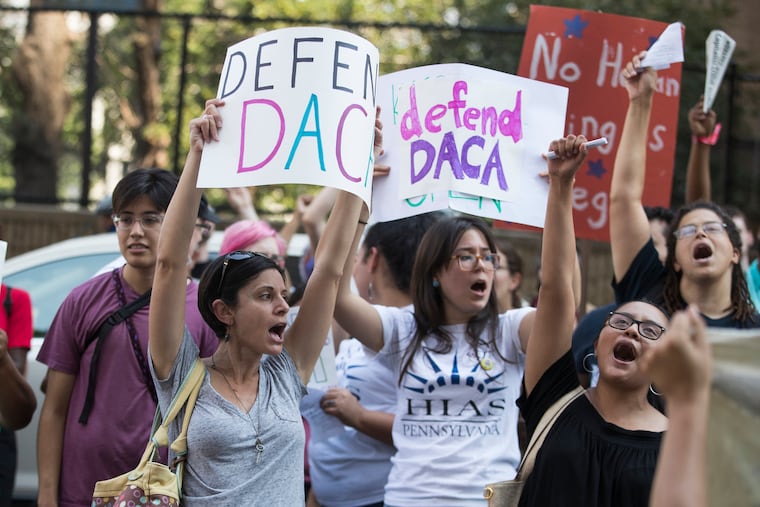
Under President Donald Trump, immigrants — whether they’re in the country illegally or came here “the right way” — are under siege by the federal government.
Led by Stephen Miller, who serves as White House deputy chief of staff for policy, the administration is doing all it can to make life hard for people whose only real sin was believing they could pursue happiness in America.
In doing so, Trump’s policies are breaking up families, devastating communities, and hurting the country. If there is no bottom-line benefit to what they are doing, then we must ask ourselves: What is the point of all this useless cruelty?
Take the immigrants known as “Dreamers,” people who were brought to the U.S. as children. In 2012, President Barack Obama created the Deferred Action for Childhood Arrivals, or DACA, program. It shielded participants from deportation and granted them a renewable work permit.
Obama’s executive order was never intended to be a permanent solution, but more than a decade of congressional inaction has left these young immigrants, many of whom grew up in the U.S. and are American but for their legal status, with little else.
During Trump’s first term, the U.S. Supreme Court kept the president from killing DACA, but other court challenges succeeded in barring any new applications, even as roughly 500,000 people — around 4,000 in Pennsylvania — continue to be able to renew participation every two years.
Delays in those renewals are the latest tactic the administration is applying to put pressure on immigrants. Across the country, thousands of people are stuck in bureaucratic limbo.
Victor Espinoza, 35, came to the U.S. legally when he was 10 years old after his father received an H1-B work visa. While he was finishing college, he turned 21 and no longer qualified as a dependent. He applied for DACA and has benefited from the program ever since.
He said he never had to wait more than three months for a renewal application to be processed and approved. Now, even though he submitted his paperwork in December, he has yet to hear anything from U.S. Citizenship and Immigration Services.
“I feel pretty helpless,” he told me. “My Employment Authorization Document expired May 12, so I’ve been on a leave of absence from my job. I had just started in January and was very happy, given the job market.”
» READ MORE: How an anti-immigrant and antisemitic conspiracy theory became U.S. policy | Luis F. Carrasco
Espinoza, who has a master’s degree from Temple, is like many other DACA recipients. He works, pays taxes, and owns a home. All told, DACA participants earn around $24 billion a year and pay more than $3 billion in state and local taxes, according to the Center for American Progress.
While he waits for the government to process his application, Espinoza not only risks losing his livelihood and his home — “I don’t think the bank’s going to care why I can’t make my mortgage this month” — he also risks deportation.
Last year, more than 260 DACA recipients were detained, and at least 86 were deported.
Fortunately, the courts continue to be a bulwark against the Trump administration’s overreach. In two recent cases, that of María de Jesús Estrada Juárez and José Contreras Díaz, judges ruled that the deported immigrants should be allowed back into the country.
Of course, as in many cases of the administration abusing its power, the damage had already been done.
Estrada Juárez was in the process of becoming a permanent legal resident when she was detained in February after a routine immigration appointment. The 42-year-old mother, who had been in the U.S. since 1998, spent 40 days in Mexico before she was able to return to her California home.
“What happened was not just a mistake, it was an abuse of power that traumatized my family and showed how easily immigrant families can be treated as disposable,” she said during a recent press call. “Now we live in fear, constant fear … my daughter asks me questions that no child should ever be asking: Will they deport you again? Would you come back home?”
Contreras Díaz, 30, was deported to Honduras, a country he left when he was 8 years old. Ordered to be returned by the court, he was again put in a detention center before being released to his Texas home.
» READ MORE: The Trump administration’s $1 billion immigration swindle | Luis F. Carrasco
“The real impact of the attacks on DACA recipients is it punishes entire families, and the truth is the nightmare still hasn’t ended,” he said. “Right now, I have to wear an ankle monitor, and in roughly 40 days, I have another appointment with Homeland Security, and instead of feeling safe, I’m preparing myself for the worst.”
The deportations and delays are all part of a plan to chip away at DACA and its protections, said Juliana Macedo do Nascimento, deputy director of advocacy and campaigns at immigrant advocate group United We Dream.
They don’t want to try to end DACA, as Trump did during his first term, she noted, because they are worried about the kind of backlash the administration received then. The program is popular across the political spectrum, with most Americans believing Dreamers deserve to remain in the country.
“DACA is not being rescinded in one sweeping announcement,” Macedo do Nascimento said. “It’s being killed by a thousand cuts.”
This slow dismantling of the program hardly negates the harm being done. Every cut is the life of an immigrant and their family being upended, and their contribution to America denied.
Over the years, I have spoken with several Dreamers, and I always walk away impressed. They are going to school, serving in the military, starting a business, or working in corporate America — they take advantage of all the opportunities too many of us take for granted.
Even as the foundation upon which they’ve built their lives has been under legal threat almost since DACA began, they’ve come out of the shadows and have thrived to the benefit of all. DACA recipients not only spend money and pay taxes, but they also annually contribute around $2.1 billion to Social Security and Medicare — all while being ineligible to receive any federal benefits themselves.
“We have built lives here on the promise from this government that we are protected,” Mace do Nascimento said. “We know that DACA was always supposed to be temporary, but until Congress acts, this is what we have, and this is what this government has to honor.”
The American Dream and Promise Act, a bipartisan bill that includes giving Dreamers a pathway to legal status, remains stalled in Congress. Voters should pressure their representatives to act and rebuke the Trump administration’s shortsighted, cruel anti-immigrant policies.
Until then, people like Espinoza in Philadelphia will continue to needlessly live in uncertainty and fear.
“I don’t know what the future holds,” he said. “I’ve seen ICE agents in the street, stopping people. I feel like a sitting duck.”

Inquirer Opinion Newsletter