How an anti-immigrant and antisemitic conspiracy theory became U.S. policy
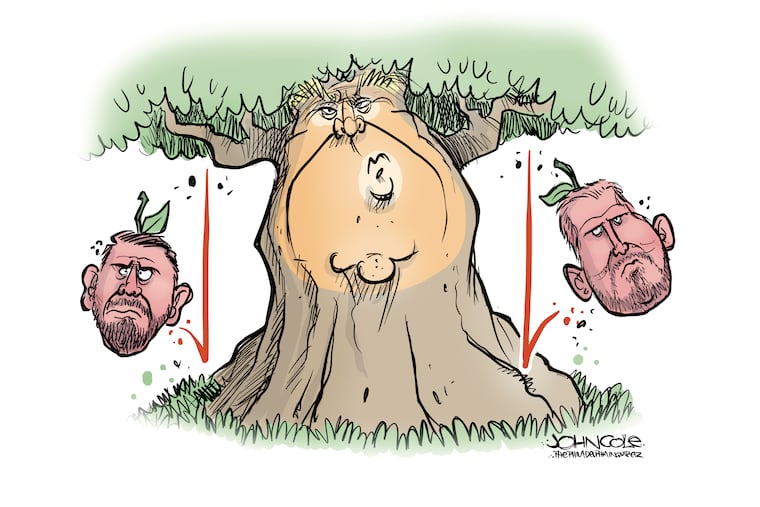
The “great replacement theory” is an idea based on fear of change, of losing power, of looking around you and not recognizing your country anymore. But America has nothing to be afraid of.

The “great replacement theory” posits that a shady cabal of elites (read: Jews) is plotting to flood Western countries with immigrants, effectively “replacing” the native (read: white) population and destroying its culture and political power.
Introduced in 2011 by French writer Renaud Camus, the far-right fever dream was once limited to extremists. It gained mainstream acceptance in America about a decade later, pushed by the likes of Tucker Carlson and Pennsylvania’s own Rep. Scott Perry.
That shameless opportunists would prey on people’s worst instincts for political gain is not surprising. But that this anti-immigrant and antisemitic conspiracy theory now undergirds U.S. policy is chilling and should never be normalized.
The most recent example came last week, as the U.S. Department of State petulantly complained on social media that the U.S. had declined to participate in the review of the United Nations’ Global Compact on Migration — a nonbinding framework meant to help countries reap the benefits of immigration while addressing its many challenges.
“The United States objects to the Global Compact on Migration and U.N. efforts to facilitate replacement migration to the United States and our Western allies,” the post claimed. The State Department also alleged that U.N. agencies “systematically facilitated mass migration into America and Europe,” and bemoaned the fact that the compact’s latest report “urges nations to expand migration pathways and pursue ‘regularization’ of migrants.”
Now, while one man’s “facilitating mass migration” may be another’s preventing people from being raped in a jungle or drowning in the ocean, the Trump administration isn’t just upset because the U.N.’s humanitarian principles cramp its anti-immigrant style. The State Department leans into the great replacement contention that globalists are behind mass migration, declaring that the U.N. was “pipelining migrants to our southern border.”
» READ MORE: The Trump administration’s $1 billion immigration swindle | Luis F. Carrasco
For people who may have reasonable objections to unchecked immigration — and I count myself among them — we are very far from economic or law-and-order arguments here. Dangerously so.
If immigrants are “poisoning the blood of our country,” as Donald Trump has said. If migration may lead to “civilizational erasure,” as Secretary of State Marco Rubio believes. Hell, if immigrants are eating Ohioans’ pets, as Vice President JD Vance once fabulated, then the basest expression of support for the great replacement theory is sadly predictable.
The 2018 killing of 11 congregants at the Tree of Life synagogue in Pittsburgh, the deaths of 51 Muslim worshipers in Christchurch, New Zealand, in 2019, and the deadly shooting of 23 people at a Walmart in my hometown of El Paso, Texas, that same year all involved gunmen who saw immigrants and people of color as existential threats.
The U.N. Global Compact on Migration is as anodyne as it gets. Even the Biden administration damned it with faint praise as an “aspirational document” and underlined that the compact respected countries’ rights to “determine their national migration policy and their prerogative to govern migration within their jurisdiction.”
Yet, the Trump administration, which never met a straw man it didn’t carry a torch for, went out of its way to blast the U.N. and signal its anti-immigrant virtues. The White House account on X, while reposting the State Department, also shared an image of the president with the term “replacement migration” crossed out and “remigration” taking its place.
Unfortunately, many GOP voters respond to this nonsense.
An Associated Press poll from late 2021 found that almost half of Republicans who participated agreed with aspects of the great replacement theory. By 2024, after Trump made his “poisoning” remarks, around three out of four GOP supporters agreed with him, according to a CBS News poll.
The great replacement theory plucks some very recognizable notes: It’s an idea based on fear, and fear is normal. Fear of change, of losing power, of looking around you and not recognizing your country anymore. But we have nothing to be afraid of.
Walking through a Berlin neighborhood earlier this year, I heard not a word of German spoken, nor a schnitzel place in sight. One may conceivably ask, Ist das Deutschland? But if I’m eating Mexican food at the Italian Market, or listening to Cantonese and Mandarin as I pass through Chinatown on my way to an Irish pub, I know I’m in America.
While other countries may define themselves by how their people look and what they sound like — which is exactly what the Trump folks want — the United States has survived for 250 years because of the ideals it was founded upon, and those ideals are color blind. English may be our de facto language, but the Constitution is agnostic on what we should be speaking, much like it is on who or what we should be worshipping.
Life, liberty, and the pursuit of happiness. Immigrants are here for that. And if they have doubts, don’t worry, their kids won’t.
The only ones trying to replace our values are those who fail to understand America. That they are in the White House should concern us all.

Inquirer Opinion Newsletter