People are dying in Trump’s squalid concentration camps
Deaths are occurring in ICE detention facilities at nearly 10 times the rate of the Biden years. It will likely get worse.
In the sweltering August heat of the West Texas desert, U.S. Immigration and Customs Enforcement — through a $1.2 billion private contract that was awarded under some strange circumstances — in 2025 opened up a large tent city detention camp near El Paso to take some of the thousands swept up in Donald Trump’s mass deportation raids.
It took just a matter of days for horror stories to begin leaking out of the sprawling camp on the grounds of Fort Bliss.
A Cuban refugee identified as Isaac, a pseudonym, told investigators from a coalition of human rights groups that guards had violently assaulted him as part of a campaign to convince him and other detainees to be dumped in Mexico rather than to contest their deportation.
Isaac told the groups’ lawyers in a sworn declaration that “the guards hit my head” and “slammed it against the wall approximately ten times” before grabbing and crushing his testicles, then handcuffing him and putting him on a bus with 20 other detainees that was driven to the border. They were told, according to Isaac, “If we don’t want to go to Mexico, then we would either be sent to a jail cell in El Salvador or Africa.”
Isaac’s complaints echoed other nightmarish tales that attorneys for the American Civil Liberties Union (ACLU) and a web of immigrant rights groups gleaned in 45 interviews with detainees that were cited in a December letter pleading with ICE to shut down what has become the largest internment camp in the United States.
The implication was that if the Trump regime did not act, things at Camp East Montana would get worse.
They did.
Over a 33-day stretch that straddled the arrival of the new year, three ICE detainees at the Texas camp died under murky circumstances. One of the cases — the Jan. 3 death of 55-year-old Geraldo Lunas Campos, also a Cuban immigrant — was on Wednesday ruled a homicide by the county medical examiner, citing efforts by camp guards to restrain him. The medical examiner wrote in his report that Campos died from “asphyxia due to neck and torso compression.”
The U.S. Department of Homeland Security, which oversees ICE, has continued to maintain that Campos’ death was “a suicide,” and that any encounter he had with guards was an effort to prevent him from taking his own life. Two fellow detainees who reported seeing guards choking Campos have now received deportation notices. The mother of two of Campos’ children told the New York Times, “He was being abused and beaten and choked to death.”
The alleged killing of Campos is arguably the worst example of what many critics predicted when Trump won the presidency in 2024, behind supporters waving placards, “Mass Deportation Now.” The squalid, hastily erected tent city in the Texas desert is the flagship of what experts describe as a growing network of concentration camps. And now, one year into Trump’s second term, people are dying in them.
“It’s everything that we warned it would be, even before it opened,” Haddy Gassama, a senior policy counsel at the ACLU who’s been working on the issues around Camp East Montana, told me this week. “I think their goal is still to put 5,000 people in this space with inadequate healthcare, inadequate food, and inadequate recreation.”
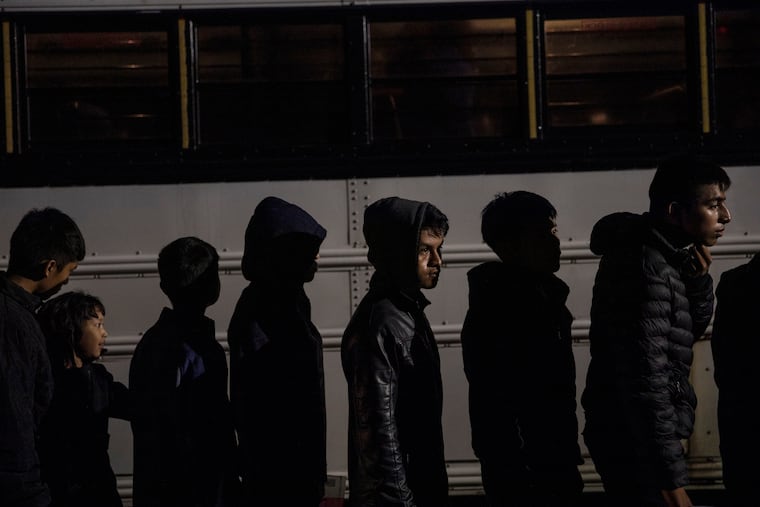
The high-profile, increasingly violent immigration raids that have been taking place in Minneapolis, Chicago, and other U.S. cities have swelled the number of detainees in ICE custody to more than 73,000, an all-time record. DHS is currently planning a large-scale 2026 expansion of its gulag archipelago that would even include repurposing remote rural warehouses for holding human beings.
In such a large population of detainees, some deaths would be inevitable, but the current ongoing spike in fatalities has shocked and alarmed experts. The sixth ICE detainee death of 2026 took place on Sunday, which is a rate of one every three days. That extrapolates to more than 120 deaths over a year, which would be more than 10 times the rate in the last year of the Biden administration, when only 11 detainees perished.
That Jan. 18 fatality also occurred at Camp East Montana, when Victor Manuel Diaz, 36, of Nicaragua, died of what government officials called a “presumed suicide.” Unlike Campos, the autopsy on Diaz will not be done by the county medical examiner, but by government doctors at an Army medical center. Diaz was one of many migrants swept up in the current ICE operation in Minnesota.
The third recent death tied to the Texas concentration camp — Francisco Gaspar-Andres, 48, of Guatemala, who was taken to an El Paso hospital — was determined by an autopsy to have been caused by complications of alcohol-related liver disease.
That the majority of ICE custody deaths are linked to medical causes doesn’t necessarily exonerate either the agency or its private contractors. A 2024 report by Physicians for Human Rights that looked at 52 deaths in ICE custody from 2017 to 2021, or during Trump’s first term, found that 95% were preventable, or possibly preventable, if appropriate medical care had been provided.
» READ MORE: This column on U.S. concentration camps is the one I hoped I’d never write | Will Bunch
One such medical death occurred here in Philadelphia earlier this month when Parady La, a 46-year-old Cambodian refugee who lived in Upper Darby, died after he was taken from the city’s federal detention center to Thomas Jefferson University Hospital. ICE said La was suffering from severe drug withdrawal symptoms, but family members are questioning whether the feds paid enough attention to his illness, or even administered the right treatment.
Human rights watchers insist that the spike in ICE detention deaths cannot be viewed as a coincidence, but as an outgrowth of problems that include not only medical neglect but also squalid conditions, substandard food, rancid water, and patterns of physical and sexual abuse by guards. They say the problems are not new, but have substantially worsened as the Trump regime hastily expands its networks of detention centers and camps.
In December, another Camp East Montana detainee — Thomas, also a pseudonym — told human rights lawyers that “he was beaten by officers so severely he sustained injuries across his body, lost consciousness, and had to be taken to a hospital in an ambulance.” Like his fellow detainee Isaac, he alleged guards grabbed his testicles and crushed them.
Gassama, the ACLU attorney, said the horrific track record of ICE detention raises all kinds of red flags about its current plans, aided by its $175 billion windfall in Trump’s “Big Beautiful Bill” that was signed last year, to house as many as 80,000 detainees in a new network of revamped warehouses. “You can only imagine what a remodeled warehouse would be like to detain people, human beings, long term,” she said.
It’s true that — as right-wing pundits are always quick to point out — the U.S. mass deportation regime offers nothing that comes close to the death camps Nazi Germany established at the end of the Holocaust. But experts like author Andrea Pitzer say the similarities to concentration camps that Adolf Hitler set up for his political enemies after taking power in 1933 are too many to ignore.
History has shown again and again that rounding up masses of people based on their identity strips them of their basic humanity. And that becomes the sick justification for violent abuse, neglect, endemic disease, and, ultimately, death.
The most famous victim of the Nazi Holocaust, the teenage diarist Anne Frank, wasn’t killed in a gas chamber, but died from typhus at the Bergen-Belsen concentration camp, which was the result of unsanitary conditions and medical neglect.
Now, people are dying in record numbers in “the camps” on sunbaked U.S. soil. This is shameful beyond words.
These human rights abuses now occurring at Camp East Montana are also a tragic echo of the longer arc of history of its Fort Bliss location. In 1942, thousands of detainees — mostly Japanese Americans, with some people of German or Italian descent — were shipped from the West Coast to be held in a barbed-wire camp under constant watch by armed guards. Over the course of World War II, some 1,862 Japanese Americans died in the broader network of internment camps, many from harsh conditions.
More than four decades later, America formally apologized for this gross injustice. This time, we need to stop it before it comes to that.

Sign up for the Will Bunch Newsletter