‘Baghdad Pete’ tries to prevent fact-based press from covering dire changes to U.S. security doctrine
New policy prioritizes war on “enemies within” and drug cartels rather than curbing Russian and Chinese aggression.

Perhaps we should start calling the Pentagon’s secretary of war “Baghdad Pete.”
Defense Secretary Pete Hegseth is trying to block the Pentagon press corps from using any information not explicitly authorized by his staff, even if it is unclassified. Shades of “Baghdad Bob,” the infamous Saddam Hussein mouthpiece who delivered the regime line daily to the international press when I was covering the 1991 Gulf War.
The Hegseth policy even requires an official to accompany accredited journalists visiting Pentagon areas where they were formerly allowed to walk freely. Reminds me of our assigned “minders” in Baghdad, whose job was to bar us from learning anything the regime didn’t want us to know.
Hats off to nearly all the Pentagon press corps — including conservative outlets such as Fox News, Newsmax, the Washington Times, and the Daily Caller — who refused to forfeit their First Amendment rights by signing on to the new rules. They thereby lost their accreditation and their access to enter the building. Even more outrageous, they have been replaced with far-right outlets and slander-mongers known for promoting election denial, fake news, Russian propaganda, and deluded conspiracy theories.
Baghdad Pete is striving not only to stop accurate news coverage of the use or abuse of U.S. military operations. In his effort to tightly control Pentagon news, he has also decreed that Pentagon officials can’t interact with members of Congress without prior approval.
Much (though not all) of the news he is trying to hide is already self-evident, and so damaging to U.S. security that he won’t be able to plug future leaks.
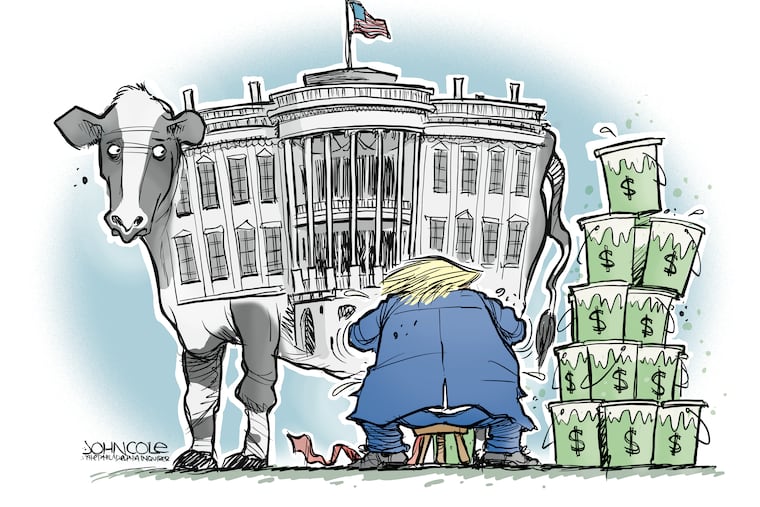
Politico and the Washington Post have already published important details on President Donald Trump’s upcoming National Security Strategy, which will assign America’s top priority to “protecting” the U.S. homeland and the Western Hemisphere. This means making war on “the enemy within” in U.S. cities, as well as on immigration and drug cartels. As if those threats overshadow our fraught competition with China, and the very real threat from Russia.
The theatrical U.S. military attacks on alleged drug smugglers in small boats off Venezuela and in the Pacific off Colombia - which could easily be stopped by the U.S. Coast Guard - are clearly illegal.
But even more obvious, while this showy policy of killing a few unknown civilians at sea may be great for the White House video feed, it does nothing to combat America’s drug problem or drub the cartels.
U.S. citizens are dying in enormous numbers from fentanyl, which is neither produced in nor smuggled in from Venezuela or Colombia (most comes in via Mexico, made from Chinese precursors).
Indeed, Colombia has been one of Washington’s closest partners for decades in combating narcotics trafficking, and the U.S. strikes have infuriated Colombian President Gustavo Petro. Yet, Trump has now cut off all aid to Colombia and labeled Petro an “illegal drug leader.”
As for Venezuela, the Pentagon has assembled a force of 10,000 in the Caribbean off its coast for a supposed anti-terrorism mission, which many Latin American experts believe is really aimed at fomenting regime change in Caracas. Despite Trump’s dismal failure in his first term to oust Venezuelan leader Nicolás Maduro, he is apparently trying again.
This upside-down set of priorities has reportedly upset top U.S. military officials.
It is hardly surprising, then, that Hegseth just announced that Adm. Alvin Holsey, a 37-year veteran, will quit his job as head of U.S. Southern Command — where he oversees all operations in Central and South America. (Could the fact that the highly qualified Holsey is African American have accelerated Baghdad Pete’s effort to get rid of him two years early?)
Thus, there is plenty of news for the now-banned Pentagon press to ferret out for the U.S. public, not just about why the armada was dispatched, but why Trump and Hegseth want to prioritize Latin America and drugs.
We know Trump has a thing about the Monroe Doctrine, the 1823 message to Congress by President James Monroe that warned off any other would-be colonizers from interfering in Latin America. Some wags now call it the “Donroe Doctrine.”
Trump has interpreted the doctrine to mean the United States’ sphere of influence should extend over Northern, Central and South America, while often seeming to concede Europe to Russia’s sphere of influence, and Asia to China’s.
In other words, a Big Man theory of politics expanding Monroe’s intended meaning, which presumes Trump, Vladimir Putin, and Xi Jinping can split up the world.
However, 2025 is not 1823, and a Donroe Doctrine doesn’t fit the world we live in. Some Latin American countries, such as Brazil, have become major forces in their own right. China, with its large-scale investments in Latin America, and helped by Trump’s tariff policies, is already an ever more powerful presence on the continent.
I see Trump’s Caribbean action as a distraction from his failures in handling China and Russia, as Putin and Xi run rings around him. It is far easier for Trump to carry out performative war off the South American coast — bang-bang on unknown boatmen about which he and Hegseth can chest thump — than to confront the real threats that endanger our country. (And he can still pretend he will tariff Xi into subservience when they meet in Seoul, South Korea, this week.)
Let me give just one example of how the boat bombs serve as a distraction. This week, they have obscured the president’s latest failure with his all-carrots approach to Putin, who stiffed him yet again on a ceasefire in Ukraine.
True, Trump has finally, after months of threats, imposed new sanctions on two big Russian oil producers. But if you read the text of the new sanctions, you will see he let Putin off the hook once more.
The new sanctions — which will not even take effect for four weeks — are levied against any U.S. firms or individuals who deal with Rosneft or Lukoil. But as the indefatigable Phillips P. O’Brien pointed out in his Substack, the U.S. does almost no business with either firm. And secondary sanctions against foreign individuals or companies who keep dealing with the named firms will not be automatically applied.
Indeed, the real issue is whether the president will try to squeeze China and India to halt their enormous purchases of Russian oil. Despite Trump’s claims, full Indian adherence isn’t likely, and forget about China.
And POTUS has already admitted he hopes the new sanctions will be short-lived.
If Trump had really wanted to pressure Putin, he would have sold Kyiv long-range Tomahawk missiles. But that would have been a hard choice, and might have disturbed some of his disciples.
Better to focus on Caribbean boom-boom and change U.S. security doctrine to fight a war against “enemies at home” and supposed threats from drug lords. And to prohibit the Pentagon press from interviewing disaffected military or civilians who would explain how this doctrine endangers the United States.