Congress should renew Affordable Care Act subsidies — regardless of whether Trump cares | Editorial
Trump treats healthcare like every other issue: mostly making nebulous, politically calculated statements that are counterproductive when leadership from the White House is needed.
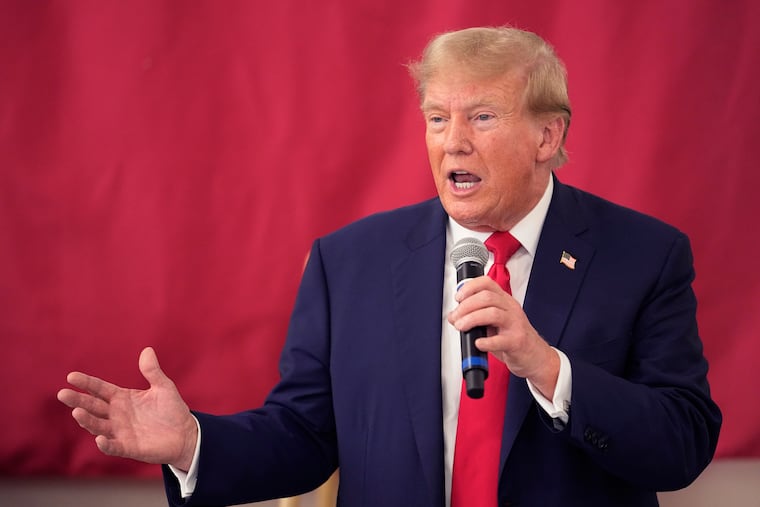
The longest shutdown of the federal government in this nation’s history ended after Republicans finally agreed to consider Democrats’ appeal for an extension of expiring Affordable Care Act subsidies that help families buy health insurance.
What action Republicans will ultimately take is anyone’s guess before the subsidies expire in January. As for President Donald Trump, he treats healthcare like every other issue: mostly making nebulous, politically calculated statements that are counterproductive when leadership from the White House is needed.
For years, Trump has derisively called “Obamacare” bad legislation that never should have been passed, but he has never offered a better alternative.
“My first day in office, I am going to ask Congress to put a bill on my desk getting rid of this disastrous law and replacing it with reforms that expand choice, freedom, affordability,” Trump said on the campaign trail in 2016. Several proposed replacements to the ACA were subsequently introduced after his election, but each was defeated in the Senate, with even some Republicans voting against the inadequate alternatives.
Trump never produced anything better than Obamacare during his first administration, but that didn’t stop him from again making the healthcare law a major talking point during his reelection campaign. “We’re signing a healthcare plan within two weeks, a full and complete healthcare plan,” Trump said in July 2020. “We’re going to be doing a very inclusive healthcare plan. I’ll be signing it sometime very soon.”
But the plan never came, and Trump lost the election.
He stewed during Joe Biden’s four years as president, but promised voters during his 2024 campaign that he was ready to replace Obamacare. Pressed by reporters to reveal his alternative, Trump had to admit he had only “concepts of a plan.” Nearly a year has passed since his second inauguration, but Trump’s concepts of a better plan to make sure health insurance is affordable are still a mystery.
Unless that changes before the increased ACA subsidies expire, Congress should vote to extend them.
The subsidies help Americans who earn up to 400% of the federal poverty level — $15,650 annually for an individual and $32,150 for a family of four — pay for insurance. Without those subsidies, a person now paying $325 a year for health insurance might have to pay as much as $1,562 annually.
Many whose insurance costs will go up may decide to rejoin the ranks of the uninsured. That would be a travesty. The medically uninsured rate in America almost halved from 17.8% when the ACA became law in 2010 to 9.5% in 2023. Studies show uninsured adults have less access to medical care, receive poorer quality of care, and experience worse health outcomes than insured adults.
Ending the subsidies will turn back the clock. That doesn’t mean Obamacare shouldn’t be touched. Adjustments should be made based on how much healthcare in America has changed since the law was signed in 2010 and fully implemented in 2014.
The ACA was this country’s alternative to installing a “single-payer” healthcare system, such as Canada’s, where most funding and payments for medical treatment come directly from the government via taxes paid by the public. The ACA system in America instead retains the third-party role of private medical insurance companies such as Blue Cross, Aetna, and Cigna, whose revenue has increased greatly under Obamacare.
Most Canadians also have private insurance to pay costs not included in their government coverage, so even they don’t consider a taxpayer-funded, single-payer system the best way to provide healthcare. In fact, a survey of 11 healthcare systems provided by the world’s highest-income nations ranked Canada 10th and the United States last.
Despite spending far more of our gross domestic product on healthcare, America is at the bottom in terms of access to patient care, administrative efficiency, equity, and healthcare outcomes. In other words, we’re spending a lot of money and getting sicker in return.
» READ MORE: Trump makes a mockery of pardon power by blithely granting clemency to his allies | Editorial
The study by the Commonwealth Fund said the highest-ranked nations, including Norway and the Netherlands, which topped the list, shared four distinguishing features:
They provide universal coverage and remove cost barriers.
They invest in primary care systems that provide high-value services to all people in all communities.
They reduce administrative burdens that divert time and spending from health improvement efforts.
They invest in social services, especially for children and working-age adults.
That last point brings up another issue regarding healthcare and Trump. The omnibus legislation passed in July, which he dubbed the “One Big Beautiful Bill,” made drastic cuts to Medicaid to help pay for tax cuts expected to reduce federal revenue by $4 trillion between 2025 and 2034. Why should Medicaid, which helps cover medical costs for low-income families, older adults, and people with disabilities, be sacrificed so that Trump can boast he cut taxes?
Trump’s minions falsely said the cuts were needed to combat fraud and abuse, including a bogus claim that undocumented immigrants were receiving Medicaid benefits.
Why is this president always finding some perceived wrong among the most vulnerable Americans while lavishing praise and largess on the wealthy? Certainly, he’s more familiar with the latter, having grown up rich and being more comfortable among his people. But so many less fortunate Americans voted for him, including more than a few who depend on Medicaid.
Shouldn’t he at least occasionally seem to care for their health?