Voters should consider their choices carefully in judicial retention races | Editorial
Pennsylvanians should vote yes to retain the three Supreme Court justices, but there are some Philadelphia lower court judges who do not deserve another term.
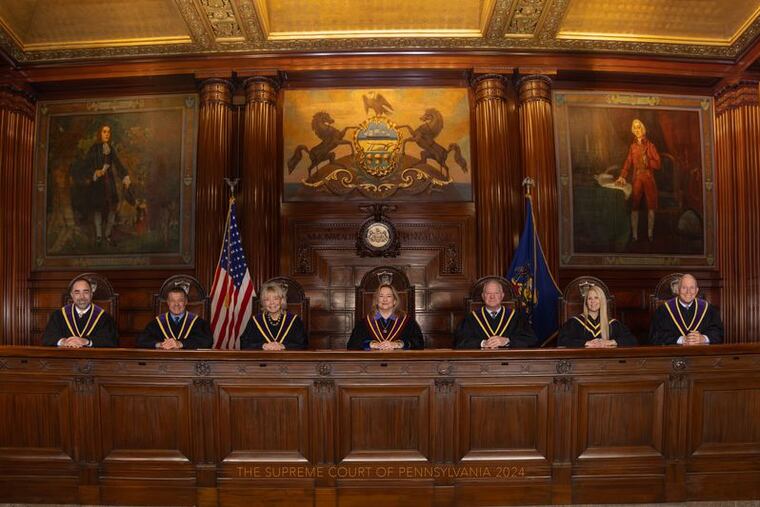
The most important election facing Pennsylvania voters on Nov. 4 involves whether to retain state Supreme Court Justices Christine Donohue, Kevin Dougherty, and David Wecht.
While voters should vote yes to retain the three justices, there are some lower court judges who do not deserve another term.
Millions of dollars have been spent on the Supreme Court race, which will impact residents in cities and towns across the commonwealth. In recent years, the state Supreme Court has ruled on a variety of high-profile issues, including elections, redistricting, reproductive health, and education.
Going forward, the court is likely to continue to confront many of the same hot-button issues — especially if Republicans gain control of the state House, the governor’s mansion, or replace the three well-qualified justices on the high court with extreme partisans.
Voters need only look to Washington, D.C., to see the danger of a politicized, conservative majority on the bench, as the U.S. Supreme Court continues to ignore precedent and rubber-stamps Donald Trump’s abuses of the rule of law.
» READ MORE: Reject the partisan push to oust Pa. Supreme Court justices | Editorial
Republican control of the White House, Congress, and the U.S. Supreme Court has resulted in a rapid erosion of the system of checks and balances created by the founders.
In just a few short months, the GOP has deferred all power to Trump, who has shuttered the government, demolished part of the White House, sicced the U.S. Department of Justice on political enemies while pardoning cronies, celebrities, and insurrectionists, summarily killed alleged drug traffickers without any evidence, and deported people living in America without any legal due process.
He has forced out tens of thousands of career civil servants, imposed tariffs that have roiled the economy, slashed environmental, health, and worker safety regulations, appointed incompetent hacks throughout the government, pressured red state lawmakers to take steps to rig elections, and sent federal troops into cities for no legitimate reason — all while evading previous criminal indictments and embarking on dubious personal enrichment schemes.
Much of Trump’s unchecked power emanates from the ruling last year by the conservative majority on the U.S. Supreme Court that effectively said presidents are above the law.
What does all of that have to do with the retention election of three Pennsylvania Supreme Court justices? Plenty.
The state is evenly divided between Republicans and Democrats. Yet, the GOP controls the state Senate and all three row offices: attorney general, treasurer, and auditor general.
The Democrats have a narrow edge in the House, while Gov. Josh Shapiro, a Democrat, is up for reelection next year.
Essentially, Shapiro and the Supreme Court, which has a 5-2 Democratic majority, are the only bulwarks keeping Trump’s MAGA-fueled zealots from seizing total control of Pennsylvania.
If the GOP were to control the governor’s mansion and the high court, voting maps would get even more gerrymandered, voting rights, including mail-in balloting, would likely get curtailed, abortion rights would get dramatically rolled back, and pro-business groups — and polluters like gas drillers — would enjoy even less regulation. Funding for public education and transit would likely also be slashed.
Other inane red state laws could get enacted that attack science, limit teaching about race, or make it harder to get a divorce. More to the point, Pennsylvania doesn’t need a radicalized state Supreme Court like the Roberts Court, which has squandered its credibility.
Donohue, Dougherty, and Wecht have demonstrated that they are fair, open-minded, and follow the law. They have restored respect to a high court that was plagued by scandals a decade ago.
But don’t just take this Editorial Board’s word for it.
The nonpartisan Pennsylvania Bar Association has a rigorous process for evaluating judges based on criteria like legal ability, integrity, and temperament. The process includes investigative panels that review the judge’s records, interview candidates, and gather input from attorneys.
After all that, both the Pennsylvania and Philadelphia Bar Associations recommended voting yes to retain Justices Donohue, Dougherty, and Wecht.
The Philadelphia Bar Association recommended voting no to retain five lower court judges. They are Common Pleas Judges Scott DiClaudio, Daine Grey, Frank Palumbo Jr., and Lyris F. Younge. The association also recommended not retaining Municipal Court Judge Jacquelyn Frazier-Lyde, the daughter of the late boxing champion Joe Frazier.
» READ MORE: Pa. Supreme Court retention is the most important election contest that no one’s talking about | Paul Davies
The association does not disclose the reasons for the recommendation, other than noting that three of the five judges did not participate in the review process, which includes surveying more than 500 lawyers to assess the judges for things like integrity, legal ability, temperament, and diligence.
Another 100 volunteer investigators interview the candidates, other judges, and lawyers, as well as scrutinize the judges’ written opinions, social media posts, and financial disclosures.
The Inquirer obtained the confidential surveys, which shed more light on how lawyers view the jurists. Inquirer reporter Samantha Melamed also reviewed opinions, interviewed some of the judges, and spent time in the courtroom.
It is not always easy for voters to be well-informed when it comes to selecting judges. But the intense focus (and misinformation) on the state Supreme Court election, combined with the nonpartisan work of the bar associations, other good government groups, and The Inquirer’s reporting, has framed the stakes.
Voters will now decide the fate of Pennsylvania’s courts — and of Pennsylvanians’ freedoms.