More than $7 million has poured into the Pa. Supreme Court judicial retention election so far
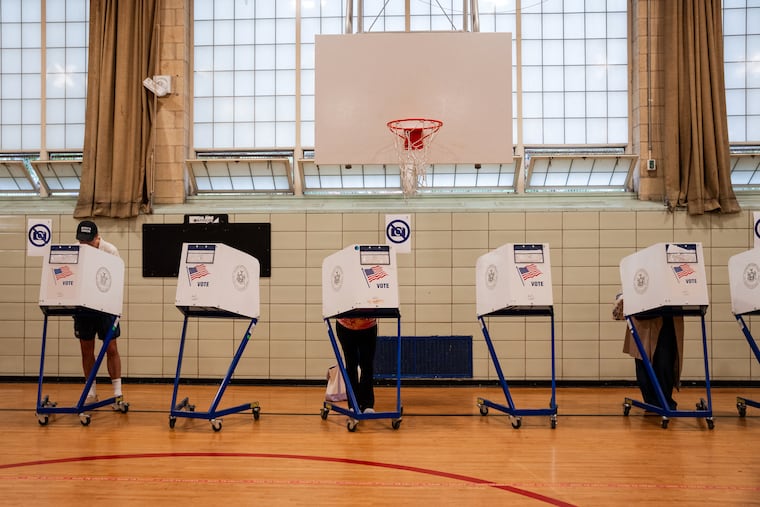
Voters on Nov. 4 will be asked to mark “yes” or “no” on whether each justice should be retained for another 10-year term, in what are usually sleepy off-year elections.

Approximately $7 million has already poured into Pennsylvania’s Supreme Court judicial retention election efforts as of Sept. 15, with state and national groups dumping millions into advertising the typically sleepy, off-year affair, and trade unions and lawyers spending big as groups aligned with both parties seek to sway the power balance on the state’s highest court.
And with more than five weeks left until Election Day, that amount, according to campaign finance reports released this week and covering spending from Jan. 1 to Sept. 15, is only expected to grow.
The three justices seeking retention to another 10-year term — Christine Donohue of Pittsburgh, Kevin Dougherty of Philadelphia, and David Wecht of Pittsburgh — were all elected as Democrats in 2015. Their election that year flipped the state Supreme Court to Democratic control and kick-started a new era of campaign spending and attention to the court as a critical battleground for consequential political fights in the swing state.
The focus on this year’s retention election has been magnified by Republicans seeking to reshape the court, with specific ire toward the three justices for their role in decisions backstopping Pennsylvania’s mail ballot voting law, striking down the state’s previous congressional maps as unconstitutionally gerrymandered, and for upholding COVID-19 shutdowns, among other rulings.
Voters on Nov. 4 will be asked to mark “yes” or “no” on whether each justice should be retained for another 10-year term. (Donohue will turn 75 in 2027 and be forced to retire at the end of that year, due to the state’s mandatory retirement age for justices.) Each justice will appear on the ballot without a party affiliation, because, while judges must list their party affiliation for their initial election, Pennsylvania’s retention elections are non-partisan.
Here are four takeaways from the first campaign finance filings made public thus far in the election cycle about who is supporting the justices’ retention and who is opposing it.
One justice raised significantly more than the rest.
Dougherty, of the politically connected Philadelphia Dougherty family and a former top judge in the city’s family court, significantly outraised his fellow justices, according to the campaign finance report.
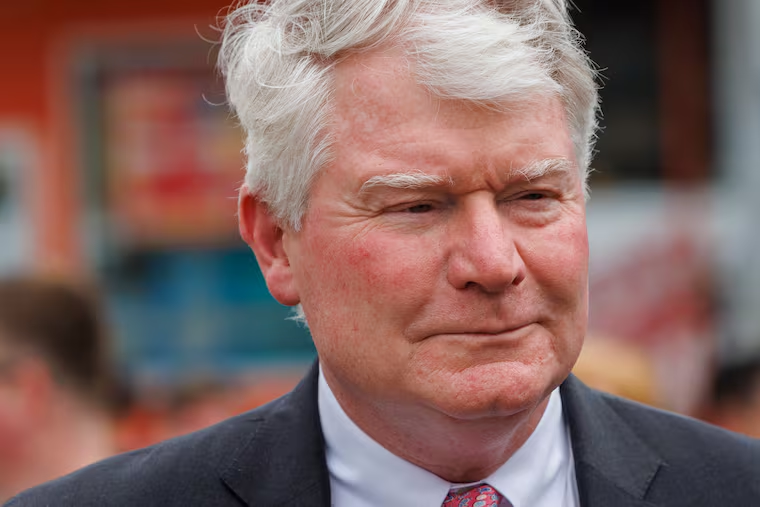
Dougherty, the brother of convicted former labor leader John J. Dougherty — widely known as Johnny Doc — and father of state Rep. Sean Dougherty, raised nearly $1.5 million as of Sept. 15 and spent approximately $380,000. This sets him up with more than $1.1 million in cash-on-hand going into the final month ahead of the election.
But all three justices are on track to surpass previous fundraising records for state Supreme Court retention elections — a sign of Democrats’ commitment to keeping their 5-2 balance.
Wecht, a former state appellate court judge, raised $803,000 and spent almost $60,000 with another $91,000 in unpaid debts, some of which are still unpaid since his 2015 election to the court. That leaves the justice with about $744,000 cash-on-hand, according to the filings.
Donohue, who is also a former state appellate court judge, raised $572,000 and spent $109,000 so far. She will enter the final weeks of her retention campaign with approximately $464,000 on hand, according to the campaign finance reports from Jan. 1 to Sept. 15.
A significant number of campaign contributions and independent expenditures are expected to continue to pour into the race as Election Day draws nearer, with the next batch of campaign finance filings expected in late October.
Compared to past retention elections, in 2017, Chief Justice Debra Todd spent a total of $625,000 to retain her seat, according to campaign finance filings. That same year, Chief Justice Thomas Saylor spent $158,000 on his retention campaign.
Only one Pennsylvania Supreme Court justice has lost retention: Justice Russell Nigro, who initially ran as a Democrat, was not retained by voters in 2005 as part of the blowback following late-night pay raises approved by the General Assembly, judges, and members of the executive branch.
Outside groups have reserved or spent more than $4.2 million so far, with the full picture still unclear.
Outside groups have dumped millions into the state Supreme Court retention race, as Republicans and Democrats alike race to the airwaves, broadcasts, and social media to get the word out about the little-known race in November’s likely low-turnout election.
However, the full picture of how much has been spent by these outside political groups — also called “independent expenditures” — remains unclear. As of Thursday afternoon, the Pennsylvania Department of State had yet to update its independent expenditure list, leaving the amount spent sending paper mailers to Pennsylvania voters’ households as unknown.
So far, Democrat-aligned groups maintain a three-to-one spending advantage over their GOP-aligned opponents, with more than $3.1 million in advertisements currently airing or reserved. Republican-aligned groups have $1.1 million in ads reserved or currently on the air, including from a group called “Citizens for Term Limits,” which has ties to Pennsylvania’s richest man, Jeffrey Yass. The campaign operations for national Democrats and Republicans have each contributed more than six figures to the retention race thus far, as both parties recognize the role the state courts play in deciding major legislative issues, such as voter access, abortion rights.
» READ MORE: The future of redistricting in Pa. could be at stake in November’s Supreme Court race
Since retention elections are only a “yes” or “no” vote for each candidate, rather than the justices facing opponents, there are no alternative GOP candidates who will appear on the November ballot. If any justice loses retention, the seat will likely be vacant until 2027, when the next odd-year election will take place. This means Republican groups are largely contributing to independent expenditures to run their “vote no” campaigns.
Trade unions are among the largest backers for retention — with extra support for Dougherty.
The politically powerful building trades unions dumped a total of more than $902,000 into the three justices’ retention campaigns, according to an Inquirer analysis of their recent reports.
While the unions contributed financially to each of the three justices, Dougherty raked in more than $655,000 from unions, making up approximately 45% of all his contributions so far. Union contributions make up a smaller fraction for the other two justices, with approximately 24% of Donohue’s total raised, or about $133,000, from the trade unions, and 15% of Wecht’s total, or approximately $115,000, according to the analysis.
The heavy labor support behind Dougherty is not surprising. In 2015, his election campaign raised more than $3.5 million, buoyed by massive contributions from his brother’s union and others. John Dougherty, who is serving a six-year federal prison sentence for embezzling union funds, remains a looming figure in Pennsylvania’s labor circles.
The largest single contribution from a labor union to the justices also went to Kevin Dougherty: $100,000 from the Sheet Metal Workers Local Union 19.
John Dougherty’s former union, Local 98 of the International Brotherhood of Electrical Workers, also contributed $70,000 to Kevin Dougherty’s retention campaign, but did not contribute to the others.
The Pennsylvania Building Trades Association gave a total of $100,000 to the three justices, splitting the contribution equally among them for about $33,333 each.
Attorneys across Pa. are backing the justices.
Also among the top funders of the retention campaigns for the three Pennsylvania Supreme Court justices: lawyers.
Attorneys from across the state spent more than $703,000 in total to support one or several of the justices up for retention.
Wecht received the most of any justice from donors who listed their occupation as an attorney, making up approximately 39% of all of Wecht’s contributions, or about $307,000, according to an Inquirer analysis.
Nearly one-third, or $172,000, of Donohue’s contributions were from individuals who listed themselves as attorneys. Meanwhile, lawyers contributed $224,000 to Dougherty, making up 15% of his funds raised so far.
All three justices have been recommended for retention by the Pennsylvania Bar Association.
Pennsylvania’s “archaic” use of partisan judicial elections where judges must run with a party affiliation — within an increasingly politicized and misunderstood judicial system — has led some attorneys to financially support the justices up for retention who they believe are most qualified and fair, said Marc Zucker, the chair of the Philadelphia Bar Association’s Commission on Judicial Selection and Retention.
“Lawyers know, perhaps better than anyone, how important it is to have a quality judiciary,” Zucker added. “So it is in our interest as a profession to support and advance the candidacy of the most qualified judges.”
However, Zucker said, the contributions from individual attorneys could later require the justices, if retained, to recuse themselves from certain cases depending on the size of the donations.
“That leaves justices and judges in this super awkward position of often having to look to lawyers and the legal profession to help them through a process that no one should be subject to in the judicial branch,” he added.
Deborah Willig, a managing partner at Philadelphia-based Willig, Williams & Davidson labor law firm, contributed the most of any single attorney. She spent $20,000, split evenly between Donohue and Dougherty.
Willig said in a statement that she supports “justices committed to fairness, impartiality, and a deep understanding of the law,” qualities she believes Donohue and Dougherty represent.
“Justices Donohue and Dougherty have shown through their records that they approach cases thoughtfully and with integrity, which is critical for maintaining trust in our judicial system,” Willig added. “Their decisions reflect a balanced approach to the law. Their continued presence on the bench ensures that working people, businesses, and all Pennsylvanians can have confidence in our judiciary.”
Staff writer Katie Bernard contributed to this article.