Who’s a Jew? The government should never ask.
Many people at the University of Pennsylvania are up in arms about the Trump administration’s effort to compel the school to identify Jewish students and employees. They should be.

I’m Jewish, and like most other Jews I know, I often wonder who else is. When I meet someone at a party, or see a new face on TV, I think: yes or no? It’s a game, and it’s all in good fun.
But when the government does it, it isn’t. It’s a dagger at our hearts.
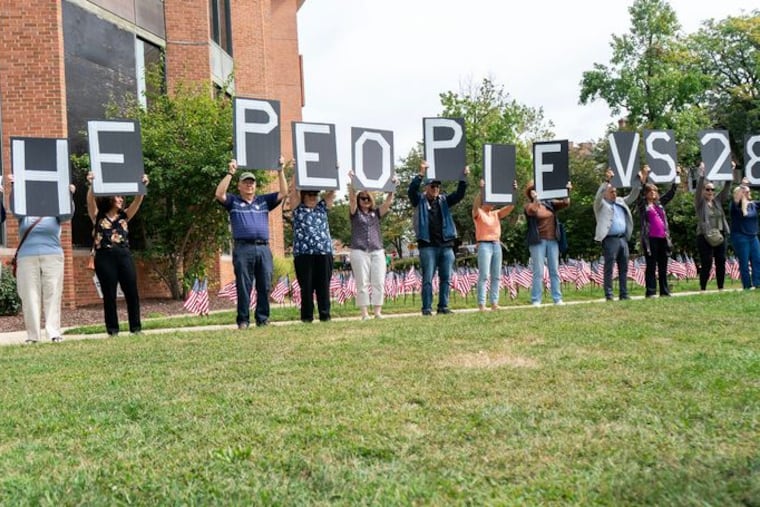
That’s why so many people at the University of Pennsylvania — where I teach — are up in arms about the Trump administration’s effort to compel the university to identify Jewish students and employees. It’s part of an investigation of antisemitism on campus by the Equal Employment Opportunity Commission, which issued a subpoena demanding the names and contact information of members of Jewish-related student groups, staffers at the school’s Jewish studies program, and anyone who had filed an antisemitism complaint.
Fortunately, Penn said no. The EEOC sued the university back in November for refusing to comply with the subpoena. And last week, several groups at Penn filed their own motion in the case. “Compiling and turning over to the government ‘lists of Jews’ conjures a terrifying history,” they wrote.
Indeed, it does. Going back to the Middle Ages, state officials have tried to establish who is Jewish. And it never ends well.
In 1215, Pope Innocent III decreed that Jews must wear markers at all times that made them distinguishable from Christians. Two years later, in England, King Henry III ordered male Jews to wear a badge on the front of their outer garments.
In England, the badge was shaped like the tablets upon which Moses — according to the Old Testament — received the Ten Commandments. In France, it was a circle of red or yellow felt. Hungarian Jews had to wear red capes. And in German-speaking parts of Europe, Jews were required wear a cone-shaped Judenhut, or “Jew’s Hat.”
The goal of these rules wasn’t simply to identify Jews; it was to segregate, humiliate, and persecute them. Jews wearing badges were mocked by children and attacked by bandits. Badge laws also led to extortion: To receive exemptions from the laws, Jews had to pay large sums to the state.
The goal of these rules wasn’t simply to identify Jews; it was to segregate, humiliate, and persecute them.
In the so-called Jewish Emancipation era of the 18th and 19th centuries, when Jews finally received citizenship in the nations where they lived, badge laws disappeared. But they returned with a vengeance in the 1930s and 1940s, when the Nazis required Jews in Germany and the territories it conquered to wear yellow stars.
That helped facilitate their deportation and murder in concentration camps, where a new set of markers developed. Jews who were also political prisoners wore a red triangle, superimposed on a yellow one; gay Jews were identified by the pink triangle, which was later adopted by LGBTQ+ activists as a symbol of pride.
And Jewish camp prisoners often received tattooed numbers on their arms. Again, that was a way to degrade Jews as well as to identify them.
“My number is A-10572. That is what I was, they did not call us by our names,” recalled Holocaust survivor Lilly Ebert, whose TikTok video about the Auschwitz death camp went viral in 2021. “We were no longer humans. We were only a number, and we were treated like numbers.”
Since then, every state effort to count or list Jews has reflected disdain for them. Convinced that Jews at the Bureau of Labor Statistics were altering employment statistics to undermine him, President Richard Nixon ordered aides to find out how many BLS workers were Jewish. “The government is full of Jews,” Nixon fulminated in a taped 1971 White House conversation. “Most Jews are disloyal … You can’t trust the bastards. They turn on you.”
» READ MORE: Please, Penn — stand up to the Trump administration this time | Jonathan Zimmerman
An aide scrutinized the BLS employees’ names — never a perfect way to figure who is Jewish — and concluded that 13 of 35 fit the “demographic criterion that was discussed,” as he delicately reported. Less than two months later, two Jewish senior officials were removed from their posts and demoted to less visible positions in the agency. That was “the last recorded act of official antisemitism by the United States government,” as political commentator Tim Noah wrote.
Forcing Penn to cough up a list of Jews would be the next one. It doesn’t matter that it comes as part of a Trump administration investigation of antisemitism. Frankly, I doubt a president who welcomed Holocaust denier Nick Fuentes to his home for dinner — and who still refuses to criticize him — cares very much about the safety of Jews on campus.
But even if he does, that’s no reason to count them. When the government does that, it isn’t fun anymore. It’s game over.
Jonathan Zimmerman teaches education and history at the University of Pennsylvania. He is the author of “Whose America?: Culture Wars in the Public Schools.”