Trump’s Mideast peace deal is high on hoopla, vague on critical details
The president must heed moderate Arab leaders if his plan is to save hostages and Gaza civilians, and advance Middle East peace.
In a week when Donald Trump openly declared war on the “enemy within” — meaning anyone who disagrees with his edicts, from blue city mayors to generals to judges to universities to media — we all could use a glimmer of hope in the wider world.
Perhaps, just perhaps, we may have one, as Hamas agreed Friday to release all Israeli hostages, living and dead, “according to the exchange formula contained in President Trump’s proposal, and as the field conditions for the exchange are met.”
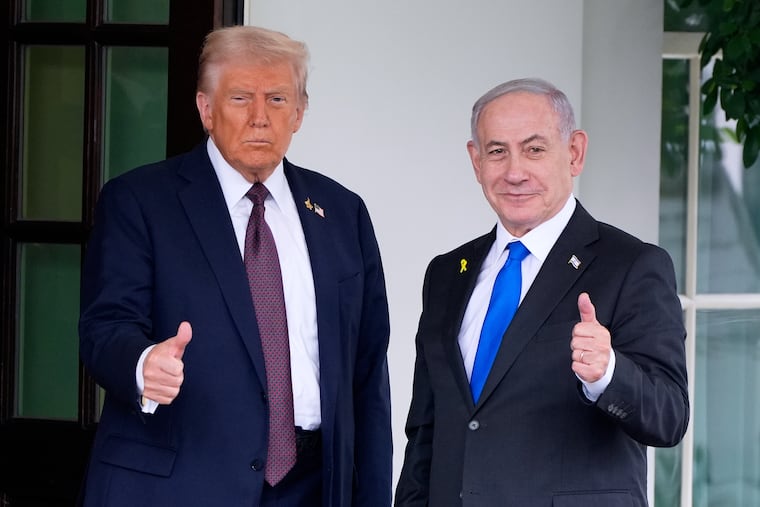
The reference, of course, is to the 20-point peace plan Trump put forth on Monday, standing alongside Israeli Prime Minister Benjamin Netanyahu.
Like so much of Trump’s foreign policy, his plan is high on hoopla but vague on details, and often fantastical in its aspirations. In reality, almost every point will require intense negotiations, including details of returning the hostages.
Most importantly, the moderate Arab states, on whom Trump is relying to squeeze Hamas and fund the project, feel double-crossed by his negotiators and want some points revised.
Yet Trump released his plan as a take it or leave it proposition, declaring “we’re beyond very close [to] eternal peace in the Middle East.” In a celebratory video after the Hamas announcement, he exulted as if peace could be achieved simply by putting words on paper.
Trump’s call on Friday for Israel to stop the bombing is welcome. But in truth, much more U.S. pressure and hard work by the White House is required for any forward movement.
However, Hamas’ offer, no matter its sincerity, may be the best chance to get the Trump peace plan off the ground.
That’s because it opens the door to clarifying many murky provisions in his proposal — clarifications that can help get the Gulf Arabs more firmly on board, which is required for any peace plan to have a chance.
Right now the plan is so full of loopholes that either Hamas or Israel could easily derail it.
The clearest of the 20 points call for an immediate end to the war once both sides accept the proposal, after which all Israeli hostages, alive or dead, are returned.
Then Israel will supposedly release Palestinian prisoners, including 250 with life sentences. (If the Israeli government gets all the hostages back, Netanyahu has already hinted Israel might renege on subsequent steps as it did on the second phase of a previous deal in 2024.)
Hamas is then supposed to surrender, disarm, and receive amnesty or go into exile, leaving Gaza to be temporarily governed by a committee of “apolitical” Palestinian technocrats, supervised by an international “Board of Peace” chaired by Trump (with an assist from former British Prime Minister Tony Blair). A very Rube Goldberg-like structure which is difficult to imagine being put into practice.
For Hamas to comply, the key enforcers will be Qatar, Saudi Arabia, and the United Arab Emirates, and Turkey, along with Jordan and Egypt. But they were furious at Trump’s bait and switch tactics to win Israel’s tentative approval for the deal.
Seeking a swift and simple triumph, the president agreed to one set of 21 points with Arab allies, then radically revised it during a last-minute meeting with Israeli negotiators without forewarning Arab leaders.
The Gulf Arabs had accepted a heavy responsibility for Gaza’s future based on three conditions, according to Nimrod Novik, an Israel Policy Forum fellow, and longtime Israeli peace negotiator, with strong Arab contacts.
“These [conditions] were a complete Israeli withdrawal, a clear role for the Palestinian Authority from the outset, and a credible Israeli commitment to a future two-state solution,” Novik told me by phone from Jerusalem.
“But during the negotiations, in the lead-up to the White House ceremony, Netanyahu managed to dilute those Arab conditions by making [Israel Defense Forces] withdrawal unbinding, PA involvement remote and uncertain, and the terms for Palestinian statehood obscure.”
This latest version leaves open the possibility for long term Israeli occupation of Gaza. It also gives short shrift to any form of Palestinian self-determination in the future, even if Hamas accepts defeat.
If they are going to play their part, moderate Arab and Muslim leaders insist that, after Hamas’ demise, there must be a political future for West Bank and Gazan Palestinians. Otherwise, the fighting will never stop.
Unless the text is revised, they are unlikely to press Hamas to lay down arms, demilitarize, and adhere to all the plan’s provisions for a path to peace.
In a statement, Gulf foreign ministers along with counterparts from Pakistan, Turkey and Indonesia, made clear they want to return to the original text they agreed upon with U.S. negotiators.
At the moment, Hamas is only offering to deal with the initial points. It has called for negotiations via mediators over hostage release details and also said it is willing to hand over administering the Gaza Strip to “a Palestinian body of independent technocrats, based on Palestinian national consensus and Arab and Islamic support.”
But Hamas’ offer provides Trump with a breather to reconfigure some of the sticking points that will block any permanent peace.
The current plan virtually rules out any role for the Palestinian Authority, which is recognized globally as the Palestinian leadership, but despised and undercut by the Israeli government — even though it has long combated Hamas.
The Palestinian Authority might have a role, after it has “completed its reform plan,” says the ninth point, but leaves out who would define when it has done so. Israel has categorically rejected any PA role. And there is little incentive for the PA to make critical reforms if Israel bans it from any governance role.
Nor is there any clear definition or any timeline for when or whether Israel Defense Forces will withdraw and hand over security to the proposed international force. In fact, although it states otherwise, loopholes in the current text leave open the prospect for permanent Israeli occupation.
And there is only the vaguest hint, in point 19, that conditions “may” emerge someday “for a credible pathway to Palestinian self-determination and statehood.” That prospect is effectively left entirely to Israel, and Netanyahu firmly ruled it out last week.
Even when it comes to humanitarian aid, the plan is murky, as the need grows more desperate. Upon acceptance of the deal, “full aid” is supposed to be sent into Gaza, with its distribution controlled by “the United Nations and its agencies or the Red Crescent,” but not by groups associated with either Israel or Hamas.
However, in recent months, Israel banned any involvement by U.N. agencies and insisted on controlling aid distribution itself, which has exacerbated the current famine. There is no clarity in the deal on whether Jerusalem would be willing to change course.
“The only thing that can be said for sure [about this deal] is that Netanyahu received a huge gift from Trump,” wrote Raviv Hecht in Haaretz on Thursday. That’s because the Israeli leader likely believes Hamas will reject most of the deal, thereby lifting international pressure on Jerusalem.
Netanyahu has left the door open for continuing the war. On Monday, he proclaimed, “If Hamas rejects your plan Mr. President, or if they supposedly accept it and then basically do everything to counter it, then Israel will finish the job by itself.”
However, now that Hamas has said, “Yes, but …”, backed by moderate Arab states seeking revisions, Trump is put in a hot spot.
The president has always preferred performance to taking on the hard stuff. But securing a hostage release, the demise of Hamas, and an end to the Gaza war, will require him to press both sides, and make a long term commitment to his peace project.
Failure to do so is likely to lead to another bloody Mideast failure, not a Nobel Peace Prize.