Europe now holds the flickering torch of Western democracy, while the Trump team pushes to extinguish it
The White House presses Germany to include the neofascist, antisemitic AfD party in government, while encouraging extremist parties across Europe.
After World War II, the United States and its allies occupied West Germany and helped its post-Nazi leaders build a successful democracy out of the ruins of fascism.
What a difference 80 years makes.
In an astonishing role reversal, German leaders, along with those of Denmark, the Baltics, Poland, and other European allies, have become the global defenders of liberal democracy — meaning free elections, free press, and free speech. Meantime, the White House embraces extremist far right parties across Europe, including in Great Britain and France.
Yet nowhere is this mind-bending shift as stunning as in the continuing White House slander against the democratic government of Germany, long one of America’s closest allies.
The Trump administration is demanding that Germany’s governing parties welcome the unapologetically neofascist Alternative für Deutschland party (known as the AfD) into their coalition government. The new U.S. National Security Strategy labels the German government’s refusal to do this as a “subversion of democratic processes.”
This Trumpian newspeak about Germany — to use George Orwell’s term for the distorted terminology of authoritarians — reveals an indifference to (or ignorance of) history that endangers not only Europe but the United States.
After the Nazis’ defeat, the Allied occupation of West Germany (which lasted until 1955) focused on rebuilding the German economy, and building democratic governing institutions; it was aided by German opponents to Adolf Hitler who returned from exile.
» READ MORE: New U.S. National Security Strategy slams Europe as greater threat than Russia or China | Trudy Rubin
Given that history, Germans have been very sensitive to any hint that neofascist parties could rise again and take power in their country.
“It is important to understand,” I was told by Anna Sauerbrey, the foreign editor of Die Zeit newspaper, “that Germany has a tradition of noncooperation with [such] parties and right-wing extremists. We have legislation and a domestic intelligence agency whose job is to monitor anything of danger to our constitutional values.”
Following a multiyear investigation, German intelligence formally classified the AfD as a “proven right-wing extremist” organization, which is a main reason why other parties refuse to join with it in forming coalition governments.
Moreover, the phrase “never again” — born out of the Holocaust — has deep meaning to older West Germans. I have met Germans who volunteered to work in Israeli kibbutzim in the 1960s and ‘70s as a repudiation of the beliefs of their parents or grandparents, and have heard the term “never again” repeated fervently by German politicians over decades.
The German school system still teaches civic education, including basic knowledge of democratic institutions and rule of law, along with the bleak history of Hitler’s fascism. Would that American schools did the same.
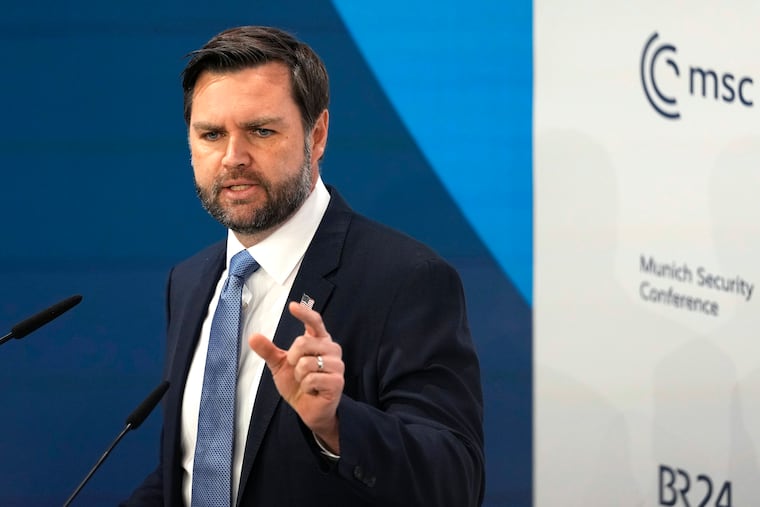
As for the AfD, far from being suppressed, as the Trumpers charge, the party is free to run for local, state, or federal office and make its voice heard in the press. In March, at the Munich Security Forum, where Vice President JD Vance was spewing charges of German censorship of free speech from the stage, Sauerbrey told me she had just run her interview with AfD leader Alice Weidel in Die Zeit, along with those of other candidates.
In other words, the party is free to operate but other parties observe an informal “firewall” against aligning with it. That is because of the extremism of the party that the White House chooses to embrace.
“It is important for Americans to understand what the AfD stands for, and why it becomes so disturbing to have any American suggest to Germans that they should be more open to the AfD,” I was told by the former U.S. ambassador to Germany and former president of the University of Pennsylvania, Amy Gutmann. “The AfD is an antisemitic party that loves Russia and hates the United States.”
Some examples of the AfD’s antisemitism: Leading AfD figure Björn Höcke called the “Memorial to the Murdered Jews of Europe” in Berlin a “monument of shame” and demanded a “180-degree turn” in Germany’s culture of remembrance of Nazi crimes. Alexander Gauland, a cofounder of the party, infamously called Hitler’s crimes “a speck of bird poop in more than 1,000 years of successful Germany history.” Last year, a leading AfD candidate for the European Parliament insisted that not all members of the Nazi SS paramilitary (responsible for rounding up and exterminating Jews) were criminals.
AfD party leaders keep doubling down on such antisemitic rhetoric, unwilling to expel well-known figures who propagate it.
It is true that the party won 20% of the vote, coming second in parliamentary elections in March. Its rise is partly due to its strong, virulently nativist campaign against immigrants, calling for mass deportation. This endears it to the White House, even though the current German government has sharply curtailed immigration.
The party’s rise has come predominantly in the former communist East Germany, which has never fully caught up economically with the western part of the country since unification. East German bitterness contributes to the AfD tally, as does the fact that decades of Soviet rule never instilled in East Germans a sense of responsibility for Hitler’s crimes.
» READ MORE: The question Trump and Hegseth won’t answer: Why is that flotilla in the Caribbean in the first place? | Trudy Rubin
But no matter the AfD’s tally, the German electoral system has no requirement that any party must form a coalition with any other party in building a majority in parliament. “German parties are consistent in holding a firewall against aligning with the AfD, whose antisemitic, white nationalist values are inconsistent with ours,” said Gutmann. “Yet the administration is pressuring Germany to let down its guard.”
No doubt that’s because Donald Trump and his team share the AfD’s values.
After his pro-AfD speech in Munich, Vance made a point of visiting party leader Weidel, but no other German political leader. Elon Musk called the AfD Germany’s “best hope” when he attended one of its national campaign rallies in January.
More recently, senior AfD leaders have been courting eager MAGA supporters on trips to the U.S., building on a growing alignment of interests. On Saturday one of the AfD’s leaders was honored at a gala held by the New York City-based Young Republican Club. The club issued a statement earlier this year calling for “a new civic order” in Germany and declaring “AfD uber alles" (meaning AfD above all), a play on a phrase associated with the Nazis.
Secretary of State Marco Rubio has said the party’s classification as extremist was “tyranny in disguise” and urged Germany to “change course.”
Thus, we have the Trump team and MAGA acolytes praising an antisemitic German party that downplays Hitler’s crimes and echoes Russian talking points, while Germany holds the line on democracy and the values it absorbed from the United States after World War II.
Too few Americans are aware of the growing MAGA links to neo-fascist political parties in Europe. They should serve as a warning to those in our country who still deny the acute danger of the anti-democratic values the Trump team is promoting at home.
