A win-win for Parker and Council brings $800 million housing spending plan closer to reality | Shackamaxon
Plus: Controversy over burning trash, the state Supreme Court rules in favor of the Chester Water Authority, and the weekend’s snowpocalypse may land kids in Zoom school.
This week’s Shackamaxon covers the return of City Council, an update on the water wars, and the weekend’s potential snowpocalypse.
Closer to H.O.M.E.
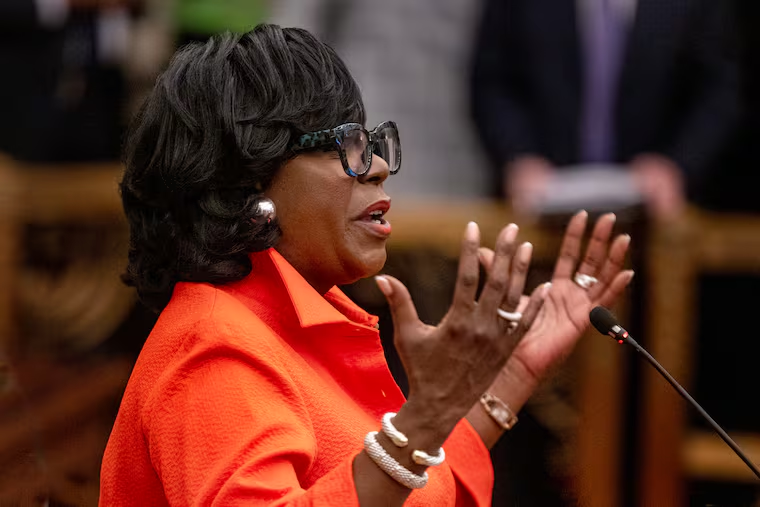
Both City Council and Mayor Cherelle L. Parker are calling the compromise agreement on the $800 million housing spending plan a win.
For councilmembers, the Housing Opportunities Made Easy, or H.O.M.E., proposal was altered to prioritize households at the bottom of the income scale, their main demand throughout the process. For the mayor, Council has approved her signature proposal and done so without significant alterations. That means the city will borrow and spend the first tranche of money soon.
Frankly, I’m surprised the income limits for just two of the dozens of programs included in the initiative became such a source of contention. Council is right that the neediest should be prioritized, while the mayor is correct in saying that raising the limits is unlikely to create a flood of interest that will squeeze out lower-income homeowners.
If a house needs modification to facilitate a resident’s physical needs, or has one of the qualifying repairs (like a major roof leak) for the Basic Systems Repair Program, most homeowners with means will address the problem as soon as they can — even if it means spending their own money. Getting help from the city can take months. That’s a lot of time to deal with a leaking roof, crumbling joists, or an inability to access your entire home.
Perhaps the argument suited both sides. For the mayor, arguing with Council about income limits meant not arguing about whether borrowing nearly a billion dollars for her housing initiative is a good idea. It also meant new concepts like One Philly Mortgage or the property-based Shallow Rent Program mostly went unscrutinized. For councilmembers, it was an opportunity to demonstrate their compassion and score a win over a mayor who doesn’t like to lose.
Burning desire
The biggest controversy during Council’s first session of the year was whether or not the city should continue sending trash for incineration at the Reworld Delaware Valley Resource Recovery Facility.
Chester residents and 3rd District Councilmember Jamie Gauthier want the city to stop a practice they view as unneighborly, blaming Reworld for poor air quality and medical issues. Reworld says incineration is better than the alternative: landfills. Both options lead to increased local emissions. Which one is considered worse often depends on whom you’re talking to.
One way to reduce the impact of the city’s trash would be to begin a municipal pilot program for composting. While many residents utilize composting services, extending access could lead to a significant reduction in waste. This would mean less impact on the environment and local communities, no matter which option the city ultimately chooses.
Water wars
The Pennsylvania Supreme Court ruled in favor of the Chester Water Authority, a win for advocates of publicly owned water utilities. The financially distressed Delaware County city had claimed ownership of the authority and its assets, based on the fact that it had originally established the agency decades ago. In the meantime, however, the coverage area has spread, even including much of neighboring Chester County.
Despite this, the state-appointed receiver for the city of Chester came to see a sale of the authority as a way to rebalance the books. Chester has been under state supervision since 1995 and was placed into receivership by former Gov. Tom Wolf in 2020. When Aqua America offered more than $400 million for the authority, it was hard for the city, which has around $500 million in liabilities, to refuse — even when the authority’s board opposed the deal.
The court’s ruling ends the push to privatize the authority, which is a win for ratepayers, especially the many who don’t live in the city but still rely on the authority for water. But it leaves Chester City in need of another way out of its long municipal nightmare.
No Zoom school
With Philadelphia expected to receive a huge helping of snow this weekend, I think it is worth reminding regional school administrators that kids deserve better than Zoom school.
Weather models that are much more accurate than the ones they used back in John Bolaris’ day are predicting a foot or more of snow. That could be enough to make getting to class on Monday unrealistic, especially given how many teachers travel in from the suburbs.
Losing a day of school is a challenge, but it doesn’t justify forcing kids to spend the day on their laptops, especially given the growing body of evidence showing that digital learning tools simply aren’t as effective. The National Assessment of Educational Progress test scores, often called the Nation’s Report Card, show that students have regressed across the board, erasing decades of progress.
This decline roughly correlates with the explosion of technology in the classroom. Additionally, children’s behavior worsened overall during the pandemic, with some researchers blaming the shift to screens. UNESCO went as far as to blame it for increasing educational inequality.
Psychologist Jonathan Haidt wrote a book called The Anxious Generation, which blames a surge in screen time (including for school) and a severe curtailment of unstructured free time for growing teenage anxiety.
Sadly, too many adults who grew up in a time when children were allowed more freedom and spontaneity keep imposing policies on kids that leave them with less of both.