Masks don’t belong on ICE agents — or on campus
An incident involving mask-wearing demonstrators at Haverford College earlier this month should force a reexamination of campus policies.
When was the last time you changed your mind?
That’s one of my favorite questions to ask students. I want them to scrutinize their most deeply held beliefs. When you do that, I tell them, you sometimes find out you don’t believe them any longer.
A few weeks ago, a student put the same question to me. I thought about it for a few days, and then I came back with my answer: I changed my mind about protesters wearing masks on campus.
I used to think they should be allowed to cover their faces, and that it was a mistake for universities to prohibit them from doing so. But I think differently now.
And my reason has three letters: ICE.
Like many other Americans, I’m appalled by the presence of masked agents from U.S. Immigration and Customs Enforcement on our streets. Even before they killed two protesters in Minnesota, I was afraid of them. Now, I’m terrified.
And I’m proud of Democrats in Congress for demanding that ICE agents be prohibited from wearing masks that hide their identities. Blocking a GOP spending bill that lacked any new curbs on ICE, the Democrats forced a partial shutdown of the federal government over the weekend. They should hold out until the mask ban is in place.
I also support a proposed City Council measure that would block law enforcement officers in Philadelphia — including ICE agents — from obscuring their identities with facial coverings.
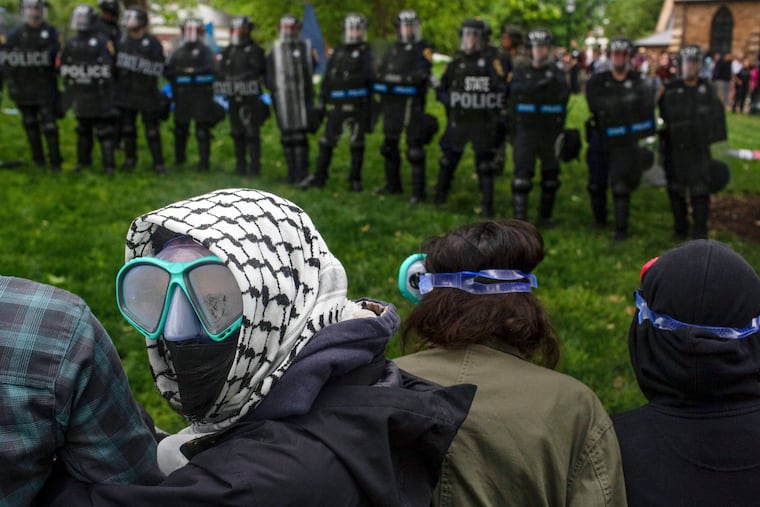
But now I believe campus demonstrators — like ICE agents — should also be barred from wearing masks. Their facial coverings stoke fear, too. And they make it next to impossible for officials to keep everyone else safe.
If you think otherwise, consider what happened at Haverford College earlier this month. Interrupting a talk by a pro-Israel speaker, several masked demonstrators burst into the room. One of them shouted into a bullhorn that “Israeli occupation forces” were killing children. “When Gaza is burned, you will all burn, too,” she said.
Most universities already have rules barring disruption of public events. But masks add something worse: intimidation.
When the masked protesters entered the room, a Haverford professor said he thought they were “terrorists trying to get in and kill us.” Another witness said she worried she might be attacked.
“No one knew who they were or whether they were armed,” the witness added. “Imagine fully masked people entering through emergency exits, hiding objects under their coats, blocking basic points of egress. It is reasonable to fear for your physical safety.”
And it’s also reasonable for colleges to ban masks. In a statement, Haverford officials said the protester carrying the bullhorn was not a member of their community. But nobody could know that when she entered the room.
How can we keep the university safe if we don’t know who is from the university and who isn’t?
At the University of Pennsylvania, where I teach, only nine of 33 people arrested during the clearing of pro-Palestinian encampments in May 2024 were students at the university. At Swarthmore, just two of nine arrested demonstrators were members of the college community.
I opposed the disbanding of the Penn encampments back then, and I still do. I also opposed the university’s new guidelines on open expression, which prohibited protests that “threaten or advocate violence” against “individuals or groups” on the basis of their race, religion, national origin, or sexual orientation. Under that rule, the Haverford protester’s comment about Gaza — “you will burn, too” — might be banned.
It shouldn’t be. We need a free and open dialogue about Israel, and everything else. And that’s also why we should ban masks, which inhibit that same dialogue. You can’t have a conversation if you don’t know who is talking.
I used to think masks were a form of free expression, so universities should allow them. I also thought protesters needed to hide their identities so they wouldn’t get doxed, which would subject them to violence and harassment.
You can’t have a conversation if you don’t know who is talking.
Then the Trump administration said the same thing about ICE agents — they need masks to protect them from doxing — and I changed my mind. Regular police officers don’t wear masks; instead, they wear numbers and name tags. That’s how we hold them accountable for their actions.
Putting masks on ICE agents does the opposite: It lets them act with impunity. The goal of the masks is not to protect the agents. It’s to foster fear in our communities and our nation.
They need to take their masks off. But so do we.
Of course, we should make exceptions for people who cover their faces for reasons of health, religion, sports, or entertainment. I’d hate to see a college kid barred from wearing a Halloween mask, for example.
But a protester? Let us see who you are. Don’t cower behind a mask. That’s what ICE does.
Jonathan Zimmerman teaches history and education at the University of Pennsylvania. He is the author of “Whose America?: Culture Wars in the Public Schools.”