Philly City Council members will soon consider seven ‘ICE Out’ bills. Here’s what the proposals would do.
Several of the bills coming before Philadelphia City Council could face legal questions, such as whether banning officers from wearing masks is constitutional.
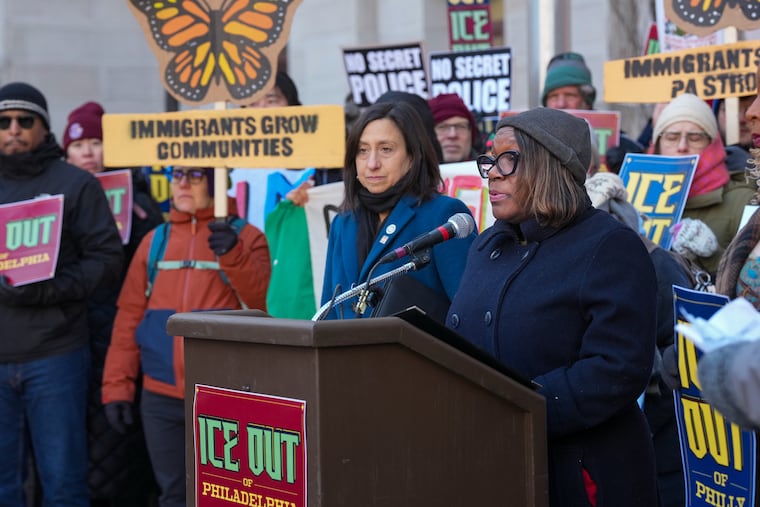
City Councilmembers Kendra Brooks and Rue Landau on Thursday plan to formally introduce their “ICE Out” legislative package, which aims to place restrictions on federal immigration enforcement operations in Philadelphia.
The seven bills range from codifying into law Philadelphia’s existing “sanctuary city” policies to a controversial ban on law enforcement officers wearing masks. Almost all of the bills contain exceptions noting that they do not apply if Immigration and Customs Enforcement agents secure judicial warrants for their activities or are acting under superseding federal laws.
If all of the legislation becomes law, Philadelphia would have some of the nation’s most stringent local restrictions on federal immigration-enforcement operations.
» READ MORE: Philly lawmakers want to restrict cooperation with ICE and ban agents from wearing masks
It’s likely that several of the bills will face legal questions, such as whether the mask ban is constitutional and whether Council has the authority to enact some of the rules the proposals seek to establish.
After the bills are introduced Thursday, Council President Kenyatta Johnson will refer them to committee. One or more hearings will likely be scheduled in the spring.
At that point, officials from Mayor Cherelle L. Parker’s administration, stakeholders, and experts will testify. Lawmakers could then amend the bills and vote on them in committee. If they advance, they would head to the Council floor for a final vote.
In a sign that the bills are likely to gain traction, Majority Leader Katherine Gilmore Richardson on Wednesday praised Brooks’ and Landau’s efforts.
“My heart breaks for everyone who has been impacted by ICE’s violent and dangerous actions and for everyone who feels afraid and unsafe in their communities,” Gilmore Richardson said, adding that she will work with other Council members “to protect our residents.”
If approved on final passage, the bills would head to Parker’s desk. The mayor can veto them, sign them into law, or allow them to become law without her signature.
Parker so far has largely avoided confrontation with President Donald Trump’s administration over his aggressive deportation campaign. The “ICE Out” bills may force her to engage more directly.
Here’s what you need to know about each of the bills.
Banning ICE agents from wearing masks
Author: Brooks.
Key excerpt: “A law enforcement officer is guilty of criminal concealment if the law enforcement officer, while performing official duties and interacting with the public …. wears a mask, facial covering, disguise or any other garment that obscures the identity of the law enforcement officer, or fails to identify themselves to a subject of arrest, holding or detention."
What it does: The bill would ban law enforcement officers from obscuring their identities with masks. It also would require officers to wear badges, and would make it an offense to conceal badges or to decline to provide identifying information if requested by people they are arresting. Additionally, the bill would ban officers from using unmarked vehicles.
Exceptions: The bill includes exceptions for undercover assignments, medical or religious masks, SWAT teams, and smoke-filtering masks worn during fires or similar emergencies.
How it would be enforced: The district attorney would be able to charge an officer with a summary offense, the lowest level of crime in Pennsylvania. If found guilty, the officer would pay a fine of $300 for each day the law was violated or face up to 90 days in prison.
Additionally, the bill would give any individual “aggrieved by a violation” the right to sue an agent for wearing a mask, with fines up to $2,000 per offense if a judge sides with the plaintiff.
Twist: This bill applies to all law enforcement officers, not just ICE agents. That includes city police. It is likely that the Philadelphia Police Department, which sometimes uses unmarked cars, will have something to say about the proposed rules once the bill gets a committee hearing.
» READ MORE: DA Larry Krasner forms coalition of progressive prosecutors committed to charging federal agents who commit crimes
Stopping Philly from coordinating with ICE
Author: Brooks.
Key excerpt: "No City Agency or Employee shall enter into, renew, or participate in a 287(g) Agreement with the federal government."
What it does: The primary objective of this bill is to ensure the city never enters into a 287(g) agreement, in which local law enforcement officers are trained to perform immigration enforcement duties. (The agreement refers to a section of the U.S. Immigration and Nationality Act.) Philadelphia is not currently in a 287(g) agreement, so that provision would not have a significant impact in the near term.
But the bill includes several other notable provisions, such as prohibiting city employees from assisting immigration enforcement in any way, and requiring them to report requests to assist ICE to their superiors.
How it would be enforced: The city solicitor, Philadelphia’s top lawyer, would be responsible for suing city agencies or employees who violate the bill’s provisions. Potential consequences include a $2,000 fine and termination.
Prohibiting discrimination based on immigration status in city services
Author: Landau.
Key excerpt: “No City agency, official, employee, contractor or subcontractor shall …
“request information about a person’s citizenship or immigration status …
“condition the provision of City benefits, services, or opportunities on a person’s citizenship or immigration status or national origin …
“threaten, coerce, or intimidate a person based on their actual or perceived citizenship or immigration status [or] …
“initiate an investigation or take law enforcement action based on a person’s actual or perceived citizenship or immigration status.”
What it does: This bill aims to protect individuals from being treated differently based on their immigration status when dealing with city government services.
How it would be enforced: The city solicitor or anyone aggrieved by violations of the bill would be able to sue the offending city employee or agency.
» READ MORE: What are your rights if ICE comes to your home or work?
Banning employment discrimination based on immigration status
Author: Landau.
Key excerpt: “It shall be an unlawful employment practice to deny or interfere with the employment opportunities of an individual based upon … citizenship or immigration status.”
What it does: The bill would add “citizenship or immigration status” to Philadelphia’s Fair Practices Ordinance, which prohibits employers from discriminating against workers based on characteristics including race, ethnicity, gender, and sexual orientation.
How it would be enforced: If the bill is approved, Philadelphians who feel their employers have discriminated against them based on their immigration status will be able to file complaints to the Philadelphia Commission on Human Rights, which adjudicates alleged violations of the Fair Practices Ordinance.
Withholding data on citizenship and immigration status
Author: Landau.
Key excerpt: “No City agency … shall enter into any contractual agreement or arrangement with a federal agency or federal contractor to provide access to any data, database, or dataset where the purpose of such access includes assisting or supporting immigration enforcement operations.”
What it does: This bill aims to prevent the federal government from accessing city data that could help immigration agents determine individuals’ citizenship status.
It also would require the city to produce an annual report tallying federal data requests related to immigration status and any violations of the bill.
How it would be enforced: The city solicitor or any individual aggrieved by violations of the bill would be able to sue the offending city employee or agency.
Prohibiting immigration enforcement on city-owned property
Author: Brooks.
Key excerpt: "It is unlawful to use City-owned or controlled property for the purposes of staging, conducting or assisting federal immigration enforcement activities."
What it does: The bill prohibits immigration enforcement operations on city-owned land, such as federal agents making arrests in city parks or ICE staging raids on municipally owned parking lots.
The bill also allows city agencies to post signs on municipal property stating: “This property is owned and controlled by the City of Philadelphia. It may not be used for immigration enforcement activities.”
How it would be enforced: The city solicitor may file a lawsuit to ask a judge to order the federal government to cease and desist from using city property.
Requiring warrants for nonpublic areas of ‘Safe Community Spaces’
Author: Brooks.
Key excerpt: "No employee or agent engaged in official duties at a Safe Community Place shall have the authority to consent to permitting a law enforcement officer to enter a nonpublic area of the facility … to identify, arrest or otherwise impose a penalty upon a person for purposes of federal immigration enforcement."
What it does: The bill would effectively require immigration agents to secure judicial warrants to access nonpublic areas in “Safe Community Spaces,” including city-owned or -controlled hospitals, libraries, courthouses, recreation centers, and other city facilities. Currently, agents can access those areas if they get permission.
The proposal also would also require judicial warrants for instances in which law enforcement seeks access to nonpublic areas “to identify or impose civil or criminal liability upon a person" exercising protected rights such as the freedom of speech, assembly, and petitioning.
Lastly, the bill would require city agencies to “identify property that has been, and is likely to be used by, immigration enforcement" and mark it with signage stating: “In nonpublic areas of this property, a judicial warrant is required for law enforcement activities and no voluntary consent may be solicited from any employee.”
How it would be enforced: Only the city solicitor can sue to enforce the bill’s provisions. Such a suit would not be filed against a federal agent. Instead, it would be filed against a staffer at a “Safe Community Space” who gave federal agents permission to access nonpublic areas at the facility.
Staff writers Anna Orso and Jeff Gammage contributed to this article.