In New Orleans and across U.S., anger over ICE raids sparks a 2nd American Revolution
Everyday folks are rising up to resist immigration raids with whistles, car chases, and noisy protests. Revolution is in the air.
NEW ORLEANS — In a city of frayed nerves over an invasion by more than 200 masked, tactical-gear-wearing federal immigration agents, a chaotic scene suddenly broke out right in front of the altar at First Grace United Methodist Church on Canal Street, just a couple of miles from the Superdome.
Several men identifying themselves as U.S. Immigration and Customs Enforcement, or ICE, agents startled a small group of bystanders, loudly demanding to know what country the people were from. “Are you supposed to be here!?” one yelled. “Do you speak English!?”
Then a gray-haired woman who was just a few feet away moved in between the shouting man and the people he was trying to question, triggering a tense confrontation.
“Ma’am, I’m going to need you to back up,” the man — young, with a beard and shoulder-length hair — barked at the woman. “You are interfering with an investigation. You are interfering with …” As the man stumbled for what else to say, a crowd of about 150 onlookers from the community reacted — with laughter.
That’s because this close encounter between an ICE agent and an aggrieved neighbor last Tuesday night wasn’t the real thing. Not this time, anyway. This was a playacting, casual-dress rehearsal during an emergency training session organized by the immigration rights group Unión Migrante. The activists were planting more seeds for what is rapidly sprouting as the most important American uprising of the 21st century.
It took about 66 hours to go from basic training to frontline action. On Friday afternoon, in a heavily Latino neighborhood near the New Orleans airport, the cartoon-villainous, strutting Border Patrol commander of the Louisiana immigration raids named “Catahoula Crunch,” Greg Bovino, struggled to conduct a sweep through blocks of low-slung apartments.
Word that Bovino and his masked secret police were in suburban Kenner spread quickly on a series of chat groups of activists who’ve played cat and mouse with his agents ever since their op began Wednesday, tailing government SUVs across superstore parking lots and down boulevards lined with strip malls.
Eventually, according to the local newspaper, the Times-Picayune, the caravan of citizen resisters following the agents grew to as many as 30 vehicles, until Bovino-friendly cops from the Kenner Police Department formed a blockade to stop them. That didn’t deter other neighbors who, as captured on video, chased the masked feds across lawns while filming with cell phones and blowing shrill whistles, a signal for immigrants to stay indoors.
On the 70th anniversary of the start of the Rev. Dr. Martin Luther King Jr.-led Montgomery, Ala., bus boycott that announced that era’s movement for Black civil rights, a new and wholly unexpected fight against racism and government tyranny is rising up — not just in the American South, but in cities from Minneapolis to Los Angeles.
It’s a moral crusade so new and so daring that it doesn’t have a name, not yet. But the almost spontaneous spark of grassroots resistance to the Trump regime’s roving immigration raids targeting their brown-skinned neighbors is starting to sound historic echoes.
You can feel the sheltering impulses of the antebellum Underground Railroad, combined with the righteous fervor of 1964’s Mississippi Freedom Summer. I spent much of last week in and around New Orleans, the resiliently rebellious heart of one of America’s reddest states. I watched everyday folks protest on street corners, create “Know Your Rights” pamphlets, and learn how to legally confront masked, armed law enforcement officers. Nearing the end of a year that began with the grim inauguration of authoritarianism, I left here convinced I’d seen the green shoots of a second American Revolution.
Paul Revere hung lanterns. Exactly 250 years later, retirees, pastors, and young activists roam the backwater subdivisions of Jefferson Parish with whistles hung around their necks. And Revere’s “One if by land, two if by sea” has been updated by WhatsApp chat groups. They are guided by what the fiery Unión Migrante organizer Rachel Taber told volunteers who packed the Mid-City church, that “the most dangerous thing we can do now is stay on our couch and do nothing while democracy falls apart.”
What’s so remarkable is that this insurgency is already claiming victories — making it much harder for ICE or Bovino and his green-clad squads to reach their absurd mass deportation goal of arresting one million immigrants in Donald Trump’s first year. The movement’s most dramatic win, arguably, came in Manhattan in late November, when protesters who had been tipped off about a planned ICE raid on Canal Street blockaded their parking garage, preventing their blitz.
But resistance is breaking out everywhere. In Minneapolis this week, a report of an active raid at the home of an East African refugee drew so many protesters so quickly that the agents left, making no arrest. In Charlotte, N.C., the Bovino-led operation dubbed “Charlotte’s Web,” which was also met with widespread community opposition, was abruptly cut short after just four-and-a-half days.
Here in Louisiana, local resistance groups that I monitored shared real-time reports about apparent Border Patrol activity and license plate numbers of suspicious SUVs, even questioning agents parked in store parking lots. When two Latino workers were trapped on a North Kenner rooftop Wednesday, as a Border Patrol sniper trained his rifle on the worksite, an arriving crowd of citizen watchdogs and journalists watched the agents move on without arresting them.
» READ MORE: Life during wartime in New Orleans as feds terrorize Latinos who saved a city | Will Bunch
“I don’t think the Border Patrol agents know what they’re doing coming to New Orleans,” Zoe Higgins, a 32-year-old social worker and volunteer who was one of those who raced to the rooftop standoff, told me. “This is a resilient bunch down here, and we fight fiercely for our own, and that’s what I’m doing. These are my own. These are my neighbors.”
Just about 17 hours earlier, Higgins had been one of the throng who packed the Mid-City church to learn about their legal rights on filming or questioning the immigration raiders. Flanked by gauzy, wall-mounted uplights, Higgins and the other volunteers discussed how to stay safe in tense situations, and how to keep their Latino neighbors out of harm’s way, before heading out into a chilly December night armed with a whistle.
The immigration raid responders were a diverse lot — predominantly white but with a healthy smattering of African Americans, with a strong contingent of retirement-age folks — much like the “No Kings” protests earlier this year — but also young liberals from this Democratic dot in a state that Trump won with 60% of the vote in 2024. Most told similar stories of outrage from watching stories and videos about deportation raids in Chicago or elsewhere, and feeling morally compelled to act.
“You think to yourself, ‘I can’t believe this is happening, and I have to do something,’ and that’s why I came here,” Nancy Condon, 70, a retired college administrator who lives in the city’s Warehouse District, told me after the training session. Condon said she is a friend to a 64-year-old local Iranian woman who’d been living in the United States for 47 years when she was detained by ICE, sparking local outrage. “I know that a majority of the people that are here, whether they are undocumented or not, are here to make a living and are not criminals.”
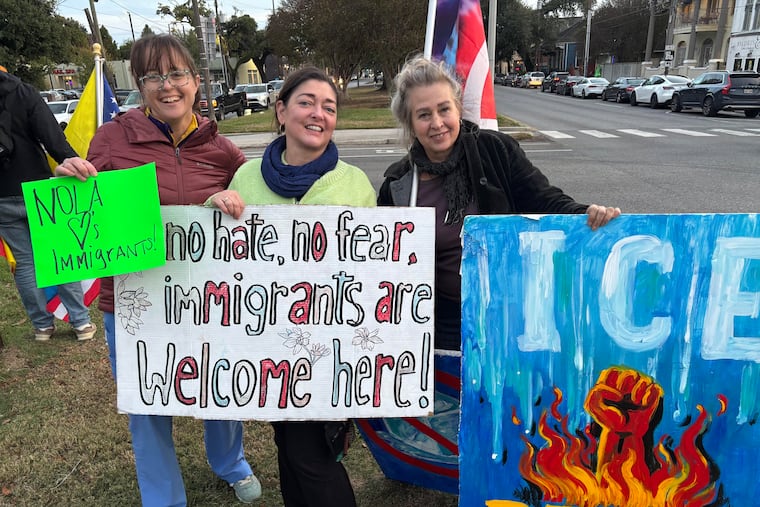
The next day, as news spread that the U.S. Department of Homeland Security’s “Catahoula Crunch” was underway and arrests were being made, about a dozen people gathered in the grassy median on busy Elysian Fields Avenue just east of the tourist-laden French Quarter to wave placards like “NOLA (hearts) Immigrants” and “ICE Resist” that denounced the raids, as passing cars honked their approval.
Jan Livingston, a 71-year-old retired gardener who lives in the neighborhood, sat in the center with her sign, “We Promise to Resist.” She told me she became politically active after Trump was first elected, but that the arrival of the Border Patrol and its targeting of day laborers has taken her outrage to new heights.
After Hurricane Katrina in 2005, she said: “I came back about six weeks later and the Hispanic crews were all singing to the radio and smiling and working their asses off until the sun was gone, in horrible conditions, and living like eight people to a one-room apartment so they could send all their money to their families … They’re beautiful people and a beautiful culture, a family culture.”
The New Orleans resisters told me they are out in the streets to speak for these Latino neighbors who feel forced to stay indoors — missing work or school — to avoid the Border Patrol. After sundown, Livingston and a few others from the protest went to a nearby apartment building. There, about a dozen people connected through the protest group Indivisible NOLA gathered for a session of what might be called revolutionary arts and crafts, folding sheets of paper into tiny “Know Your Rights” magazines in English and Spanish that they’ll be passing out across the city.
“It’s an origami party,” Nora Casserly, the group leader, told the gathering of mostly women as they folded the tiny magazines on a long table splayed with plastic bags, rubber bands, a bowl of grapes, and a bag of gluten-free cookies. The vibe was almost Martha Stewart — except the chatter sounded more like Angela Davis, about the urgency of resisting masked secret police tyranny.
Casserly told them that four short tweets on the whistle means the feds are in a neighborhood, while one long blast means someone is detained. She exhorted them: “Form a crowd. Stay loud.”
If the Indivisible volunteers are the Betsy Rosses of this movement, the rapid response teams and their 24-hour online chats are more like the French Resistance, engaged in a constant manhunt to report when a caravan of SUVs parks at a suburban Walmart or debunking many false alarms. Sometimes they get in the face of Border Patrol officers when they find them — asking who they are and making sure these federal intruders know that the public is watching them.
The results can be powerful. Although dozens of immigrants have been arrested in the sweeps, “Catahoula Crunch” seems nowhere near its announced goal of detaining 5,000 people. The constant citizen watchdogging forces Border Patrol to constantly shift tactics or keep moving to avoid angry crowds. From that rooftop in Kenner to the snowy streets of Minneapolis, citizen action has already spared an untold number of migrants from getting deported to their native countries in shackles.
What’s more, the movement is swaying public opinion and encouraging elected officials to get bolder in their opposition. Here in New Orleans, Mayor-elect Helena Moreno urged transparency from the Border Patrol, demanding that officers remove their masks and wear badges. In Minneapolis, Police Chief Brian O’Hara ordered his officers to intervene against federal agents using unlawful force, adding they’ll be fired if they don’t. This is how revolutions gain momentum.
That’s a palpable feeling in a city that fired its guns and sent the British running at the Battle of New Orleans in 1815, and hears the echoes of modern trailblazers like Ruby Bridges, who walked past the pre-MAGA reactionaries of 1960 as a little girl to integrate city schools.
“So we are taking risks,” Unión Migrante’s Taber told the packed church. “You know, brave men and women sat in at lunch counters on Canal Street” — also in 1960 — “and they took risks, and we are all freer because of that.” Her words sparked a buzz of recognition from the pews, from the people who know it is their turn.
» READ MORE: SIGN UP: The Will Bunch Newsletter