It took U.S. years to lose a war in Vietnam. Trump lost one in days.
It's increasingly clear that Trump's war of choice in Iran has failed spectacularly. America learned nothing from past war failures.

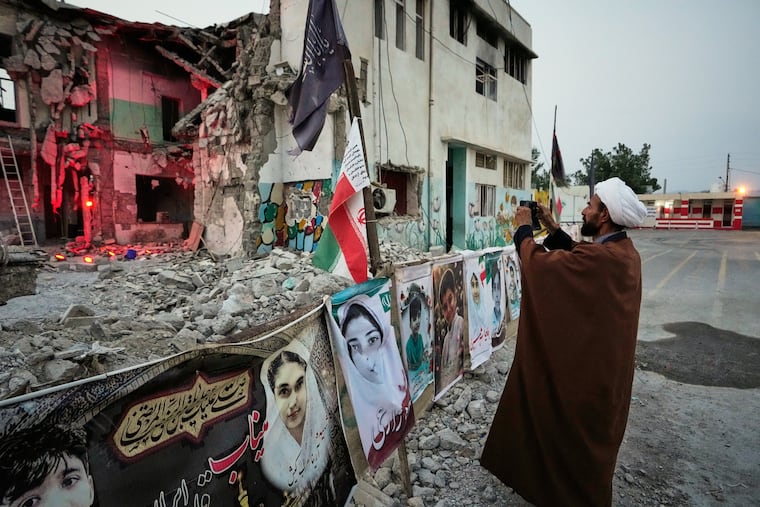
As the U.S.-Israel war of choice against Iran ends a second week and our social media feeds fill with incredible scenes of exploding oil tankers and refineries, the rubble of an Iranian elementary school, and shock prices at American gas stations, I can’t stop thinking about a remarkable piece of television journalism from just over 50 years ago.
Nearly two decades of U.S. involvement in Vietnam and surrounding Southeast Asia — including eight years of active combat with more than 58,000 American troop deaths — had ended in a spectacular defeat when the North Vietnamese rolled into Saigon on April 30, 1975. What’s more, the moral bankruptcy of that war effort meant America’s standing in the world had never been lower.
The legendary then-NBC newsman David Brinkley wrote a commentary on what had just happened, and then went with a camera crew to the rows of headstones at Arlington National Cemetery where so many of the war dead were buried.
“When some future politician, for some reason, feels the need to drag this country into a war, he might come out to Arlington and stand right over there somewhere to make his announcement and to tell what he has in mind,” Brinkley said. “If he can attract public support speaking from a place like this, then his reasons for starting a new war would have to be good ones.”
I seriously doubt that Donald Trump — who avoided fighting in that war by finding a friendly doctor to discover “bone spurs” and called his 1970s efforts to avoid venereal disease in New York’s dating scene “my own personal Vietnam” — ever saw Brinkley’s commentary, or if he did, that it would have mattered.
Needless to say, Trump didn’t travel to Arlington to explain to the nation how the Iran war would require the same sense of purpose and sacrifice that has filled that hillside with the remains of so many young Americans over 250 years. He barely even mentioned the case for attacking a powerful adversary in the Persian Gulf during his State of the Union address just days before the first cruise missile was launched. This president couldn’t even be bothered to seek the congressional approval for war as required by the Constitution.
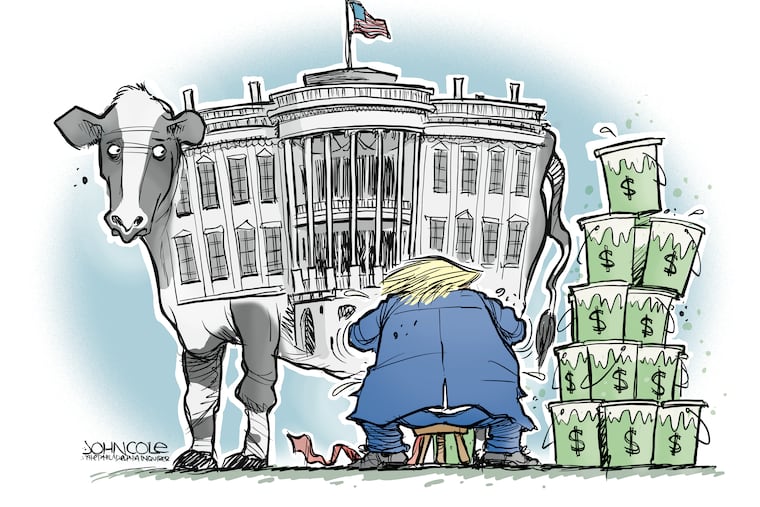
At the start of 2026, the first fully authoritarian president of the United States bragged to the New York Times that he can be restrained only by “my own mind, my own morality.” Now, this autocrat’s “morality” — such as it is — has met its match on the enflamed oil fields and urban rubble of a Middle East ravaged by a regionwide war.
As I write this on Thursday, at least three tankers are ablaze in or near the critical Strait of Hormuz, where Iranian military action has stopped almost all Western oil shipments, and a large oil facility is on fire in Oman, one of several Gulf states dragged into the war. The roller-coaster ride of crude oil — the toxic fentanyl of the world economy — is skyrocketing back up over $100 a barrel. The U.S. government is slowly acknowledging — if not yet apologizing for — the mistakes that sent a Tomahawk missile into a packed elementary school, killing at least 175 people, mostly children.
As Trump travels from golf course to campaign rallies stumbling to justify a war that might only be “a little excursion,” Israeli intelligence reportedly laid out a stark assessment of how this war of choice turned out to be a terrible choice, with virtually zero war aims accomplished.
The long-oppressed Iranian people — whose January protests were murderously put down by the Islamist regime — did not rise up when their top leaders were killed in the opening salvo of the war, and now seem even less likely to do so. The new government appears to be more anti-U.S. and anti-Israel than the old one, and has no interest in “unconditional surrender.” The murky state of Iran’s nuclear weapons program is unchanged from the start of the attacks.
The best possible outcome, it seems, would be to emulate the Vietnam-era maxim attributed (with some misquoting, as always) to then-Vermont Sen. George Aiken that we “declare victory and go home.” If the U.S. had followed that plan in 1966, about 50,000 U.S. lives and countless Vietnamese would have been saved. But the crazy Pandora’s box that Trump has opened in the Middle East may not be so easy to close.
We should still take one lesson from Vietnam. We should face the honest, painful truth. It took America 20 tortured years, an unspeakable death toll, and finally the image of desperate people climbing toward helicopters on an embassy roof to acknowledge the bitter reality that our nation had lost a war.
Today, it’s clear after less than two weeks there won’t even be a premature “Mission Accomplished” banner for Trump’s and Benjamin Netanyahu’s irrational gambit in Iran. Victory is unattainable, and arguably we have lost a war.
Again.
And even if Trump elects the option of what one Israeli official told the Al-Monitor would be an “elegant exit,” it would already be too late for those Iranian first graders, for at least seven dead American service members and as many as 140 seriously wounded, and for hundreds of others from Beirut to Bahrain who gave their lives for a war that neither you, nor I, nor the two despots who started it seem to know what is even about.
My boomer generation was born into the afterglow of U.S. victory in World War II that was arguably the last unambiguously and morally necessary conflict, to defeat Nazi tyranny and halt a mass murder. In our lifetimes, we’ve watched that capital squandered with one “dumb war” after another.
To many citizens who saw family and neighbors come home in body bags, the Vietnam War was almost as incomprehensible then as the Iran war now. A novel with the plaintive title, Why Are We in Vietnam?, was a bestseller for Norman Mailer. The one thing that became clear over time was that the escalation and ungodly length of fighting in Southeast Asia was to project our imperial power to the world, although in the end we only showed our weaknesses.
That Brinkley commentary from Arlington captured a moment of national reflection that was far too brief. Instead of absorbing what seemed like the obvious moral from Vietnam about humility and influencing world affairs through democratic example instead of militaristic bullying, we only took from Vietnam “lessons” about how to better kill foreigners from the sky with less U.S. sacrifice, and with even less honesty to our own citizens.
» READ MORE: The U.S. learned some lessons from the Vietnam War. The wrong ones | Will Bunch
In the middle of life, in 2004, this frustrated boomer turned to opinion writing after conventional journalism had proved no match for the relentless campaign of lying that took us into a disastrous war next door to Iran, in Iraq. But the time for truth and reflection was already long gone.
In a cruel irony, the loss of public trust in government that started in the killing fields of Hue and spiked in the desert quagmire of Fallujah caused Americans to turn to a dictator too lazy to even come up with good fibs this time around. And with no plausible answer to the question, why are we in Iran?
Instead of learning from the obvious mistakes of America’s recent past, we have tossed our history down an Orwellian memory hole. That was clear in an amazing TV moment this week that felt like a bookend to Brinkley’s wise commentary, as Wall Street blowhard Jim Cramer insisted that America could force a reopening of the Strait of Hormuz “if we bomb Tehran into the Stone Age,” as happened to North Vietnam.
It was left to Cramer’s guest, journalist Carl Quintanilla, to point out that North Vietnam then won the war. Indeed, our intentional ignorance of history has finally turned the United States into what Richard Nixon had feared even as he expanded the Vietnam War in 1970: a pitiful, helpless giant.
Congress must not further fund this illegal, losing war, but we need not wait for that. Trump could apply the same gold spray paint that’s vandalized everything else in his White House, give himself another “peace prize,” declare victory and go home. But that requires taking his “mind” and his “morality” to a good place it’s never been before.

Sign up for the Will Bunch Newsletter