Parker’s Land Bank shakeup may lead to more affordable housing | Shackamaxon
In this week’s column, a deep dive into city land sale dysfunction and the continuing budget woes in Harrisburg.
Continued budget delays in Harrisburg are, unfortunately, again part of this week’s Shackamaxon. But first, all you ever wanted to know about the Land Bank (but were afraid to ask), including the mayor’s recent board shake-up.
Running on empty
Ever since Philadelphia lost more than a quarter million residents between 1970 and 1980, blight and vacancy have been a problem. Abandoned, deteriorating homes, schools, and factories provide a convenient staging ground for criminal activity, cost the city millions in annual maintenance, and don’t contribute property taxes to city coffers.
For years, the city struggled to find a way to repurpose this land. While some residents admirably turned lots into community assets like gardens, most of the space sat unused. Some properties languished because potential buyers considered them unprofitable, with expected rents or sale prices that were too low to justify the cost of construction. But other lots were in high demand, drawing interest from developers, nonprofits, and community groups.
Like a deer caught in the headlights, City Council members often opted against selling to anyone.
To shake that inertia, City Council created the Land Bank in 2013. Yet, despite a push from then-Councilmember Maria Quiñones Sánchez, Council did not cede control of land sales. This meant the analysis paralysis continued. So did side arrangements, like when then-Council President Darrell L. Clarke steered city land to a developer through a no-bid process.
Some parcels that were allocated to the Land Bank became the subject of fierce debate. Municipal policy wonks urged Council to sell the most valuable plots as a way to underwrite the city’s subsidized housing efforts. Meanwhile, advocates for affordable housing called for the creation of homes for people at the lowest income levels.
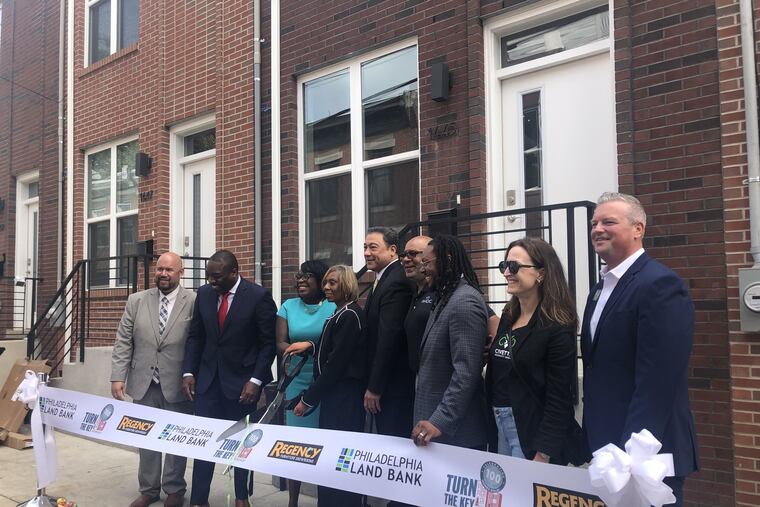
City Council seemingly found common ground in 2022, nearly a decade after the Land Bank was first authorized, with a compromise called “Turn the Key.”
Under the terms of that program, land would go to what’s often called “workforce housing,” available to residents of modest means who earn up to 100% of our area’s median income ($119,400 for a family of four).
This would still come at a cost, mostly the millions of dollars in potential revenue from auctioning off the land, but it did ensure plots would return to productive use, rather than attracting trash and crime.
It also offered a quicker timeline for reuse than federal affordable housing programs like the Low Income Housing Tax Credit, which can take four to seven years to get to construction.
Poor results
Despite the new program, the same old problems remain. Namely, that most Council members have been reluctant to disburse land.
The program, which was intended to yield 1,000 homes, has only managed to produce 202, per the Philly360 dashboard. Even though Turn the Key is a Council-designed program, only about half of the city’s 10 districts have participated. In the 5th District, which accounts for most of the homes, all 120 sales were approved in the last Council term.
In addition to Council, the Land Bank board has also served as an obstacle to selling land, because of a faction of board members who would prefer an approach that prioritizes deeply affordable housing (for people at or below 30% of our area’s median income) and are concerned the program could cause gentrification.
Mayor Cherelle L. Parker, who has doubled down on Turn the Key as a key component of her own housing plan, seems to have decided that it is time for a change, replacing two of her own appointees, both of whom tended to balance their own support for workforce housing with a preference for avoiding conflict.
The two new board members, Chief Housing and Urban Development Officer Angela Brooks and community development expert Alex Balloon, are likely to have a “full steam ahead” approach to the program. Parker has also pressed Council to supply a list of “preapproved” parcels, where development can proceed without an ordinance. For those of us who want to see city-owned vacant land returned to productive use, these appointments are a win.
Philadelphia needs quality housing options at all income levels, and the extreme appreciation in home prices over the last five years has made it harder for the working-class families who are the focus of Turn the Key to afford a home. While few households in the city have a white picket fence, achieving the Philadelphia dream of a move-in-ready rowhouse should not be out of reach for the sanitation workers, teachers, and others eligible for the program.
The idea that workforce housing will foment gentrification is also hard to accept. The income levels for Turn the Key are designed for first-time home buyers with below median incomes. According to a Riverwards Group analysis of their Clifford Street project in North Philadelphia, all their buyers identified as African American, and most came from either the same zip code or a neighboring one. How can working-class people buying homes close to where they already live drive gentrification?
Furthermore, the Land Bank’s remit is to implement city policy, not to make it. If advocates want to prioritize nonprofit developers, community gardens, or deeply affordable housing, the right venue is City Council, not the Land Bank board.
With the mayor now putting her stamp on both the Philadelphia Historical Commission and the Land Bank, the Zoning Board of Adjustment, which has seen monthslong delays since the pandemic, should be next.
Budget doublespeak
Pennsylvania continues to suffer the consequences of the nearly four-month delay in the state’s budget. Counties, school districts, and nonprofit organizations across the commonwealth are struggling to pay their bills. Beleaguered residents might have seen a recent state Senate vote approving a nearly $48 billion spending plan as a step in the right direction. Unfortunately, it represents the opposite of progress.
That’s because the Senate still refuses to consider any proposals that might stand a chance of passing the House or garnering Gov. Josh Shapiro’s signature. While Democrats have shrunk their initial $52.5 billion proposal to just over $50 billion, Republicans have yet to make a serious offer. In fact, the budget they approved is nearly identical to last year’s.
Their insistence on sticking to this number is curious, especially given that Senate Majority Leader Joe Pittman, who was selected as their negotiator, publicly stated a willingness weeks ago to pass a budget in the $49 billion range. I asked Kate Flessner, Pittman’s spokesperson, for an answer to this disparity more than a month ago.
Just like the many Pennsylvanians, counties, school districts, and nonprofit organizations who rely on state support, I have yet to receive anything from Pittman.