Letters to the Editor | June 29, 2026
Inquirer readers weigh in on a potential ban on skill games, a loophole in Philadelphia’s early retirement program, and Educational Improvement Tax Credit scholarships.
Books to bars
Why can’t Johnny read? That depends on whom you ask. For years, they blamed it on Johnny. Then they blamed his teacher. Now, a new culprit has emerged: They are blaming Johnny’s teacher’s teacher. The new blame came from a recent report from the National Council on Teacher Quality examining whether colleges and universities have aligned their curriculums for future teachers to teach reading. They evaluated 23 graduate and undergraduate programs in Pennsylvania; five received “A’s” and five received “F’s.” Ron Noble, director of teacher preparation, said it all: Pennsylvania is “among the lowest performing states in this analysis.”
I don’t buy this new scapegoating. Don’t blame it on the colleges and universities. Teachers must know how to teach before they take the job. And, if they have deficiencies, it is their duty — not that of the colleges and universities — to correct them. Sadly, by the time Johnny gets to third grade, if he still can’t read, the system will cease to prepare a curriculum and begin to prepare a jail cell.
Leon Williams, Philadelphia
Regulate, don’t ban
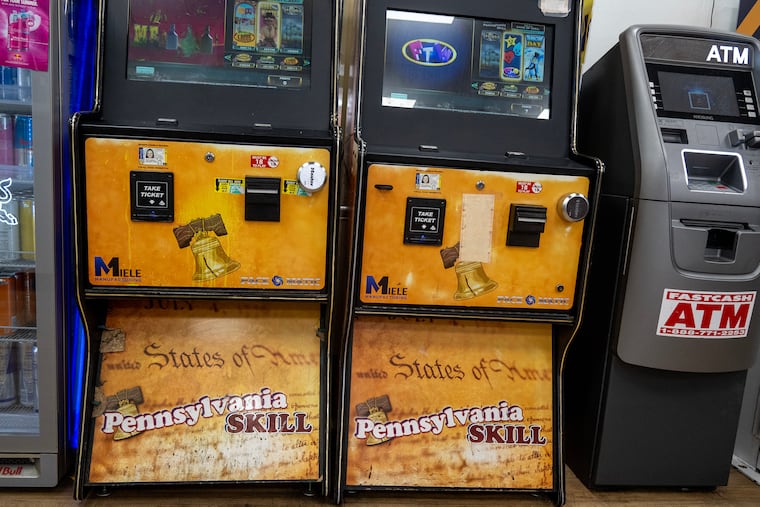
Recently, the Pennsylvania Supreme Court decided that skill games, now found in many local bars and social clubs, should be treated as slot machines. The Inquirer Editorial Board believes Harrisburg would be making a mistake if it tried to tax the games at the same rate as slots.
I would take the other side. Since Donald Trump became president a second time, many useful federal programs that helped the states, including Pennsylvania, to balance their budgets have been shut down, or at least severely curtailed. Exhibits A, B, and C could be the Supplemental Nutrition Assistance Program, money for hospitals, and funding for federal housing programs. So now the General Assembly is finding its fiscal cupboard bare as it tries to pay for these useful programs.
With that in mind, why shouldn’t the 70,000 skill games outside the casinos also be taxed?
The Editorial Board mentioned how skill games contribute to problem gambling. I believe it is possible to seriously reduce the urge to gamble with these skill games. One idea I have is that the legislature declares that someone has to be 18, 21, or even 24 years old to play and win at these skill games. By the age of 24, most people realize money doesn’t grow on trees and know they need to earn it.
Andrew Saul, Media
Drop DROP
I was struck by two articles in a recent issue of The Inquirer. On one hand, Mayor Cherelle L. Parker’s budget slashed $1.5 million from the city’s $5 million arts budget; a rounding error for the city, but a cut that will hurt arts and culture groups throughout the city. And then, I read that Councilmember Curtis Jones Jr. and Jazelle Jones, an appointee of Mayor Parker, by themselves, are grabbing a $750,000 payday thanks to DROP. Fully half of this cut to the arts throughout Philadelphia is being paid out to two people who are gaming the pension system. Councilmember Jones is planning to retire temporarily before his next term starts. We, the voters, should remember this next year and make it permanent.
Jared Cram, Philadelphia
Citizenship needs reform
I applaud The Inquirer’s story of Muhammed Emanet. It highlights the plight of those who have entered our country legally, applied for green cards, and then are left in limbo for years because of our nation’s faulty immigration system. Regardless of where one stands on the issue of immigration and the need to deport criminals who are here without legal status, we know that, like Emanat and his family, most immigrants are here in search of a safer life and are actually contributing to our society. This issue becomes more dire today, as the U.S. Supreme Court cleared the way for the current administration to remove legal protections from thousands of Haitian and Syrian immigrants in the United States, meaning they could be subject to deportation. Again, we are not talking about criminals, but rather people seeking refuge. I hope The Inquirer will continue to publish front-page stories like that of the Emanet family. Readers need to better understand the many difficulties within the pathway to citizenship in this country. We have so much work to do before we can ever be considered “Great Again.”
Kathleen Coyne, Wallingford
Profits over patients
The special interests that have shaped America’s dysfunctional healthcare system remind me of Oliver Hardy’s comment to Stan Laurel: “Well, here’s another nice mess you’ve gotten us into!” The Editorial Board suggests that we need a public option that “would allow eligible participants of all ages to pay adjusted health insurance premiums based on their incomes.” I assume infants would be excluded? While most agree that we need major reform, allowing for profit greed to continue only perpetuates the enormous administrative overhead that sucks 30% of healthcare dollars. It would also allow the “expensive” ill patients to be turfed to the “public option,” accelerating a death spiral for taxpayers. The cost savings we need only come from a single-payer, national health insurance program with a private delivery system focused on public health, prevention, and primary care.
Walter Tsou, Philadelphia
The writer is a former health commissioner of Philadelphia.
Smart meter mandate
The entire General Assembly should be ashamed of how it let the Public Utility Commission, an out-of-control, unelected bureaucracy, wholly controlled by the utilities it is supposed to regulate for the good of the public, dictate the mandating of electric smart meter installation, with zero opt-out, contrary to the original intent of Act 129, which was electric smart meter opt-in legislation.
The case had to be taken to the Supreme Court of the United States. It is a complete disgrace that the legislature treats Pennsylvania citizens in this way.
Tom McCarey, Berwyn
House Bill 2632
In their recent op-ed, Michael Marrone and Joseph Marano claim that the average Liguori Academy family’s income is close to the federal poverty line, that Liguori students typically display significant growth in reading and math, and that, according to a study commissioned by the Children’s Scholarship Fund of Philadelphia, educational tax credit scholarship recipients outperform their public and private school peers.
All of those claims may be true. Or not. We have no way of knowing because current Pennsylvania law prevents such information as a scholarship recipient’s family income levels, household demographics, or former school from being shared with the state government. We, therefore, have no way of knowing whether these tax credits are going toward a quality education for the commonwealth’s neediest students or for a family vacation in the Bahamas.
This is not simply conjecture. In 2019, a Keystone Crossroads investigation found that many private schools that accept Educational Improvement Tax Credit scholarship admissions have no low-income students in attendance.
House Bill 2632 will begin to address this problem by allowing the auditor general to acquire the necessary information to determine whether qualified families have access to a quality education.
The foundation of our children’s education should rely more on accountability than acts of faith. This is the reason we need the state Senate to pass House Bill 2632, and for Gov. Josh Shapiro to sign it into law.
Diane Payne, retired public schoolteacher, Philadelphia
Join the conversation: Send letters to letters@inquirer.com. Limit length to 150 words and include home address and day and evening phone number. Letters run in The Inquirer six days a week on the editorial pages and online.