Letters to the Editor | June 8, 2026
Inquirer readers on animal housing standards on Pennsylvania farms and the protests at the Delaney Hall immigrant detention center in New Jersey.

Debating farm standards
Brent Hershey argues in a recent op-ed that a bipartisan farm bill provision that has passed the House of Representatives would undermine Pennsylvania farmers, threaten animal health protections, and destroy markets producers have spent years building. Those are serious claims. They deserve careful examination.
The provision under debate does not prevent Pennsylvania from regulating farms within Pennsylvania. It does not affect the state’s authority to manage livestock disease, conduct inspections, or respond to outbreaks. Claims that it somehow jeopardizes protections against avian influenza, bovine tuberculosis, or chronic wasting disease simply are not what Congress is considering.
Hershey also argues that Pennsylvania farmers invested to meet California’s standards and now earn premiums from those markets. Even if true, a business opportunity created by California’s policy does not answer the question now before Congress.
The actual issue is whether one state may impose farming production requirements on farms located in other states as a condition of market access.
Reasonable people can disagree about animal housing standards — and on this issue, the American Veterinary Medical Association does not support California’s arbitrary and unscientific approach that it says provides no demonstrable advantage for animals. What should not be in dispute is the question being debated.
That question is where state authority ends, and interstate commerce begins. It deserves to be characterized accurately and debated on those terms.
Andy Curliss, chairman, Carver Center for Agriculture and Nutrition, Des Moines, Iowa
. . .
California’s Proposition 12 is driving up food costs across the country by imposing mandates on pork and egg farmers. Prop 12 prohibits farmers from selling pork and eggs in California unless they make expensive and arbitrary changes to their operations, driving up costs for all consumers, not just Californians.
Prop 12 is opposed by major veterinary and farm organizations. If it’s allowed to stand, it will set the stage for more overreaching state laws that drive up the cost of meat and reduce consumer choice at the supermarket.
So why does pork farmer Brent Hershey approve of the law? Because he happens to already be California-compliant — meaning the law drives up the costs of other farmers who compete with him. It’s a cynical and selfish position.
Congress should pass a fix in the Farm Bill that keeps state laws within state borders. California should not be allowed to impose costly regulations on farmers in other states. A federal fix will help consumers and farmers by preventing these hidden food taxes from taking hold in more states.
Will Coggin, research director, Center for the Environment and Welfare
Delaney Hall protests
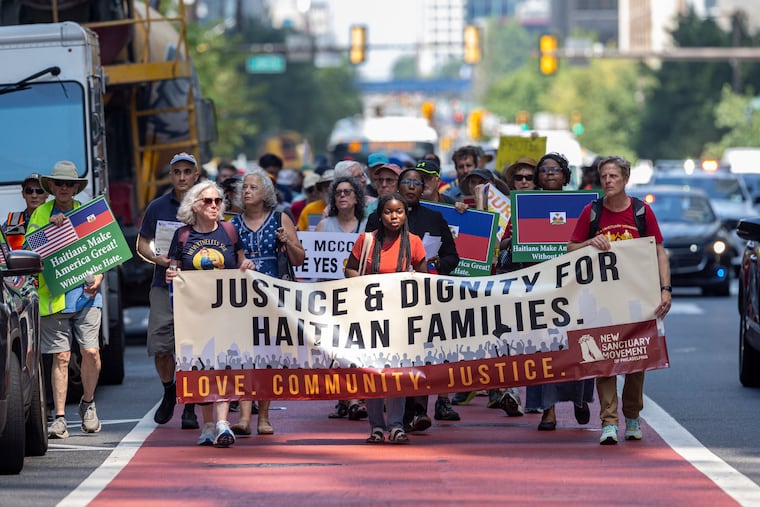
As a child of the ‘60s and a frequent protester, I disagree completely with Will Bunch’s critique of New Jersey Gov. Mikie Sherrill’s handling of the demonstrations at the Delaney Hall immigrant detention center. Any kind of protest by the left instantly becomes fodder for Rupert Murdoch’s conservative news agencies, which spin video images into “lawlessness and anti-Americanism.” I’m sure the governor was torn as to how to handle this situation, and — as much as I admire the protesters — I also see them becoming fodder for a future campaign commercial for the party that spouts “law and order” in every other sentence. You may accuse Sherrill of being too harsh, but she is keeping the Delaney Hall protesters from being the lead story on right-wing television.
Gerard Iannelli, Haddon Heights
Cruel Medicaid requirements
Reading a recent article about stricter rules for Medicaid work requirements, my stomach curdled. The cruelty of Trump’s administration has reached a new high. The preamble to the Constitution states: “We the people of the United States, in order to form a more perfect union, establish justice, provide for the common defense, promote the general welfare …”
Healthcare is “general welfare.” Yet now, people working at minimum wage jobs 20 hours per week would have great difficulty obtaining and submitting proof of employment to keep their Medicaid. People with terminal kidney disease and cancer will have to prove their inability to work 20 hours a week to keep their Medicaid.
Where’s the outrage? Let heartless legislators and policymakers know this is unacceptable.
Mardys Leeper, Bryn Mawr
Teen employment challenges
Many adults encourage teenagers to get jobs to build responsibility, gain experience, and prepare for the future. However, what is often overlooked is how difficult it can actually be for teenagers to find and maintain employment while balancing school, family responsibilities, and transportation limitations.
As a high school student, I have seen firsthand how challenging it is to manage academics, extracurricular activities, and responsibilities at home while also trying to enter the workforce. Many teenagers are eager to work, but employers often want experience that young people have not yet had the opportunity to gain. In some cases, limited transportation and restricted work hours for minors create even more barriers.
Teen employment is important because it teaches communication, time management, independence, and financial responsibility. Yet, many teenagers are caught in a cycle in which they are told they need experience to succeed, while struggling to find opportunities that allow them to gain that experience in the first place.
Communities and employers should recognize the value that motivated young workers bring. Offering more flexible scheduling, entry-level opportunities, and support for teen workers would benefit both businesses and young people preparing for adulthood.
Deanna Giorgio, Ardmore
Gracious in defeat
As a college Hall of Fame athlete and U.S. national team coach, I was taught from an early age that competition carries responsibilities beyond simply winning. One of the most important lessons was that when you lose, you shake your opponent’s hand, accept the result with dignity, and work harder to “get them next time.”
That is one reason I could never again support Donald Trump after the events surrounding Jan. 6, 2021. Disputing election procedures through lawful courts is one thing. But continuing to encourage the belief that the election was illegitimate after repeated court losses, and then watching the U.S. Capitol being attacked during the certification process, crossed a line for me.
Now, discussions about compensating some individuals with taxpayer dollars who were convicted in connection with the Capitol riot only deepen that concern. As a Republican, I have always believed our party stood for law and order, personal responsibility, and respect for police officers and constitutional institutions. Rewarding people involved in that event feels inconsistent with those values.
Reasonable Republicans can disagree on taxes, immigration, spending, or foreign policy. But sports taught many of us that character is revealed most clearly in defeat. Leaders, like athletes, are ultimately judged not only by how they win, but by how they lose.
Thomas E. Feaster, Tampa, Fla.
Join the conversation: Send letters to letters@inquirer.com. Limit length to 150 words and include home address and day and evening phone number. Letters run in The Inquirer six days a week on the editorial pages and online.