Letters to the Editor | May 11, 2026
Inquirer readers on the Supreme Court’s voting rights ruling and a historian's case for President Trump’s triumphal arch.
Racial division
Will Bunch’s recent column hits racial hatred dead on. MAGA should, in reality, be called by its real, naked name: MAWA — “Make America White Again.” Alexander Stephens, vice president of the Confederacy, wrote in 1861 that “our new government is founded upon exactly the opposite idea; its foundations are laid, its cornerstone rests, upon the great truth that the Negro is not equal to the white man; that slavery subordination to the superior race is his natural and normal condition.” This belief is deeply internalized in the tier of Southern states that are abandoning the Voting Rights Act of 1965 to eliminate black voting districts in some states of the former Confederacy. Bravo to Bunch — shame to all who support Stephens’ “cornerstone” belief that perpetuates racial division and hatred.
Terry Furin, Philadelphia
. . .
Last Monday, the U.S. Supreme Court put the final nail in the coffin of the 1965 Voting Rights Act. It has conclusively eliminated the opportunity for people of color to have equal representation in the South. As soon as the verdict came in, multiple governors in the South called for legislative sessions to gerrymander their electoral maps, and their efforts couldn’t be more transparent.
For some reason, this has been the agenda of Chief Justice John Roberts for decades, and it is indefensible. While there has certainly been progress in race-based discrimination since 1965, this decision is Jim Crow 2.0, and tragically sets back the hard work of those civil rights warriors, some of whom died for their efforts. There is hope that some of these obviously discriminatory maps can still be challenged in court, but, as Justice Elena Kagan stated in her dissent, the court has ushered in “a new era of elected politicians picking their voters instead of voters picking their politicians.”
Bill Maginnis, North Wales
. . .
Make no mistake about it: When the U.S. Supreme Court declared that race-conscious redistricting, Section 2 of the Voting Rights Act of 1965, was unconstitutional, it denied the rights of Black citizens to obtain meaningful representation. The Voting Rights Act of 1965 forbade racial discrimination in voting and enforced the 15th Amendment. The act banned literacy tests, allowed federal oversight for jurisdictions with histories of discrimination, and enabled federal examiners to register voters. In just one year after the act passed, about 250,000 Black citizens registered to vote, and the number of Black elected officials rose from 72 to 159. This ruling will not just affect federal congressional districts; state legislative, local, and school board districts can also be gerrymandered. But unlike before 1965, this gerrymandering will be done with scalpel-like precision using data mining tools. State legislators have access to our real estate records, income levels/job titles, purchasing patterns, race/ethnicity, voting history, party affiliation, educational background, and gun ownership. Legislators don’t know our individual votes, but they know how our demographic votes. With mid-census redistricting now allowed, districts can be continuously updated, block by block, to obtain preordained results. Yes, the Supreme Court is targeting Black voting rights today, but everyone’s voting rights are now in jeopardy in the years to come.
Cynthia Sherbin, Malvern
Facilitating conversation
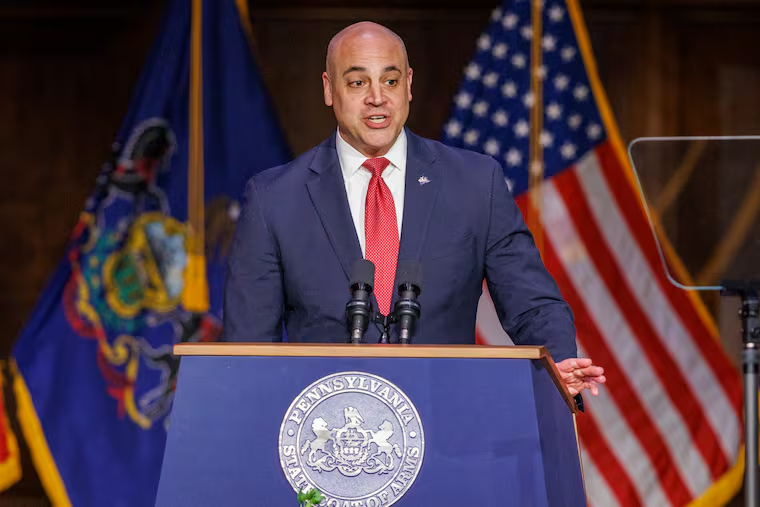
As the chief transformation and opportunity officer for the Commonwealth of Pennsylvania, it’s my responsibility to listen to businesses — big and small — across the commonwealth and work with them to grow our economy, improve state government, and, ultimately, create more opportunity for all 13 million Pennsylvanians.
The Inquirer’s recent article about my office’s engagement with Merck & Co. frames our dialogue with the pharmaceutical firm as something the public should be alarmed about, but that is simply not the case.
What actually happened: Merck, an employer of 7,000 people, raised a concern about a regulation. My office listened. We asked the Department of Environmental Protection — the agency with the actual environmental expertise — to study whether the rule could be clarified. The public voiced their opinion and disagreed that the proposed change would be an improvement, so our administration listened to that feedback and withdrew the proposal.
That’s how our system is supposed to work.
This was an example of the government actually listening, and along the way, a major Pennsylvania employer felt the commonwealth was finally a place where you could raise an issue and get an honest hearing, a sentiment that has been in short supply in Harrisburg for a long time.
Gov. Josh Shapiro should be commended for creating an office like ours in the first place. We help to facilitate conversations between residents, advocacy groups, and the business community — each of whom has a chance to make their voices heard and help the government reach well-informed decisions.
The Shapiro administration will continue standing up for Pennsylvania jobs, Pennsylvania families, Pennsylvania school districts, and a Pennsylvania economy that can finally compete with our neighbors — and we’ll do it while protecting our environment.
Ben Kirshner, chief transformation and opportunity officer, Commonwealth of Pennsylvania
Provisional truth
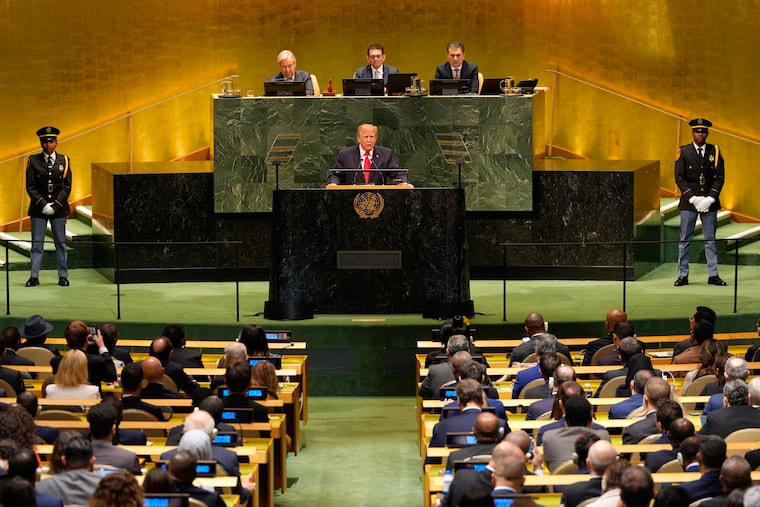
A functioning democracy rests on a simple but indispensable foundation: trust between the governed and those who govern. Today, that foundation feels increasingly strained. At the highest levels of federal leadership — most notably the presidency — truth is too often treated not as a fixed principle, but as something pliable, shaped by circumstance.
Among the most corrosive patterns is the “immediate pivot”: a statement offered with certainty, only to be qualified or reversed almost instantly. This habit erodes credibility, not just at home but abroad. When our words are perceived as provisional — subject to revision within hours or even minutes — we diminish both our moral authority and our diplomatic leverage.
In confronting this erosion, it is worth turning to enduring moral teachings. The Ahmadiyya Muslim Community, drawing from the example of Prophet Muhammad (peace and blessings be upon him), places truthfulness at the very core of a just society. He taught that while a person may struggle with many weaknesses, habitual dishonesty is incompatible with genuine faith. The Quran reinforces this principle in 22:31, where believers are commanded to shun falsehood alongside idolatry — an intentional pairing that underscores the gravity of untruth.
This comparison is striking. Just as idolatry represents a turning away from the divine in favor of something constructed and false, so, too, does dishonesty reflect a willingness to abandon principle in pursuit of self-interest. A lie becomes, in effect, an idol — something fashioned to serve immediate ends, yet ultimately hollow and corrosive.
When leaders place political survival above honesty, they risk elevating power itself into such an idol. For decades, the United States has been regarded as a stabilizing force on the global stage, its commitments carrying weight because they were presumed to be anchored in truth. That reputation, however, is not immune to erosion. If “truth by convenience” becomes normalized, the consequence will be a diminished voice — one that no longer commands confidence or trust.
Integrity is not a partisan preference or an abstract virtue. It is the currency of national credibility. Without it, even the strongest institutions begin to lose their standing, both at home and in the eyes of the world.
Kalim A. Bhatti, Harrisburg
Trump’s arch
Far from being a “historian’s case for Trump’s arch,” Brady Crytzer’s recent op-ed is simply an assertion leading to a foregone conclusion. We can all agree that the 250th anniversary of the nation’s founding is worth celebrating. That hardly makes the case for the Trumpian arch, though. The proposed design is completely out of scale with the nation’s capital, and would be a blight on the sweeping view from the Lincoln Memorial up to the hallowed ground of Arlington National Cemetery. Moreover, Mr. Crytzer’s potted history is selective in its lessons. He neglects to mention that George Washington, the “American Cincinnatus,” resigned his commission at the end of the revolution and would later refuse a third term as president. Somehow, though, I doubt the current administration sees the arch as a celebration of the peaceful transfer of power.
Juan Peñalver, Medford
Demand better
For the wealthy: Extreme corporate profits. Record stock market levels. Curtailed consumer protections. Massive tax cuts. Epic CEO bonuses.
For the public: Surging gas prices. Consumer tariff taxes. Mounting inflation. Crushing medical costs. Painful rents and mortgages. Worsening trade deficits. Massive national debt hikes. An emerging police state.
In the face of these realities, the president and his Republican enablers dismiss our concerns.
Plummeting affordability, mounting credit card debt, defunded healthcare, disrupted world economy, alienated allies, and empowered international opponents are tolerated, and even celebrated, by the president and his men. They pat us on our middle-class heads and tell us: “Don’t complain. All is well.”
Are we fools? When will we demand better from our representatives?
Mike Shivers, Altoona
Join the conversation: Send letters to letters@inquirer.com. Limit length to 150 words and include home address and day and evening phone number. Letters run in The Inquirer six days a week on the editorial pages and online.