SCOTUS gutting 1965 Voting Rights Act is a wake-up call from a dream
Boomers growing up in an era of rising Black political power thought America had changed for good. What went wrong?
I have a dream that one day this nation will rise up and live out the true meaning of its creed: “We hold these truths to be self-evident, that all men are created equal.”
— The Rev. Dr. Martin Luther King Jr., 1963 “I Have a Dream” speech
Is a dream a lie if it don’t come true?/ Or is it something worse?
— Bruce Springsteen, “The River,” 1980
When the news broke Wednesday morning that the U.S. Supreme Court’s six conservative justices had taken a wrecking ball to the last vestiges of the landmark 1965 Voting Rights Act, my mind went back in time to an oppressively hot day in the summer of 1984, driving up and down the red hills of western Alabama with a remarkable tour guide named Wendell Paris.
On TV, it was morning in Ronald Reagan’s America, but off camera in predominantly Black Sumter County, Ala., they were taking out the trash, quite literally. The trash-hauling giant, Waste Management, had built the nation’s largest toxic-waste dump — an environmental justice nightmare — in a tiny hamlet called Emelle.
Paris, who, as a 1960s college student, had fought for civil rights in Alabama’s most dangerous counties, took me — a 20-something reporter for the Birmingham News — to meet underpaid Black workers who went down into the pits with no protective gear, and to show me the sprawling estate of the local white lawyer who got rich doing Waste Management’s bidding.
But Paris was fighting Waste Management with a weapon Alabama’s African Americans could not have dreamed of a generation earlier: a position of political power. He’d been elected chair of the Sumter County Board of Education, and he and a new generation of other first-time Black officials were fighting daily for better schools and economic justice that had been denied under segregation.
It was a similar story back in Birmingham, where Richard Arrington Jr. had just won a second term as the Black mayor of Alabama’s largest city. Sure, the former segregationist George Wallace had returned to the governor’s mansion yet again, but he’d done so by actively campaigning for Black votes and apologizing for his past sins.
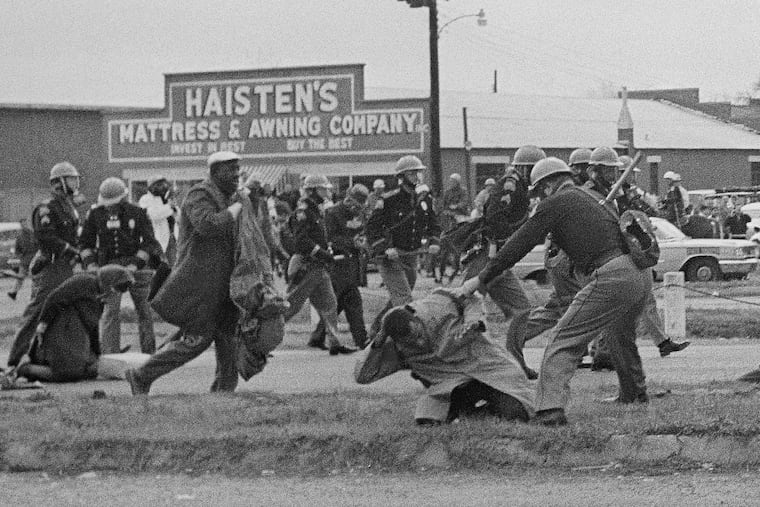
The humid winds of change that blew across a state that called itself the “Heart of Dixie” in the early 1980s were all the result of what is still the most important piece of legislation passed in my lifetime: the 1965 Voting Rights Act, forged in the blood of Paris’ fellow Black activists on Selma’s Edmund Pettis Bridge.
It was a time when government could not only do big things but make them work. The VRA ended racist practices like literacy tests and poll taxes that, for decades under Jim Crow segregation, had kept the vast majority of Black people in places like Sumter County or Birmingham from voting, even after the 15th Amendment supposedly guaranteed that right. The law also required political maps that would guarantee Black representation in these former Confederate states with large African American populations, launching the congressional careers of legends like Barbara Jordan of Texas and Andrew Young of Georgia.
The great Joan Didion’s most famous observation was that we tell ourselves stories in order to live. I can’t understate how central the 1965 Voting Rights Act has been to the story that my generation of boomers told ourselves about believing in the American dream.
The narrative that took someone like John Lewis out from under those police batons in Selma and into the corridors of Congress, and that peaked with Barack Obama’s once unthinkable election as America’s first Black president in 2008, seemed proof positive of another famous MLK maxim: that the arc of the moral universe is long, but it bends toward justice.
Late Wednesday morning, the U.S. Supreme Court — with three of its six-member conservative majority appointed by a racist president who routinely calls Black and brown members of Congress “low IQ” — grabbed that moral arc and twisted so hard that it broke.
Its 6-3 ruling in Louisiana v. Callais — destined to join Dred Scott v. Sandford, Plessy v. Ferguson, and Korematsu v. United States in the SCOTUS hall of shame — struck down a Louisiana congressional map that created a new Black-voter majority district. The majority opinion by conservative firebrand Samuel Alito tried to argue that they were saving the 1965 VRA by destroying it, that political maps like the ones that currently have 23 Black House members from the former Confederacy are essentially racist — because they discriminate against white people.
The decision provoked widespread condemnation. Slate’s Richard L. Hasen ranked it as maybe the worst Supreme Court ruling of the last century; that in pandering to aggrieved white Republicans, the conservative majority had created “a disaster for American democracy.” The often-cautious New York Times editorial board lashed out at “a mind-boggling piece of judicial overreach” in which “the court has acted more like partisan legislators than like impartial judges.”
» READ MORE: New civil war just dropped … at the Supreme Court | Will Bunch Newsletter
I recommend this powerful analysis from the Atlantic’s Adam Serwer, who traces the verbal jiujitsu of white conservatives who — amid the changes of the 1960s, ‘70s, and ‘80s — raced to embrace King’s language about a colorblind America while scheming to twist those words into a bludgeon to restore white power.
Legal scholars will no doubt study and debate for many years to come how the nation’s highest court came to view the legislative high point of the 1960s Civil Rights Movement as meaning the exact opposite of what Lyndon B. Johnson and that era’s lawmakers thought they were enacting. But the political and psychic fallout is already here.
Across the Deep South, news of the ruling was like a starter’s gun for a race to the bottom among GOP-dominated state legislatures to redraw majority-Black congressional districts into oblivion before the November midterm election.
Louisiana on Thursday postponed its May 16 primary, presumably to craft new boundaries that could eliminate both districts now represented by Black lawmakers. Likewise, Mississippi’s white state auditor urged an end to the congressional district long represented by Black Rep. Bennie Thompson, who led the House probe into the Jan. 6, 2021, insurrection.
Who will advocate for the mostly low-income and mostly African American residents of Louisiana’s “Cancer Alley,” the unbroken stretch of refineries and chemical plants that continue to pollute and sicken people from Baton Rouge down to New Orleans? Who will fight on Capitol Hill for the long-suffering Black farmers of the Mississippi Delta?
The practical fallout is bad, and so is the damage to America’s psyche. The Voting Rights Act felt to our generation like an unbreakable granite monument to progress, tied to real gains for Black people and other racial or ethnic minorities, not only on Capitol Hill but everywhere from office cubicles to TV sitcoms. As recently as 2006, a GOP-led Senate reauthorized the VRA by a 98-0 vote, then signed by George W. Bush. The endless cycle of slavery and freedom, Jim Crow and civil rights, had finally been broken, and we weren’t going back.
Until we did.
“I just never in my wildest imagination ever dreamed that we would be, in 2026, where we are now, based on what happened in 1965,” Leslie B. McLemore — a 1960s civil rights activist in Mississippi, now 85 — told the New York Times on Wednesday.
Was King’s dream just a lie that didn’t come true? In hindsight, the stench of backlash was already strong in 1984, even as the wave of Black politicians from Birmingham’s Arrington to Philadelphia’s W. Wilson Goode were taking power. Sumter County’s Paris was one of several Black Alabama leaders caught up in a ridiculous voter fraud probe by an ambitious young U.S. attorney, Jeff Sessions, who would later become Donald Trump’s attorney general during the president’s first term.
It seems now that the faux granite of the Voting Rights Act wasn’t as durable as the white supremacy embedded in the red clay under Sumter County and so much of the rest of America. Every action toward a more diverse and more democratic nation — especially Obama’s election in 2008 — triggered an equal and opposite reaction.
Dreams can be beautiful, but they aren’t reality. Even though the alarm was set years ago, Wednesday’s Supreme Court ruling was still a piercing wake-up call for anyone who wants the United States to ever fulfill its promise of democracy. If the Voting Rights Act didn’t save America, we need even more revolutionary action this time around.
If a corrupt and broken Supreme Court insists on playing partisan politics, then we need partisan politicians to bring them to heel. Expand the court to 13 justices, impose term limits, and investigate and impeach any justices who broke the laws about gifts or anything else.
Radical steps? You bet, but the alternative is allowing a kangaroo court to finish the job of dismantling the American Experiment, of turning a dream that became a lie into something worse. We can’t bend the arc of the moral universe until we grab it back from the people who stole it.

Sign up for the Will Bunch Newsletter