Letters to the Editor | Jan. 30, 2023
Inquirer readers on DeSantis honor, Trump's return to social media, and the Doomsday Clock getting closer to midnight.
Not worth repeating
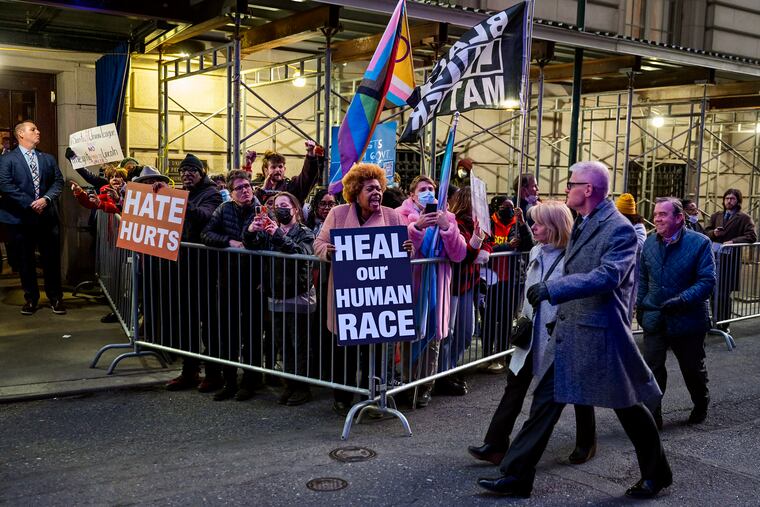
The Inquirer article about the Doylestown Rainbow Room continues to give oxygen to opportunistic State Sen. Doug Mastriano. The echo chamber of the right-wing commentary does not need The Inquirer’s help repeating its claims about the “dangers” of the Rainbow Room’s program. If there is a danger, it comes from the attempt to outlaw activities that are celebrated and should be part of a free, respectful society. “Balanced” reporting ends up repeating, even when debunking, the unfounded and harmful claims behind the proposed legislation.
Let’s protect our LGBTQ friends, of all ages, with respectful coverage, without the front-page limelight. Noise in the Twitterverse is not news.
Bob Blacksberg, Philadelphia, robert.blacksberg@gmail.com
Closer to midnight
Our country, along with others, is on the road to making an extremely dangerous nuclear situation even more alarming. Vladimir Putin has made thinly veiled nuclear threats, accompanying Russia’s ongoing invasion of Ukraine. The North Korean government has increased the frequency of its missile tests and hinted at a new nuclear test coming soon. China is growing its nuclear arsenal. Negotiations to reenter the Iran nuclear deal have been unsuccessful. And the U.S. Congress has decided to fund the development of new nuclear delivery systems. The Doomsday Clock now stands at 90 seconds to midnight, the closest it’s ever been. If we and several other countries have the capacity to visit catastrophe on the planet, does it really matter who presses the button? Why do we continue, like lemmings, along this path that we know is self-defeating? Congress must defund the dangerous and expensive SLCM-N and the LGM-35 Sentinel. The U.S. must recommit to pursuing global nuclear disarmament — as it promised in the Treaty on the Non-Proliferation of Nuclear Weapons. We can be a model to other countries, instead of a threat.
Judith Inskeep, Gwynedd
Out of reach
An American Academy of Pediatrics study has found a sharp rise in the number of children who accidentally ingested marijuana edibles. From 2017 through 2021 there were over 7,000 confirmed cases of children ingesting edibles in the U.S. Cases rose from 200 in 2017 to more than 3,000 in 2021 — a 1,375% increase — with almost a quarter of the children requiring hospitalization. These findings are of great concern, as the rise of these cases directly coincides with more states legalizing cannabis use both medically and for adult recreational use. Edibles are often packaged to resemble candy or cookies and look appealing to children. Marijuana can be harmful to brain development, which continues until a person is in their mid-20s, and cannabis exposure can be very serious for young children. As we are learning to navigate the adult use of marijuana, we must remember that although edibles are packaged to look like food or treats, we must treat them as we would with any medicine and ensure that they are kept in a secure place and out of the reach of children.
Angelo Valente, executive director, Partnership for a Drug-Free New Jersey
Trump’s back
Nick Clegg, president of global affairs at Facebook’s parent company Meta, said Donald Trump will be allowed back on Facebook, where he was banned over his praise for people engaged in violence at the U.S. Capitol on Jan. 6, 2021. Clegg claims the public “should be able to hear what their politicians are saying ... so that they can make informed choices at the ballot box.” Letting someone known for his repeated lies, gross distortion of facts, and spread of misinformation back on Facebook is not the way to help people make informed choices. There are obviously other reasons for this decision.
Ted Swirsky, Erial
Silent majority
Columnist Jenice Armstrong speaks for many of us when she decries the Union League’s gold medal award to Florida Gov. Ron DeSantis. But we are naive if we think that a letter signed by a paltry 107 dissenting members amounts to much of a protest. According to the league’s website, its membership numbers 3,500 people “in the vanguard of Philadelphia life ... [including] top leaders” in an array of area professions. This means that roughly 3,400 of those “top leaders” seemingly had no objection at all to the honor and that the league’s leadership has its fingers firmly on the pulse of its membership and its real values.
Beth Z. Palubinsky, Philadelphia
Keep it quiet
Anyone who spends time in Philadelphia has been assaulted by cars and motorcycles roaming the streets with ear-splitting, roaring engines and/or music being blasted at damaging decibel levels at all hours of the day and night. Why the people who drive these vehicles choose to do so is beyond me, but they are a definite nuisance at best and a danger at worst. Neither they nor nearby motorists can hear approaching sirens, car horns warning them of dangers, and so on. Pedestrians within earshot are also at risk. People living above the streets have their peace disturbed and their sleep interrupted. Finally, there is a solution, at least a partial one. Other cities have installed cameras with recording devices that sense an approaching vehicle with excessive noise levels and photograph them with cameras able to record their license plates. Violators are fined. Philadelphia has enjoyed great success with speed cameras on Roosevelt Boulevard. This technology can do the same for noise pollution. Officials, are you listening?
Ben Zuckerman, Philadelphia
A slippery slope
There have been so many mass shootings in the United States that it is impossible to keep up from one 12-hour period to another. More angry grievances addressed, more mental health conditions violently expressed, more irrational hatred satisfied, and more earnest calls for control of weaponry and ammunition, always ignored. Civic-minded gun owners appear open to safer access and control. Others predictably block legislation, gravely warning about a “slippery slope” that will lead to gun confiscations. We are indeed already descending a slippery slope, slicked by the blood of the innocents as we accept this endless brutality with intimidated responses and no end in sight. Frankly, a disturbingly ugly image, but one that I will now hold each time these cynical conspiracy theories are elevated.
Joseph B. Baker, West Chester
More empathy needed
Regarding the op-ed “EMTs should be able to refuse to take someone to the hospital,” this is the worst idea ever. Tellingly, the author doesn’t tell us what happened to his elderly patient who complained of dizziness after she was taken to the hospital. Did she have a heart arrhythmia that wasn’t there when he saw her? Was she dehydrated? Did she have a urinary or other infection? I’m sure he doesn’t know, and that’s the point. How could he base his opinion only on his triage in her apartment? It’s better that some patients be treated unnecessarily rather than one denied treatment inappropriately. The author is a fourth-year medical student. I hope that with experience he develops more empathy for his patients than he demonstrates in his opinion piece.
Ronald Fronduti, MD, Media
Join the conversation: Send letters to letters@inquirer.com. Limit length to 150 words and include home address and day and evening phone number. Letters run in The Inquirer six days a week on the editorial pages and online.