As a Black man, I was initially angry about plans to scrap DEI goals for city contracts. But then I remembered: They don’t work for us anyway.
Why don’t participation goals work better for Black people? The answer lies in a system with steep financial rewards and little accountability.
I felt a rush of anger when I learned the Parker administration planned to scrap the so-called minority participation goals for city contracting. Then I remembered what I’d learned while covering race and city contracting over the last decade: participation goals don’t work well enough for Black people.
This is not to say people of color aren’t getting city business. The Office of Economic Opportunity (OEO) said what it calls “minority, women, and disabled business enterprises” received more than $370 million in city contracts in fiscal year 2023.
The city’s goals call for 35% of city contracts to be awarded to businesses owned by women, people of color, and people with disabilities. During the 2023 fiscal year, 31.4% of city contracts went to companies owned by people from those demographic groups.
However, Black-owned businesses only accounted for about 13.5% of all city contracts.
Given that Black Philadelphians make up the city’s largest ethnic group — we’re more than 38% of the population — that’s a problem.
So why don’t participation goals work better for Black people? I believe the answer is simple. Bias and race-based exclusion are built into a system where money is plentiful but accountability is not.
In construction, a business where city contracts abound, developers and contractors tend to be big political donors.
The companies are almost always white-led, since only 9.2% of Philadelphia businesses with employees were Black-owned as of 2022.
In addition, the building trades unions, though they are now run by a Black man, Ryan Boyer, spent generations excluding Black people.
That leaves the city asking white-owned businesses with largely white workforces to meet minority participation goals set by the Office of Economic Opportunity.
According to a former manager in the OEO, who would speak to me only on the condition of anonymity, companies that don’t meet the goals rarely face consequences.
That’s been the case for years. In fact, I wrote a 2016 Inquirer column that noted that in the 2015 fiscal year, nearly 70% of city-funded construction projects with budgets over $250,000 did not reach the city’s participation goals for people of color, and 44% had no participation by people of color at all.
Even if the goals didn’t deliver what they should have, it’s galling to lose them at a time when the president is pushing an anti-Black agenda.
Very few were held accountable for it then, and very few are held accountable now.
But even if the goals didn’t deliver what they should have, it’s galling to lose them at a time when the president is pushing an anti-Black agenda, complete with policies that led to job losses for over 300,000 Black women during his first year in office. Sadly, that’s just the tip of the iceberg.
Donald Trump has sought to erase Black history in our city by pushing for the removal of a slave memorial. He sent federal agents to snatch Black American citizens and Venezuelan immigrants from their beds in Chicago. He has targeted Black political representation with a Texas redistricting scheme that judges have blocked — for now.
But this is about more than the president’s recent actions. This is about Trump’s long game. From Road-Con Inc. v. City of Philadelphia, which challenged the city’s minority set-asides, to the U.S. Supreme Court’s decision to kill affirmative action, the multipronged attack is not just meant to set precedents. This attack is meant to set us back.
That’s why, when we see our civil rights gains under attack, we want our leaders to stand and fight.
» READ MORE: I love seeing anti-Trump protests. Like many other Black folks, I won’t be joining them. | Solomon Jones
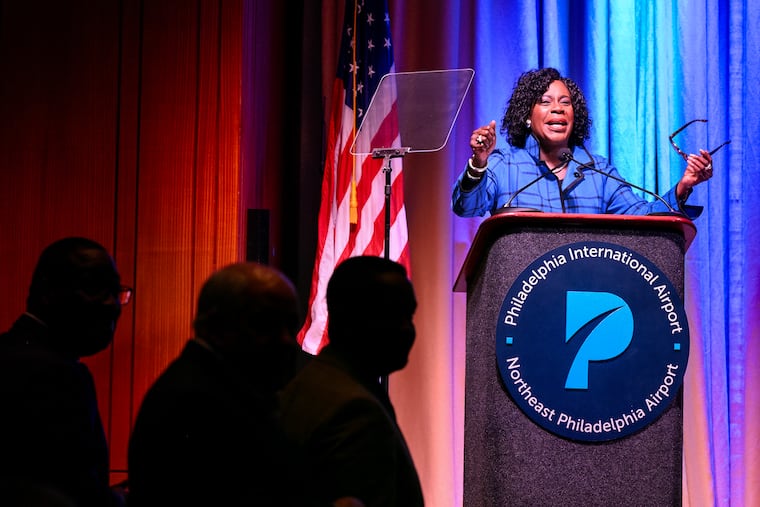
I asked Mayor Cherelle L. Parker if changing the minority participation goals to small and local business goals represented the kind of fight our community wants from her.
“I am 53 years old,” she said, “and I have been working in government and public service since I was 17 years old. I don’t know anyone in this city who knows me who has ever questioned whether or not I’m willing to fight for what I believe in. I’m a product of this city. You heard me reference the intersection of race and gender. But I thank God that I’m made and built from the kind of material that says a speech is not enough. You have to deliver tangible results.”
The mayor went on to say the community should hold her accountable. I agree, and we will.
But I am also one of those people who have known the mayor for years. She is indeed a fighter, and she’s fighting this her way. We only need one thing from her: a win.