Savannah Guthrie’s mother is missing. But let’s not forget many others are, too.
During a recent visit to Tucson, Ariz., I stopped by the home of Nancy Guthrie, and couldn’t help but think of the pain experienced by her family — and hundreds of others with missing loved ones.

I like to visit Tucson, Ariz., this time of year to get away from the cold. Winters are mild, and it hardly ever rains in the Sonoran desert there, averaging roughly 300 days of sunshine.
But when I was there last week, it felt as if a dark cloud were hovering. I kept being reminded about the disappearance of Nancy Guthrie, the mother of NBC’s Today show cohost Savannah Guthrie, who is a longtime resident. I checked for updates multiple times a day. Then, one overcast and rainy afternoon, I grabbed a notebook and went to Nancy’s home in the Catalina Foothills.
TV is a medium that creates false intimacy, making it feel as if we actually know the on-screen performers. I’ve watched Savannah Guthrie coanchor the Today show for years, but I have never met her. When I learned her mother had gone missing, my blood ran as cold as if she had been a close friend.
I wondered if her family was targeted because of her work as a high-profile journalist. A Today show segment featuring Guthrie giving a tour of her hometown aired in November. It includes footage of the host’s mother and sister sipping tequila from teacups at a popular Mexican restaurant.
The day I showed up outside the Guthrie residence, there were no law enforcement officials to interview about the status of the investigation. A lone sheriff’s vehicle was parked in the driveway, near Nancy’s front door, where a masked gunman had been caught on doorbell camera footage around the time investigators say she’s believed to have disappeared on Feb. 1. Blood splatters have been found outside.
A handful of spiky agave plants flanked a red gravel driveway. People had dropped off yellow roses, potted plants, and other offerings at a makeshift memorial out front. A sign reads, “Dear Guthrie Family, your neighbors stand with you.” Saguaro cacti tower over the scene.
Meanwhile, reporters and social media influencers milled about on the street, waiting for answers that never came.
If this had been a targeted kidnapping, Guthrie had said on video, “We will pay.” Why hasn’t Nancy been released? And is she even still alive?
Two things can be true simultaneously: As much as I felt my heart ache for the Guthrie family, I also spared a thought for other families who are waiting for their missing loved ones to come home, too.
I also couldn’t help but think that if Nancy Guthrie weren’t related to a celebrity, or if she were a person of color, it’s doubtful we’d even know her name, much less that she was missing.
It’s also unlikely President Donald Trump would have bothered to offer his condolences and as many resources as he has, posting on Truth Social, “ALL Federal Law Enforcement to be at the family’s, and Local Law Enforcement’s, complete disposal, IMMEDIATELY.”
He has since threatened to impose the death penalty on the perpetrators.
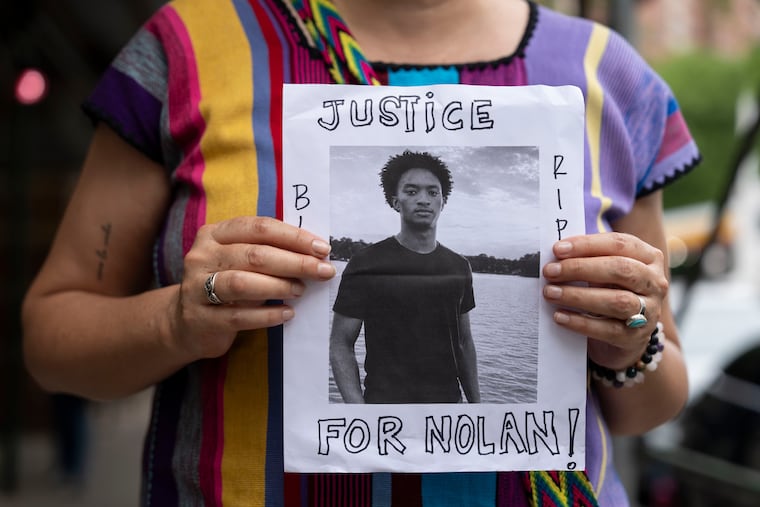
Meanwhile, there are so many other missing people whose cases could benefit from just a fraction of the attention Nancy’s case has attracted.
An estimated 2,300 children are reported missing every day in America. The National Missing and Unidentified Persons Systems database currently lists 134 people — ranging from infants to 85 years old — missing in Philadelphia County alone. U.S. Immigration and Customs Enforcement also snatches up countless undocumented immigrants whose loved ones frequently know only that they’ve suddenly gone missing.
Roz Pichardo, who runs the Missing in Philly page on Facebook, pointed out that when local people disappear, it often escapes the notice of the media or public officials. “No one is hardly looking at that page other than families who are searching for someone,” she told me.
Natalie Wilson, cofounder of the Black and Missing Foundation, agreed that not enough is done to find those who have disappeared. “Your observation about the media cycle is exactly why we stay so focused on our mission.”
None of this takes away from the Guthrie family’s nightmare. But their situation can help us understand how familiar the horror and accompanying heartache might be for people standing in line or sitting on the bus next to us.
What resources should we allocate locally to help those who are experiencing something similar to what the Guthrie family is going through? What ways can we make sure others who have disappeared get more attention and a share of our concern, as well?
My prayer is that any family with a missing loved one finds peace, including the Guthries. I hope my friend-in-my-head Savannah will wake up from this bad dream soon — and that Nancy will be safely returned to her beloved home in the Sonoran desert with her agave plants, cacti, spiny ocotillo, and some fresh yellow roses.