Using skill game revenue to fund SEPTA will disproportionately harm Pa.’s Black communities
The prevalence of skill games in Black communities siphons off money while also fueling racial inequity, Solomon Jones writes.
I know dependency, because I’ve seen it so often it in my own life. At its best, dependency is an umbilical cord, providing vital nourishment. At its worst, it is a vise, clamping down on every instinct that tells you to stop and walk away.
In considering casino-like skill games as a possible funding source to fill the $213 million budget shortfall for SEPTA, Pennsylvania lawmakers are playing both sides of dependency.
On one hand, state legislators know that our region is dependent on public transportation as a driver of our economic engine.
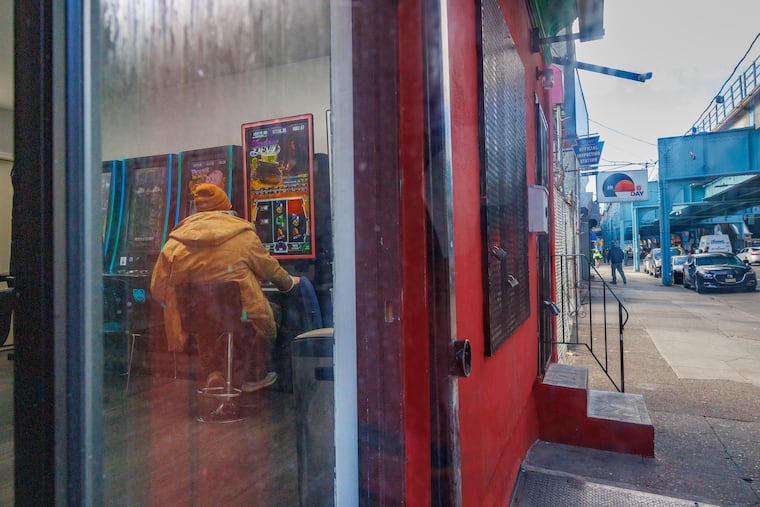
But in our most impoverished neighborhoods, where public transportation is a necessity, there is a dark and growing dependency on the colorful machines that line the walls of corner stores, bars, and gas stations.
Courts have ruled that the games are based on skill, rather than chance. Still, they closely resemble slot machines, and for those dealing with gambling addiction, I doubt that there’s much of a difference.
My concern is that the prevalence of skill games in Black communities siphons off money while also fueling racial inequity.
So, if the state is planning to regulate and tax those machines, and use the resultant revenue to plug SEPTA’s budget hole, that’s not some brilliant economic workaround. It is a ploy to exploit the ravages of addiction.
Make no mistake, the proliferation of skill games in poor Black communities is real. According to a study conducted by city officials, the games are clustered in North Philadelphia, Kensington, and Southwest Philadelphia.
To make matters worse, commercial corridor managers say 64% of the establishments where skill game are located should be considered nuisance businesses.
Targeting poor Black communities with these devices is profitable, because studies show that these are the communities where problem gambling is most likely to take hold.
In fact, the National Institutes of Health, in a 2017 study, found that Black people had twice the rate of gambling disorders, compared to their white counterparts. They had “lower scores on general health measures; they were also more likely to be women in the lowest income brackets.”
Those factors played a role in City Council’s unsuccessful effort to ban skill games in Philadelphia last year. Commonwealth Court ruled in December that the games were “neither illegal nor regulated.”
Pace-O-Matic, a Georgia-based manufacturer of skill games that opposed the city’s ban in court, says its machines help augment the revenue of small businesses and fraternal organizations across the state. Perhaps that’s true, but when I walk into gas stations and corner stores in Black neighborhoods, I see people feeding money into the machines with the dead-eyed gaze of the addicted.
Dependency is big business in America, and government typically looks the other way when vices feed underground economies in poor communities.
That’s how Kensington became the center of the city’s heroin trade. It’s how drug corners like Eighth and Butler flourished during the crack era. It’s how street lotteries created millionaires, even in the worst of times.
Bad habits generate revenue, which is why government inevitably turns to so-called “sin taxes” to fill budget holes. We’ve seen it with the legalization of marijuana, with states entering the liquor business, and with states cashing in on gambling by creating their own lottery systems.
The clear difference between those endeavors and taxing skill games is a simple one: location.
Using skill game revenue is not some brilliant economic workaround. It is a ploy to exploit the ravages of addiction.
Skill games are clustered in impoverished communities where gun violence and drug activity happen more frequently than in other parts of the city. Though there is no indication that the machines cause the crime, it’s clear that they are magnets for illicit activity.
Last July, a man was robbed and shot while using a skill game in Kensington. Prior to that, thieves targeted skill games, breaking into the machines to steal cash.
Those incidents are shocking, but my objection to the use of skill games to raise millions for SEPTA is about much more than crime. It’s also about when and where we are willing to turn addiction into a commodity.
The same people who argue it’s fine to profit from mini casinos in Black communities will fight tooth and nail to protect white addicts who abuse opioids.
That’s wrong, but there’s an even worse element to this funding scheme.
Skill games are concentrated in neighborhoods that are served by SEPTA stations and vehicles where shootings and other violent crimes can sometimes occur. SEPTA’s Regional Rail service, a high-end product whose customers are primarily suburban, serves areas where skill games are sparse.
Filling SEPTA’s budget hole with revenue from skill games will not only feed gambling addictions and crime. It will leave impoverished Black people with the bill.