Trump should not weaken U.S. support for Taiwan at Beijing summit with Xi Jinping
China’s closure of the Taiwan Strait would do more global damage than the Strait of Hormuz blockade.

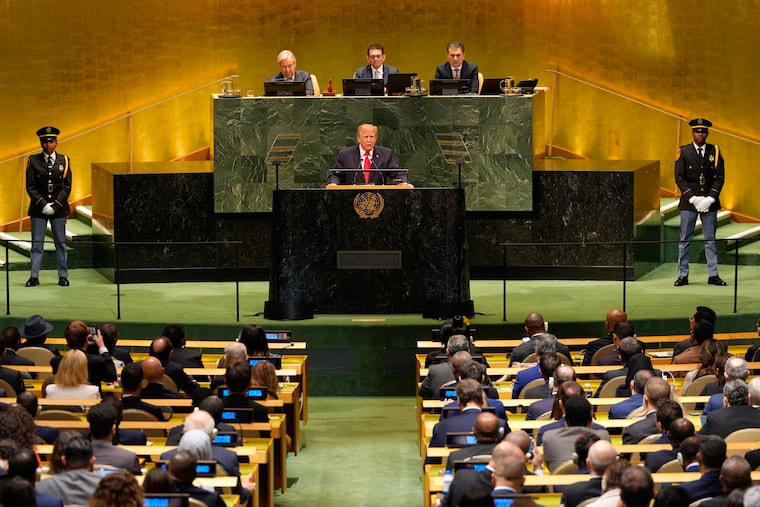
TAIPEI, Taiwan — As Iran maintains its choke hold on the Strait of Hormuz, another crucial waterway will be a focus of attention at this week’s Beijing summit between Xi Jinping and President Donald Trump.
The Taiwan Strait, a 97-mile body of water roughly 110 miles wide, separates the southeast coast of China from the self-governing island democracy of Taiwan.
Any blockage of this waterway would be even more damaging to global trade than the closure of Hormuz — and would have a disastrous effect on the United States.
Why so? It’s not only because roughly 20% of global commerce passes through the Taiwan Strait (as compared with about 8% through Hormuz), traveling to and from Asia.
More specifically, that waterway controls the flow of more than 90% of the world’s advanced semiconductors, which are manufactured mostly by the Taiwan Semiconductor Manufacturing Co., known as TSMC.
This tech giant makes the chips that power everything from artificial intelligence to smartphones to automobiles and are crucial to the U.S. and world economies. If the flow were cut off, the damage would be almost inconceivable.
Yet, Beijing insists Taiwan is a renegade province that must be “reunited” with the mainland — even though Communist China never ruled Taiwan, and most of its 23 million people identify as Taiwanese, not Chinese. China has already been holding naval exercises that temporarily block the waterway to practice squeezing Taiwan if it doesn’t bow down.
For decades, the United States has been Taiwan’s strongest supporter and provider of defensive weapons. But at the summit, Xi will try to convince Trump to weaken longstanding American support for the island democracy and the U.S. commitment to sell it arms.
Enmeshed in his Iran quagmire and eager for a trade “win,” the president could be receptive to Xi’s wiles.
On a recent trip to this island, I saw how its people and leaders are gearing up for self-defense against Chinese aggression. Yet, Trump has shown little grasp of the importance of Taiwan to the United States — not just for the sake of national security and the economy, but to uphold U.S. commitments to democratic allies.
From dictatorship to democracy
A massive bronze seated statue of Taiwan’s late dictator sits ensconced in splendor inside the controversial Chiang Kai-shek Memorial Hall in Taipei, staring out endlessly under the shade of an upturned bright blue tiled roof and over a massive public square.
Lining one side of the plaza, created to showcase official government rallies, is Taiwan’s national concert hall which resembles a Chinese temple. On the ground floor, Chinese tourists crowd into the famous Chun Shui Tang tea house, which boasts that it invented bubble tea. In front of the building, a dozen teenage boys film themselves doing stunts to post as a birthday tribute to their favorite pop star, and a band of young Chinese drummers assembles nearby.
The tourists and teenagers are living a life that would have been unimaginable when Chiang was alive.
The onetime strongman was the leader of the Chinese Nationalist Party (known as the Kuomintang, or KMT), which fought the Japanese during World War II, as did Mao Zedong’s communist forces.
After the war ended, the allies handed Taiwan over to the KMT-led Republic of China (ROC). To keep the resentful Taiwanese population under control, a KMT-appointed governor massacred more than 10,000 of the island’s educated elite on one terrible day, known as 2/28, in 1947. The KMT kept the island under martial law until 1987.
In the Chinese civil war of the late 1940s, Mao defeated Chiang, who then fled to Taiwan with thousands of his followers. Chiang reestablished his ROC in Taipei, while Mao set up the communist People’s Republic of China (PRC) in Beijing, with each claiming to be the true leader of one China.
Today, “reunifying” Taiwan with the mainland is an obsession for Xi.
Contrary to Beijing’s claims, Taiwan has never been an integral part of China. Home to Indigenous peoples and Han Chinese migrants from the mainland, the Taiwanese coast was loosely ruled by the Ching dynasty from the 17th century until 1895, after which Japan occupied it until the end of World War II.
When Chiang arrived in 1949, he established a brutal dictatorship that deprived the Taiwanese of all political rights.
At the former Jingmei Military Detention Center, now a grim human rights museum, one-time security prisoner Fred Chin showed me the tiny bare cell where he spent a dozen years for reasons unknown — one of 100,000 people arrested during the KMT’s “White Terror,” which continued up until the early 1990s. Thousands of names are printed on long rows of small black stones in the prison courtyard, engraved with the dates of their sentences — or executions.
Chin placed his fingers on his own stone.
It is that bitter history of repression that makes most Taiwanese reject a future of dictatorial rule under China’s Xi.
Taiwan managed to create a multiparty democracy through courageous public pressure from below that forced the KMT to shift gears. Even though Chiang’s son ruled as a dictator, he and successive KMT leaders introduced free elections at the village level that were gradually elevated to a nationwide competitive ballot.
In 2007, the plaza facing Chiang’s statue was renamed Liberty Square and became the locale for protest rallies, including by students who wanted the statue to be dismantled (although others want to retain it as a part of Taiwan’s history). Perhaps it will someday join 200 other statues of Chiang relocated — some say “dumped” — from schools, government buildings and military sites into a sculpture park next to his tomb.
The opposition Democratic Progressive Party (DPP) stands in principle for an independent Taiwan (while not openly demanding it for fear of Beijing’s response). The DPP first won the presidency in 2000 and has held that office again since 2016. (Xi refuses to speak with its leaders.)
And even the pro-China KMT, Xi’s favorite, whose chairwoman, Cheng Li-wun, held a highly publicized meeting with Xi in April in Beijing, is divided over how far this coziness should go. While the party opposes independence, it doesn’t call for outright unification. Rather, it endorses the status quo along with closer ties to China (which Xi eagerly tries to exploit).
No doubt the KMT reads the polls, which show the percentage of the population who consider themselves Taiwanese increased from 17.6% in 1992 to 62% in 2025, while only 3.8% consider themselves exclusively Chinese.
In the late 1990s, when democratic ferment still bubbled within the Chinese political system, I met with young democracy enthusiasts at Beijing’s Civil Affairs Ministry who had visited Taiwan to learn how the transition to free elections had been managed.
In Xi’s China, that ferment has long since been crushed. Taiwan’s democracy presents a challenge to his tight control of the mainland. Taipei’s survival, and the future of the Taiwan Strait, will depend not only on the de facto nation’s ability to upgrade its own defense capabilities, but on whether the United States lives up to past commitments of support.
‘Strategic ambiguity’
During the Cold War, the anti-communist Chiang Kai-shek was a favorite in Washington, and his Taiwan-based ROC was recognized by the United States as the legitimate government of China.
All that changed after the United Nations transfer of the China seat from Taiwan’s ROC to Beijing in 1971, and President Richard Nixon’s trip to China in 1972. The United States formally recognized the People’s Republic in 1979 and withdrew recognition of Taiwan, while retaining strong informal ties.
In a sense, Taiwan has become a “ghost nation,” to borrow the title of Taipei-based, U.S. journalist Chris Horton’s fascinating new book about Taiwan’s struggle for survival. As of May, only 12 countries formally recognize Taiwan as a sovereign state, while Beijing presses constantly to shrink that number and keep Taipei out of international organizations.
But Taiwan acts like a state, and has a full complement of state institutions. It operates as an economic powerhouse, which, because of its chip exports, has recently become the United States’ fourth-largest trading partner — topped only by Mexico, Canada, and China. It also ranks fifth in the number of international students sent to study in the U.S.
While not as glitzy as Shanghai or as officially spruced up as Beijing, Taipei displays all the attributes of a modern city of 2.5 million citizens, with high-end shopping malls, middle-class neighborhoods, museums, theater, parks, and top universities on urban campuses teeming with student bicycles and coffee shops.
Moreover, successive presidents from both parties, along with large, bipartisan majorities in Congress have maintained close economic and military relations with Taipei. An private foundation called the American Institute in Taiwan acts like an unofficial embassy.
Based on the Taiwan Relations Act of 1979 and a series of joint communiqués and assurances, the United States acknowledges the PRC as China’s sole legal government but does not formally endorse its claim to Taiwan. Instead, Washington’s “one-China policy” insists their differences must be settled “peacefully.”
The 1979 act also commits Washington to providing Taipei with defensive weapons and states that any Chinese attack on Taiwan would be “of grave concern to the United States” including “by boycotts or embargo.”
There is no concrete promise, in other words, to come to Taiwan’s aid militarily if attacked — leaving a sense of “strategic ambiguity” about what will happen if China uses its military might to try to subdue its neighbor.
Trump, however, has weakened that ambiguity. He has questioned whether the U.S. should even defend Taiwan. With his delusional belief that his personality can sway dictators, POTUS claims Xi promised him not to invade while he is in office. More worrying, he has also carelessly suggested Taiwan’s fate was “up to” the Chinese leader.
The president is clearly annoyed at TSMC’s chip dominance. He has demanded, and received, massive investment commitments by the company to build manufacturing plants in the United States. However, a shortage of available U.S. engineers has required TSMC to transfer 2,000 to 3,000 high-level personnel to operate its new plants in Phoenix, Arizona. This talent gap ensures a continued U.S. dependence on production in Taiwan, at least for some years.
Moreover, unlike President Joe Biden, who weakened “strategic ambiguity in the other direction, Trump has made no open commitment to defend Taiwan. POTUS has threatening only to tax China at “150%-200%” if it enters the island, and Xi can easily dismiss such bluster given Trump’s many idle threats and abandonment of tariffs under pressure.
The bad news is that Trump’s perceived ambivalence toward Taiwan may ease Xi’s efforts to weaken U..S. support and weapons sales in return for trade concessions. The good news is that uncertainty about U.S. intentions has spurred the Taiwan government to focus more intensely on its own self-defense.
Can Taiwan defend itself?
When I visited the island in 2019, the term of required military service was only four months, barely enough time to learn to clean a rifle, and the government’s attitude toward self-defense seemed to be to hold out long enough for U.S. help to arrive.
That attitude has changed.
Military service has now increased to one year. While young Taiwanese with whom I spoke still complained this was time wasted, the low pay has increased and conditions are a bit improved. Annual training periods for reservists are reportedly more rigorous.
There is also a growing awareness of the importance of asymmetric warfare, as illustrated by Ukraine’s drone success against Russia and Iran’s drone use to block the Strait of Hormuz. Younger officers who appreciate the need for flexible methods of modern warfare appear to be gaining more influence against the older, more bureaucratic KMT generals trained under the rigid Chiang dictatorship.
But, as I heard repeatedly from government officials and defense experts at Taiwan think tanks, there is a long way to go.
I still felt no sense of urgency about impending war. Neither U.S. nor Taiwanese intelligence believes Xi seeks to, or would be capable of, invading the main island within the next couple of years, according to press reports and my contacts.
However, I heard many complaints that the government should be doing more to train the public for civil defense.
At present, the only real preparedness training comes from nongovernmental organizations, which often charge for instruction. The government is wary about sparking public panic or provoking Beijing by hyping the Chinese threat. It has gone only so far as publishing the “little orange book,” the nickname for a 29-page government guide on how to find air raid shelters, prepare emergency kits, and discount Chinese propaganda.
“That’s the starting point,” explained Tzeng Yisuo, an expert on information warfare at Taiwan’s Institute for National Defense and Security Research. “If we are under attack, if I were Beijing [or internal collaborators], I would spread falsehoods that Taiwan will surrender. So, the little orange book has one simple message: ‘That is fake news’.”
When it comes to weaponry, U.S. pressure and increasing Chinese threats have had concrete results.
Taiwan’s 2026 defense budget proposal was raised to 3.32% of GDP — approximately $31 billion — with a “special budget” of an additional $40 billion over eight years. That special assessment was meant to fund long-term projects such as a multi-layered air defense system known as T-Dome (Taiwan Dome) and an accelerated domestic production of unmanned systems.
“There is a special budget for drones,” I was told by Wang Ting-yu, chair of the Taiwan legislature’s defense and foreign affairs committee. “UAVs (unmanned aerial vehicles) are crucial to our development.
“We keep learning from Ukrainians, some in the field, some from remote observations. Ukraine complains that the U.S. learned nothing from their experience when it launched its attack on Iran, but we try to learn.
“We want to make China realize once you launch a full-scale invasion toward Taiwan it will be hell,” Wang added. “And you cannot win because it takes longer than you think it will, and you can’t stand that. [Vladimir] Putin thought he could conquer Ukraine within 72 hours.”
Wang believes that even an attempt to seize one of Taiwan’s smaller outer islands would inevitably lead to all-out war.
“Our strategy is to prevent an invasion,” he continued.
Taiwan is placing hopes on assistance from regional allies, with whom it has been conducting joint exercises. It has high expectations of Japan, whose new, popular prime minister Sanae Takaichi, has stressed that an attack on Taiwan would trigger a Japanese response in self-defense.
Still, Wang insisted, “all the war plans we have are based on no help from outside, and how to survive an invasion.”
But those self-defense plans have been hampered by political infighting at home.
Taiwan’s special budget was stuck in its legislature for weeks because the KMT and a small coalition partner now comprise a majority and refused to greenlight the funds.
On Friday, the bill finally passed, but the pro-China KMT managed to reduce it by one-third, defunding critical plans to build a modern, self-sufficient defense industry. These plans included massive production of drones and drone interceptors (built without Chinese parts), AI-boosted command and control systems, and deeper technical exchanges with the United States.
DPP officials have charged that the KMT is “deliberately disarming Taiwan” under Chinese pressure, which sounds about right.
Funding was retained for a planned $11 billion purchase of U.S. weapons, including short and long-range missiles and missile interceptors. But those those weapons may not be available any time soon due to severe shortages caused by the Iran war.
And the entire sale is now in limbo because of Trump’s reluctance to upset China before the summit.
The president has announced he is discussing the arms sale with Xi — a break with precedent that rules out such discussion with Beijing, which obviously opposes the sale. POTUS could well use Taiwan’s legislative paralysis and the U.S. weapons shortage to justify further delay.
So the questions that hovered over my entire trip, both spoken and unspoken, still remains unanswered: will Trump back Taiwan in a crunch? And how will his ambivalence affect China’s plans?
The Chinese threat
The consensus I heard from government officials and think tank experts in Taipei was that any near term Chinese hostilities would likely use “gray zone” tactics short of official war. They believe China isn’t ready for a ground invasion, especially after Xi’s recent dismissal of most of his top generals.
Certainly, Trump’s foreign overreach and apparent ambivalence toward Taiwan presents a tempting opening to Beijing. Yet a frontal assault on the island by an untried Chinese army would be very risky and might goad Trump to react.
The more likely tack, I was told, has been previewed by ongoing People’s Liberation Army exercises that imitate a full maritime and air blockade of key Taiwan ports, and by air intrusions into Taiwan’s Air Defense Identification Zone.
In addition, the Iran war has set a clear example of how control of a waterway can bolster economic and military blackmail.
However, a full blockade, which is an act of war, might not be necessary to take control of the Taiwan Strait. A less aggressive Chinese approach could compel ships entering the Strait to submit to Chinese inspections, say for supposed contraband. This would test how far Beijing could go in asserting domination and unnerving maritime insurance companies - thus strangling Taiwanese ports and the island’s economic lifeline.
The goal: to force the Taiwanese people, also aided by heavy propaganda, cyberwarfare and military threats, to recognize they must submit to Beijing’s overlordship. Ideally, this goal would be accelerated by Chinese infiltration of the KMT party, helping to spread Beijing’s message and undermine self-defense.
I don’t believe this strategy will work. Most Taiwanese are too wary of Beijing. They have watched how it snuffed out political and human rights in Hong Kong, and know what to expect if communist proxies take over their ghost nation.
The biggest danger is that a Chinese gray zone strategy would morph into a kinetic war in which ships started firing, and missiles flew.
This is something the United States must try to prevent.
If China ever takes control of Taiwan, it will endanger U.S. treaty allies such as Japan, which sits just to Taiwan’s north, and the Philippines, just to the south. China seeks to seize outlying territory from both countries. which are part of the “first island chain” that blocks Beijing naval aggression further afield.
Turning Taiwan into a Chinese naval base would enable its ships to move into Pacific waters and closer to U.S. bases on Okinawa — and even Guam. It would further cement Beijing’s domination of international shipping lanes, as has done with the South China Sea.
A more competent U.S. president would have developed a strategic approach together with Japan and other Asian allies that dissuaded China from such aggression. But Trump’s transactional approach — as with Russia — fails to distinguish between democracy and dictatorship, friend and foe. It fails to grasp how a Chinese move on Taiwan could upend the balance of power in Asia and the future of the U.S. presence in the Indo-Pacific.
The summit in Beijing will reveal whether Iran’s success in Hormuz has taught Trump anything about the urgent need forestall a future Chinese move to control the Taiwan Strait.