Sorry, MAGA Christians, you aren’t the only ones praying
Some people think you must support Trump if you are a “good Christian,” some think the opposite. Where will the foregrounding of Christianity that has happened in our national political scene lead?

Pope Leo XIV made my day.
Last week, I was on Day 7 of a novena (nine consecutive days of intentional prayers offered by a community or individual) for migrants, asylum-seekers, refugees, and other displaced persons, when the pope’s apostolic exhortation, Dilexi te, was released. In the first major document of his papacy, the U.S.-born leader of more than 1.4 billion Roman Catholics wrote about “the close connection between Christ’s love and his summons to care for the poor and marginalized,” including migrants:
Gotta love the Holy Spirit, as a friend of mine says.
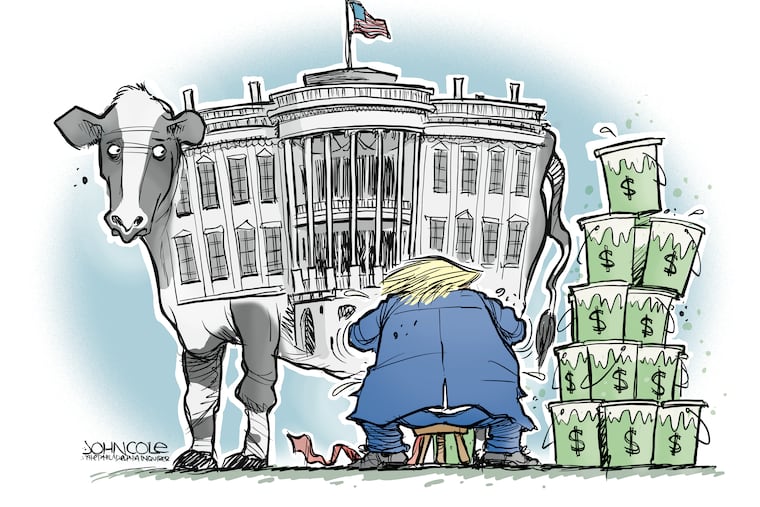
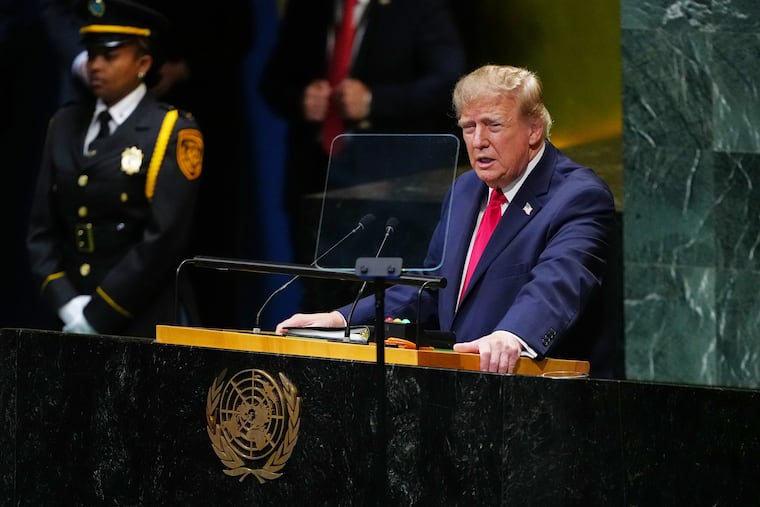
The pope’s guidance immediately made waves, landing squarely in the middle of a national argument about Christianity and its relationship to President Donald Trump and his administration’s policies and personalities.
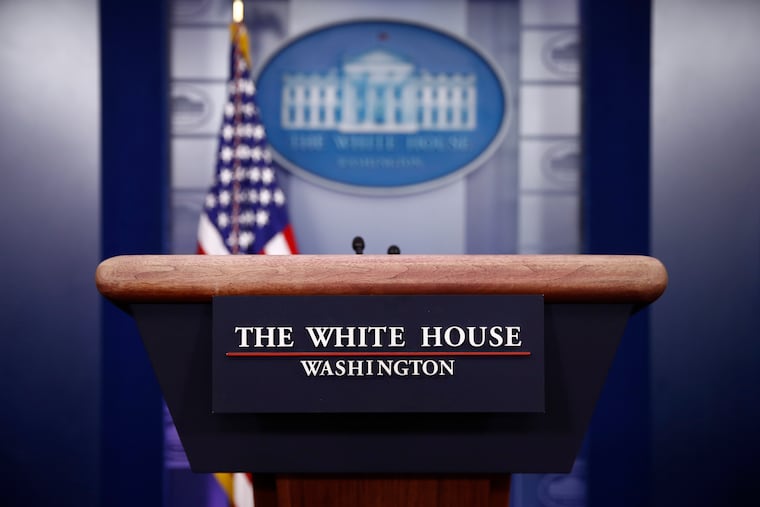
Some Christians in the argument point to Kristi Noem, offering a prayer before sending U.S. Immigration and Customs Enforcement agents out into communities looking for immigrants to arrest, or Karoline Leavitt, praying as she readies to take the podium at a White House press briefing, as a welcome sign that Christian belief is centered in this administration in a way no previous administration has centered it.
» READ MORE: When the state uses more force to take down a Latino senator than a suspected assassin | In Conversation
In a Pew Research Center poll of U.S. Christians conducted in September, 7% said they believe supporting Trump is essential to being a good Christian. Another 11% said exactly the opposite, and 80% of the remaining U.S. Christians polled felt that “good Christians” can disagree about Trump.
» READ MORE: ‘Say it with me: Our government is forcibly disappearing people’ | Sabrina Vourvoulias
I hasten to add that I’m not sure if I belong in the 11% or the 80% — I feel sick every time Christian belief is trotted out to sanctify or sanitize racist claims and the grievous harms the administration has visited upon so many of our neighbors (especially with regard to the brutal and dehumanizing treatment of immigrants). But people have extended grace to me in the past when I have been dead wrong about things … and I want to do the same with my fellow Christians.
Still, I am curious about how local faith leaders — tasked with reaching all Christians under their spiritual care — even manage to preach to a people so divided.
“Whether one is a native-born American, an immigrant seeking freedom and opportunity, or a naturalized U.S. citizen, all of us are impacted by American culture and the political landscape,” Archbishop Nelson Pérez, the leader of the Archdiocese of Philadelphia, told me via email. “The Catholic Church is not partisan. She works to transcend divisive actions and ideologies. She constantly reminds us to see each person as a member of the human family, and to care in a special way for the weakest and most vulnerable among us by serving as the compassionate Christ who sought to bring peace, hope, and unity to the world.”
The Rev. Jessie Alejandro, the Episcopalian vicar of the Church of the Crucifixion and Church of St. Jude and the Nativity, said via email that “when a person, mainly now in our Latino community, is being treated unfairly, what I can bring is hope — in spite of what the world is doing. [I can help people to] trust God in their daily walk.”
“Every time I preach I talk about love and forgiveness,” she added. “I believe that is the message that we should be imparting to every human being, to love one another as Jesus Christ has loved us, to love your neighbors as you love yourself.”
“I don’t teach, nor do I use, the Bible to weaponize or take anything away from folks,” she said.
Archbishop Pérez, meanwhile, brought it back around to the recently released papal document.
“We all must recommit to our common responsibility to care for the weak and the poor with an open heart, and to respect their God-given dignity with hands outstretched to our brothers and sisters,” he said. “Any expression of charity is an act of love. I join in Pope Leo’s vision for the Church acting with compassionate love in his conclusion to Dilexi Te, in which he calls love both ‘a way of looking at life and a way of living it.’”
I would like to be able to close this column with some deeper understanding of where the foregrounding of Christianity in our national political scene during this particular administration might lead. But I cannot.
The journalist in me fears that, given the Trump administration’s authoritarian bent and need for an “enemy” to fight, it will be nowhere good. The Catholic in me, however, is a creature of hope.
I pray daily, with intentions ordinary and special, that wherever we end up, it is — to steal some final words from Pope Leo — a place of moral and spiritual dignity.