I’ve seen struggles for democracy around the world. It’s painful to see that battle come home.
For decades I’ve reported on the struggles of other countries to achieve the kind of free elections that most Americans have taken for granted. The U.S. was a lodestar. That's all changed.
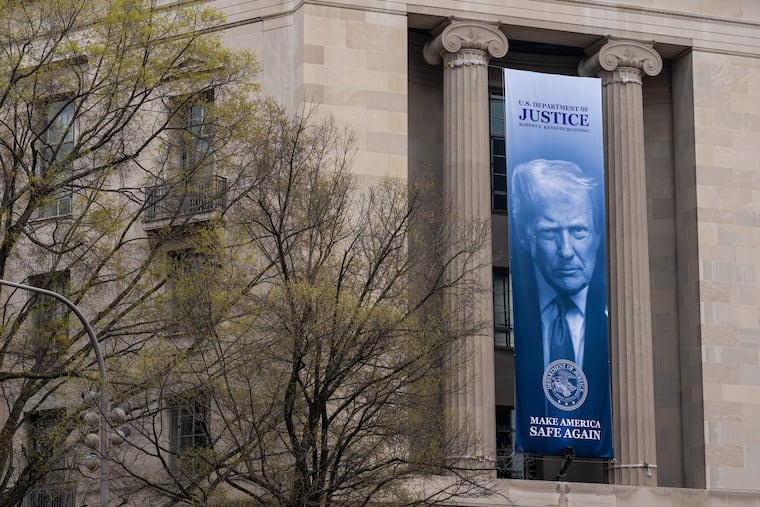
As we approach the 250th anniversary of America’s founding, I can’t help recalling my 1999 visit to the Central Asian republic of Turkmenistan, whose dictator had a fetish for white marble architecture decorated with gold.
As I drove around the dusty capital of Ashgabat, it was impossible to escape Saparmurad Niyazov’s face.
It was emblazoned on banners hanging from government buildings and appeared on every denomination of paper currency. Statues of the dictator (I learned there were more than 2,200 of them in a country of 4.2 million people) loomed all around the city. The oil fields of this desert backwater funded Niyazov’s whims. Much of the country’s budget went into his private slush fund — all while he slashed resources for healthcare and renamed the months of January and April after himself and his mother.
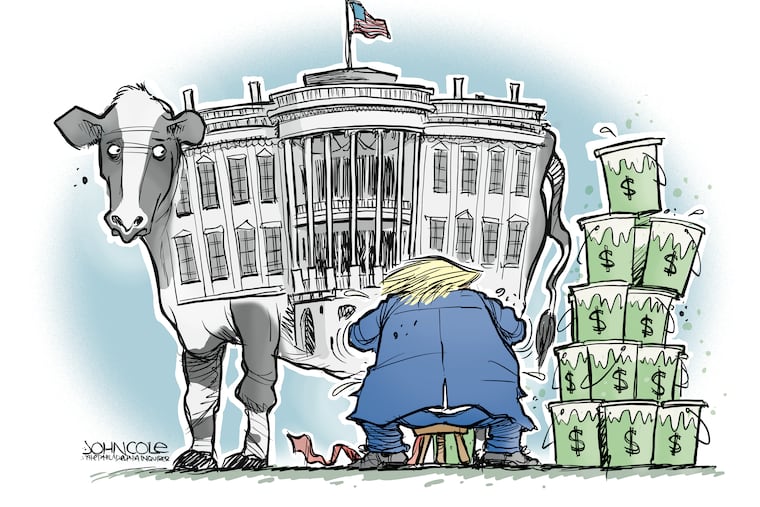
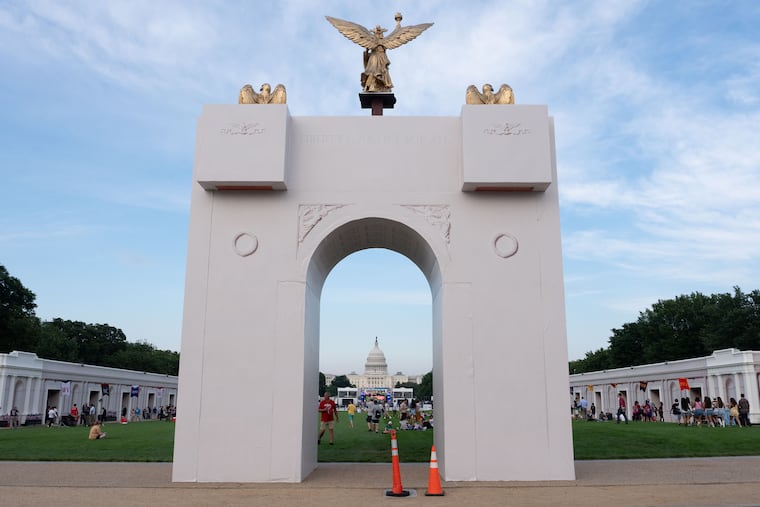
What sticks out most vividly among my memories, as President Donald Trump turns our nation’s Semiquincentennial into a celebration of himself — festooning government buildings with huge banners of his face and holding a political rally on the mall Wednesday to kick off July Fourth events — is Niyazov’s arch.
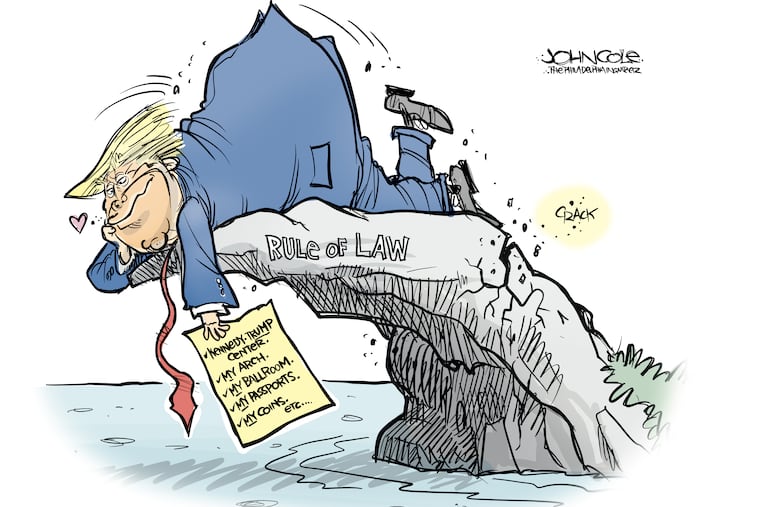
The three-legged arch, sitting in the center of Ashgabat, supported an observation tower that, at 226 feet, soared higher than the nearby presidential palace. The structure was topped by a 36-foot gold plated statue of the Asian potentate that rotated constantly to face the sun. Perhaps if the planned 250-foot high “Arch de Trump” ever gets built, and blocks the view of Arlington National Cemetery, the face on the gold winged figure atop the memorial will look familiar.
It seems all dictators and wannabes have the same instincts: to build grandiose monuments of marble and gold, the bigger the better, in order to impress their subjects with their magnificence. Back in Ashgabat all that seemed bizarrely amusing. Whoever thought it could happen here?
Instead of honoring the country’s founding values and documents in this year’s celebrations, Trump is performing like a wannabe Niyazov of Turkmenistan.
The main point of the Declaration of Independence was that governments “derive their just powers from the consent of the governed,” i.e., the people. The 13 colonies were quitting the British Empire because they refused to submit to a monarch who tried to rule by decree, rather than respect the elected representatives from the colonies.
Trump, who disdains any restraints on his powers and wants to rig election rules so they guarantee GOP victories, is turning the meaning of the Fourth of July on its head. I find it personally painful how this distortion has changed attitudes toward the United States all around the world.
For decades I’ve reported on the struggles of other countries to achieve the kind of free elections that most Americans have taken for granted for decades. I had the privilege of bearing witness to struggles for some form of democracy in the Soviet Union and China, in new post-Soviet nations, during the 1980s upheavals in the Philippines and South Korea, during the Arab Spring revolts, in post-Saddam Hussein Iraq, and during the post-Taliban interval in Afghanistan.
Those who struggled for the right to choose their leaders often paid a terrible price. More often than not, their struggles failed or have been reversed after brief periods of freedom.
Throughout those struggles, the U.S. election system was a lodestar - even though reformers abroad may have opposed specific U.S. foreign policies or the U.S. exercise of overweening power. That admiration was especially evident in the ’80s and ’90s inside communist countries that were trying to break away from their past.
Russians listened to Voice of America (now nearly shuttered by Trump) and would eagerly query me about U.S. politics on my yearly visits to Moscow during those decades.
In 1989, I shadowed then-President of the Soviet Republic of Russia Boris Yeltsin for a day when he visited the room where the Declaration of Independence was adopted inside Independence Hall. He asked the National Park ranger how the American colonies apportioned power between states and central government after independence. I realized only later that he was preparing to take Russia out of the Soviet Union and wanted tips on how the Founding Fathers managed their exit from the British Empire.
In May 1989, Chinese students erected a 33-foot-tall Goddess of Democracy statue in Tiananmen Square inspired by the Statue of Liberty. I was in Poland at the time, observing that country’s first free parliamentary elections on June 5 that were won by Lech Walesa’s Solidarity movement. But on June 4, I watched with horror on television, along with Polish colleagues, as the Chinese army sent tanks into Tiananmen Square.
Yet, despite hundreds to thousands of deaths (the exact figure is still unknown), Chinese democrats didn’t give up. In the 1990s, I reported on their efforts to press the central government to permit village, and then town, elections. I interviewed law students at top universities who traveled to small villages to instruct peasants on their rights according to Chinese laws that were ignored by officials.
This progress has been totally reversed by China’s hard-line dictator Xi Jinping, who also crushed democratic institutions in once autonomous Hong Kong. But as recently as 2023, it was inspiring to hear Hong Kong high schoolers, who were protesting the ongoing crackdown by Beijing, recite from memory their rights under law as they had learned in civics classes. Since then, such classes have been banned, and students must memorize rote lessons on “patriotic education” or “Xi Jinping thought.”
It saddens me now to hear self-exiled Russian liberals or Hong Kong democrats or visiting Chinese who once worked for some form of democracy at home, express shock at Trump’s attacks on America’s democratic institutions and efforts to rig elections. Repeatedly, I get the same questions expressed with genuine bewilderment: Why isn’t it possible to stop him from doing this? How is it possible that this can happen in the United States?
Ukrainians, who have fought bravely for more than four years to save their independence from Vladimir Putin’s imperialism, ask me how a U.S. president can back a dictator who hates the West, and wants to restore the Soviet empire. As Independence Day approaches, POTUS continues to ignore the parallel between Ukraine’s courageous struggle for freedom and ours long ago against the imperial British.
Europeans have given up on Trump, and I understand why, having watched Vice President JD Vance at the 2025 Munich Security Conference praise far right, neo-Nazi parties and demean Europe’s democracies. Trump, Elon Musk, and other MAGA acolytes continue to support extremist Europeans whose values would make the Founding Fathers gag.
So it isn’t surprising that a new Pew Research Center poll reveals a steep decline in the popularity of the United States worldwide, especially over the past year. Only a median of 37% of adults polled across 36 countries hold a favorable opinion of our nation. Only 23% express confidence in Trump’s leadership of world affairs, ranking him behind Putin and Xi.
But what is even more striking is that only 39% believe the U.S. government respects the personal freedoms of its own citizens. This is how the world now views a country that was once seen as a beacon of democracy.
During July Fourth celebrations across the country, in places far away from Trump’s pollution of the capital, I hope Americans will reflect on what the Founding Fathers bequeathed to us 250 years ago. For inspiration, reread the Declaration of Independence and brainstorm with friends, colleagues, and family on how to prevent the president from desecrating its principles at the polls come November.