White House rejection of Ukraine’s help to fight Iranian drones may cost U.S. military lives
Donald Trump’s rebuff of Kyiv’s offer reflects his confusion about the goals of the Iran war, or how to end it.
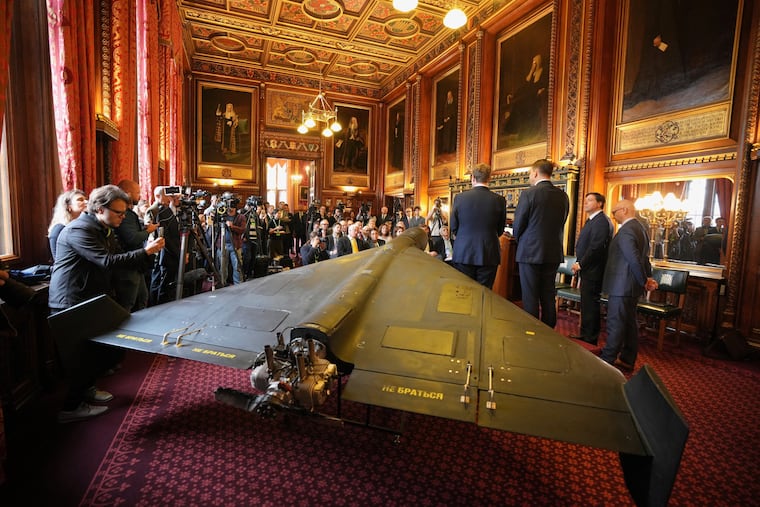
Nothing so perfectly demonstrates Donald Trump’s reckless approach to waging war on Iran than his rebuff of Ukraine’s offer to share drone technology that could save U.S. military lives.
Clearly, the president had little idea what he was getting into when he joined Israel in bombing Iran and killing its top leadership. This was a war of choice — the ugly Iranian regime posed no immediate threat to the U.S. — but Trump thought the effort would be easy.
As his tsunami of Truth Social verbiage and endless stream of comments to reporters show, he expected a quick victory — either a popular uprising leading to regime change, or a Venezuela-type win in which the ouster of a dictator (or ayatollah) let him dominate the country and its oil.
How any president could be so willfully blind is a question for psychiatrists, but Tehran ain’t Caracas. POTUS failed to foresee the obvious: that Iran would likely retaliate by closing the Strait of Hormuz to oil exports from the Persian Gulf for the very first time.
Voila! U.S. gas is at over $4 a gallon, and the entire world economy is threatened if the strait isn’t reopened. Now, Trump faces only bad options in a war he clearly doesn’t understand.
Despite his claims, indirect U.S. contacts with Tehran via Pakistan are likely going nowhere since the president is demanding total surrender, and Israel keeps wiping out potential Iranian negotiators.
Most scary, as POTUS keeps dispatching more troops to the Mideast, he seems oblivious to the nature of the war in which he has enmeshed our conventional forces. For the first time, the United States is facing the new style of hybrid warfare that Ukraine has been waging for four years against Russia.
Neither the White House nor the Pentagon is ready. Yet, Trump keeps rejecting President Volodymyr Zelensky’s offers of vital help.
The Iran war has exposed how unprepared the United States still is for modern conflicts in which large numbers of inexpensive unmanned drones and smaller, cheaper missiles can be used asymmetrically against pricey U.S. conventional weapons.
» READ MORE: Trump’s Iran quagmire distracts from Chinese threat to Taiwan | Trudy Rubin
Over the past four weeks, Gulf allies and U.S. forces have been downing Iranian Shaheds, drones that cost $20,000 to $50,000, with Patriot interceptors and other multimillion-dollar systems meant for targeting ballistic or cruise missiles.
The U.S.-made Patriots are in increasingly short supply, as the demand for them mounts in Europe, including Ukraine, and Asia — as well as among Gulf allies whose infrastructure is now being attacked by Tehran.
In the first four days of the Iran war, according to figures published by Philadelphia’s Foreign Policy Research Institute, the Gulf allies used up 618 Patriot PAC3 missiles, the equivalent of a whole year’s production by Lockheed Martin.
In those first four days, the Pentagon likely fired about $5.7 billion worth of interceptors to shoot down Iranian ballistic missiles — and drones.
It is infuriating, then, that Trump keeps rejecting help from the country that knows better than any other how to counter drone attacks, especially Iranian Shaheds.
It was Iran that first sent Russia the Shahed drones Moscow has used relentlessly to attack Ukrainian soldiers and cities. Vladimir Putin, in turn, has upgraded those drones and is transferring drone technology and satellite intelligence to Tehran to help target U.S. soldiers in the region. (Yet, Trump still insists on giving Russia a pass.)
Zelensky offered nearly a year ago to share Ukraine’s experience and technology, and to send drones and interceptors that have been tested and constantly updated on Ukraine’s front lines. In return, he requested U.S. air defense missiles that Europe would pay for.
“Today, Ukraine has more experience than anywhere in the world to defend against drones,” I heard the Ukrainian president tell European leaders at the Munich Security Conference in February. “Iranian Shaheds are killing our people. Our world of drones is your world of drones. Our ability to stop this sabotage is yours.”
But POTUS keeps turning the Ukrainian leader away.
Sneering at Kyiv’s offer, Trump insisted in March that the U.S. military didn’t need Ukrainian expertise. “No, we don’t need their help. We know more about drones than anybody,” the president boasted in a Fox News interview. That simply isn’t true.
If U.S. Marines and soldiers try to take Iran’s key oil depot on Kharg Island, or attempt an extremely risky effort to unearth buried stores of enriched uranium at Isfahan, they will provide rich targets for drone warfare. The island is only around 21 miles from the Iranian mainland, within easy reach of waves of Shaheds.
Landing craft and vehicles make easy targets. And even though the U.S. has sunk Iran’s navy, its small boats can launch drones at American ships. Recall that Ukraine drove Russia’s Black Sea fleet out of its waters and back to home ports using unmanned sea drones, some of which could fire missiles.
Iranian drones are now also targeting the infrastructure of Arab allies and U.S. bases in those countries. More than two dozen U.S. troops were injured by an Iranian missile and drone strikes at the Prince Sultan Air Base in Saudi Arabia on March 24, proving their reach. And the six U.S. Army Reserve soldiers who were killed in Kuwait on March 1 were victims of a drone attack.
That is why those Gulf states, unlike Trump, have been eagerly courting help from Ukrainian drone experts. In mid-March, according to Zelensky, 201 drone defense specialists had been deployed to Qatar, the United Arab Emirates, Saudi Arabia, and Jordan, where the Ukrainians are setting up anti-Shahed defenses for a U.S. military base.
» READ MORE: Beware the similarities between the wars in Iraq and Trump’s Iran war | Trudy Rubin
It gives me chills to think of Trump sending U.S. troops to launch a ground war in Iran when he is so blinkered about his goals or the necessary means to achieve them. He enjoys using force, but wants easy wins, and is clearly uneasy with complex challenges. He is hinting he may quit this war without Iran regime change, or removing enriched uranium, or reopening the Strait of Hormuz, leaving the whole region in chaos and the global economy in peril as energy prices continue to soar.
Honestly, I don’t know which would be worse: sending ground troops to Kharg or to the Iranian mainland, with a high likelihood of disaster and/or a quagmire, or the president pulling a TACO (Trump always chickens out) and leaving ill-equipped Arab and European allies to cope with a global economic mess.
I do know that it is criminal to reject the help of Ukrainians who stand ready to aid U.S. troops against the asymmetrical warfare that a weakened Iran can still muster. If more U.S. troops die from Iranian drone strikes that Kyiv could have helped counter, then their blood will be on Trump’s hands.