After another Kremlin humiliation, it’s past time for Trump to pressure Putin on Ukraine
Moscow rules out a Budapest summit between President Trump and Vladimir Putin after POTUS calls for a ceasefire in place.
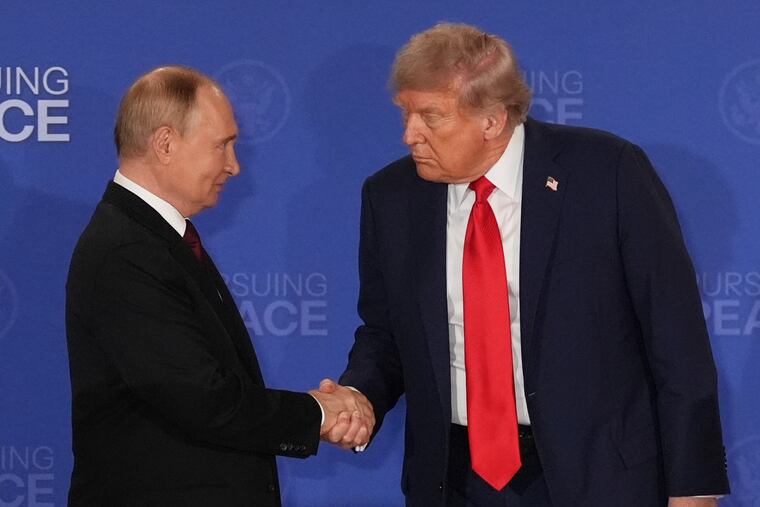
How much Russian humiliation can Donald Trump swallow before conceding that Vladimir Putin is making him look like a fool?
On Tuesday, the White House was forced to announce the cancellation of a supposed Trump-Putin summit the president had recently stated would take place in Budapest, Hungary, in around two weeks.
Russian Foreign Minister Sergey Lavrov effectively told Secretary of State Marco Rubio by phone that the U.S. president hadn’t kowtowed sufficiently to Moscow to justify a summit. There are “no plans” for Trump to meet Putin “in the immediate future,” the White House admitted.
In past weeks and months, Trump has bowed down so deeply to Russia’s leader it’s a wonder his head hasn’t banged on the ground. Yet, the Kremlin keeps playing him and disrespecting the self-declared champion of global peacemaking.
It won’t be surprising if Trump chooses to blame the summit fiasco on Kyiv’s refusal to surrender to Moscow — rather than recognize Putin’s total disinterest in a peace deal. If he doesn’t want to go down in history as Putin’s lapdog, the president needs to recognize that carrots won’t bring peace if they aren’t backed up by sticks.
» READ MORE: Trump caves again to Putin rather than strengthening Ukraine | Trudy Rubin
Ironically, Trump appeared to have grasped that truth when he finally pressured a reluctant Benjamin Netanyahu to accept a ceasefire in Gaza in return for Hamas’ release of living and dead Israeli hostages.
But with Putin, Trump’s tactic has been all carrots. So far, the president seems blind to the reasons why his peacemaking efforts with the Kremlin have failed, again and again.
A red-carpet summit in Alaska in August was a dismal disaster, even though POTUS dropped his support for a ceasefire in favor of Putin’s demand to negotiate while fighting.
When Putin rewarded Trump’s faith by massively ratcheting up air attacks on Ukrainian civilians, the president seemed to recognize he was being played. He began hinting he would sell Kyiv long-range Tomahawk missiles that could take out Russian missile bases at the source, and was set to meet Ukrainian President Volodymyr Zelensky to discuss the missiles on Friday.
Putin, knowing his man, called the White House on Thursday and said nyet. Trump immediately dropped all talk of delivering Tomahawks.
Instead, the president angrily urged Zelensky to accept Putin’s demands that Ukraine surrender the entire Donetsk region to Russia, including a large chunk that Kyiv still holds, which is a critical “fortress belt” preventing further Russian advances toward major cities. Trump reportedly berated Ukraine’s leader in foul language to accept the Russian demand (on the false presumption it would end the war). Otherwise, he claimed, Putin would “destroy” Ukraine.
Needless to say, Zelensky refused this suicidal proposal. Trump then resurrected a call for Russia to agree to a ceasefire in place in Ukraine. Kyiv and America’s NATO allies supported this idea.
Russia refused, and continued to demand Ukraine’s complete capitulation, including the handover of unoccupied Donetsk, Ukraine’s demilitarization, a change of government (meaning installing a pro-Putin puppet regime), and a cutoff from any NATO member support.
Which brings us to now, and what comes next for Ukraine.
Much depends on whether an egotistical Trump can sense how weak he is being made to look by Putin. It also depends on whether the president has the guts and smarts to pressure Putin sufficiently to convince him the war has become too costly.
It is hard to imagine such a presidential self-awakening. But were it to happen, it would require recognition of certain facts that Trump has failed to grasp until now.
First, the Ukraine war is not about territory. I cringed when Trump told Fox News on Sunday he was confident he could end the conflict, but Putin was “going to take something, he’s won certain property.”
» READ MORE: Trump’s ‘new Middle East’ depends on leaders who skipped his Egypt summit | Trudy Rubin
That is the equivalent of claiming that American patriots waged the Revolutionary War up and down the Eastern Seaboard over waterfront footage, not for their independence from imperial rule. As former Ukrainian Defense Minister Andriy Zagorodnyuk told me by phone from Kyiv, “This is not a territorial war, it is an existential war about the existence of the Ukrainian state.”
Nor is Putin fighting for land. He is waging an imperial war to destroy Ukraine’s existence as an independent country, eradicating its religion, culture, language and civic freedoms. Such Russian cruelty is already the norm in Ukrainian territory that Moscow has seized.
Until Trump and his Putin-bedazzled negotiator Steve Witkoff grasp this, they will never understand why Ukrainians continue to fight.
Second, Putin does not want peace, no matter what platitudes he feeds Trump. He is angling to see how many carrots Trump will offer him in return for nothing. That is why it is past time for sticks — including secondary sanctions on Russia, and Tomahawks and Patriot air defenses for Ukraine.
Third, the portion of Donetsk that Ukraine still controls contains key cities and critical fortifications that prevent Russian troops from entering vast flat steppes which would give them open access to major Ukrainian cities such as Dnipro. The Russians have been struggling for three years to take this area, with huge losses of man power, and still haven’t succeeded.
And contrary to a naive Witkoff’s astonishing ignorance of any Ukrainian history, and repetition of Russian talking points, the population of Donetsk was not begging to be reunited with Mother Russia. After the breakup of the Soviet Union in 1991, the citizens of that region voted by substantial margins for independence from Moscow.
Nor did they yearn for Kremlin overlordship because they were Russian speakers, a Putin talking point Witkoff keeps repeating. Most Ukrainians were bilingual or Russian speakers before Moscow’s invasion because of the long-term impact of prior Soviet rule.
Fourth, Putin won’t be able to “destroy Ukraine” if Kyiv refuses to capitulate. Contrary to Putin’s lies to Trump and Witkoff, his economy is ailing, and his massive losses of soldiers are being felt. Were it not for aid from Iran, China, and North Korea, Moscow could not keep up.
“Putin won’t be able to destroy us,” Zagorodnyuk told me. “He is selling himself as the leader of a superpower, but he isn’t. He is much weaker than he is perceived. Most of the world sees this, but unfortunately, he still seems able to communicate this message to the United States.”
Fifth, forging peace requires U.S. toughness. If Trump truly wants peace in Ukraine, it’s time to recognize Putin’s weakness and Ukraine’s strength, born from painful knowledge that Putin intends to turn their country into a Soviet-style satellite ruled by terror. Trump’s weakness will only encourage further attacks on Europe and aggression against other U.S. allies by a Chinese-Russian-North Korean entente.
Handing over Donetsk would only feed Putin’s appetite for more. “He would just take the territory and move on,” said Zagorodnyuk, rightly.
If Trump is the tough guy his followers claim, and not Putin’s patsy, it’s past time for more sanctions, Tomahawks, and air defenses for Ukraine.