Why Yale’s term paper on what’s wrong with college gets a ‘D-’
An Ivy League university’s report on the loss of faith in higher ed ignores what really killed the American dream of college.
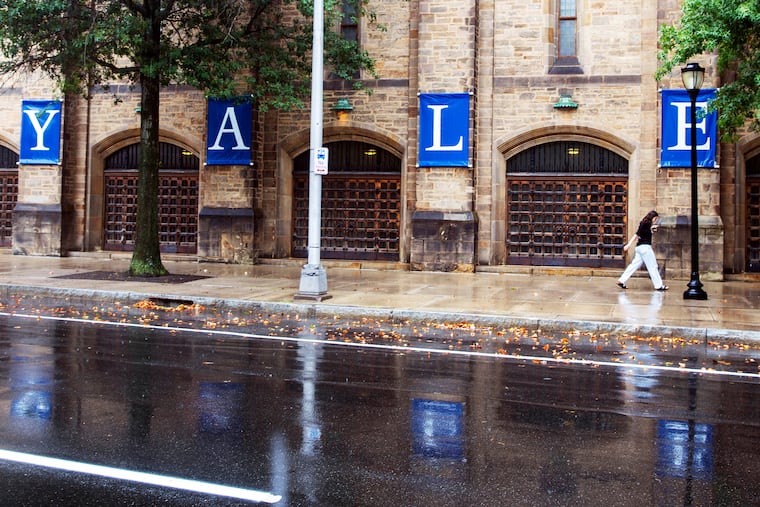
By Yale’s sad standards, the Ivy League university’s new, high-profile report on why Americans have lost all faith in higher education deserves a grade of at least an “A-.”
Why? Because nearly every student paper that’s produced on the New Haven, Conn., campus — a gobsmacking 79%, according to a 2023 study by a Yale economics professor — is handed an “A” or an “A-.” The utter meaninglessness of classroom grades, not just at Yale (which, in 1963, at the zenith of the golden age of college in America, awarded an “A” just 10% of the time) but at most elite universities, is, understandably, cited in its report on what’s gone wrong.
The Yale committee of 10 professors was appointed a year ago amid a moment of high anxiety for America’s colleges and universities, with the arrival of a Donald Trump regime that has all but declared war on higher education, willing to use federal research dollars as a bludgeon. No one disputes that the loss of public faith in an institution once cherished as the gateway to the American dream is real — with 70% of the public telling a 2025 Pew Research Center survey that higher ed is headed in the wrong direction.
Nor can anyone really disagree with both the committee’s findings about some of the major problems — the insane cost of a four-year diploma, an inscrutable admissions process correctly seen as unfair, a bloated bureaucracy, and, yes, runaway grade inflation — and in noting that an arrogant and isolated academy has brought many of these problems upon itself.
But if we’re going to grade Yale’s term paper by 1963 standards — and we should — then we ought to give it a barely passing grade, maybe a “D-,” because its world-class academic authors somehow failed to see the proverbial forest, for all the dead trees it correctly identified. There are at least two, and arguably three, ways the Yale team got it wrong.
For starters, the report was immediately spun in the major media as an indictment of all higher ed, when the tree rot it uncovered was in many ways more specific to the Ivy-draped woods of New Haven and other elite campuses, not the vast wilderness of American college.
The New York Times seems to constantly forget, or just doesn’t care, that only about 1% of U.S. college kids attend the dozen so-called Ivy-plus top-tier universities, and that less than 30% attend any type of private university. The typical American student isn’t found at Princeton’s dining clubs, but at the food pantry at a school like Kutztown University, struggling to pay the high tuition bills for a public education that cost next to nothing a couple of generations ago.
» READ MORE: America’s real college debt: How we failed an entire generation | Will Bunch
That dissonance is related in a way to an even greater blindness in the Yale committee’s report. The public’s very real lack of trust in college didn’t happen in some hermetically sealed vacuum. Instead, those currents were driven by outside forces — a six-decade-long right-wing campaign to undermine the academy.
Indeed, it’s the 60th anniversary of Ronald Reagan’s historic campaign to capture the California governorship, which he won in a landslide by running against the Berkeley student protester as a young man “who dresses like Tarzan, has hair like Jane, and smells like Cheetah.” Conservatives’ real fear was that the surge of middle-class kids getting a low-cost college diploma was sniffing out adult hypocrisy, from Selma, Ala., to Vietnam. A Reagan adviser famously warned in 1970 — the same year six students were killed during protests at Kent State and Jackson State — that “an educated proletariat” would be “political dynamite.”
The problem for the roughly three-quarters of U.S. college students in public universities and community colleges is that since the so-called Reagan revolution of the 1980s, state tax-dollar support for higher education has plummeted — by a whopping 42% here in my home state of Pennsylvania. The difference is largely made up in tuition paid by families who borrow heavily when told there is no future without a diploma.
This vicious cycle is what really sparked the loss of public trust. Conservatives have been hating on higher ed because they are bombarded daily on talk radio or Fox News with horror stories about alleged liberal indoctrination. But budget cuts by the Republican lawmakers they elected caused a student debt crisis that made almost everyone else despise college, too. And don’t forget that faith in college has fallen in virtual lockstep with a loss of confidence in almost every other public institution, in a nation slip-sliding away into authoritarianism.
This points to a second problem with the Yale report. To be sure, there have been some unnecessary and unhelpful self-inflicted wounds on the college free speech front. From time to time, this progressive-minded columnist has warned when individual or small-batch actions on the left have crossed from legitimate protest into unwarranted silencing of voices.
But the First Amendment was written not to deal with wayward individuals, but to prevent government itself from clamping down on public discourse. Both the Trump regime and red-state governments and their conservative university trustees have seized upon lower levels of public trust in college to impose unconscionable and arguably unconstitutional restraints on campus speech.
Just in the days before the Yale report, for example, Texas Tech University went so far as to restrict research on hot-button topics like gender, the University of Missouri cut off its historic Black student government, and Kentucky made it easier to fire faculty members.
These are not the problems caused by an ultraleft academy, but by a suffocating authoritarian worldview that is crushing campus freedom from the outside. These beatings will continue until we start electing political leaders who see higher education the same way many people saw it during that golden age of 1963 — as a public good that can uplift American society, if we still want that.
There’s arguably another problem with the Yale report, which is that it identifies a lot of bad and unfortunate things that have already happened to American universities this century while ignoring that darkest cloud lurking overhead. The valid concerns that college is ridiculously overpriced for student consumers to rack up meaningless “A’s” have segued into a much bigger debate over the very meaning of a diploma in an age of artificial intelligence, or AI.
The Yale report didn’t tell me nearly as much about the state of higher education as a recent, stunning editorial in the Daily Pennsylvanian that argued that a speedy adoption and overreliance on AI at the Ivy League school is threatening to ruin their education. “In its tireless support for AI,” the student journalists wrote, “the University has essentially endorsed shortcuts and the outsourcing of academic thinking, threatening the very freedom of inquiry and open expression it claims to promote.”
There’s no question that the old models of higher education need to be thrown out the window for a major rethinking of what college needs to become for the mid-21st century. But I’m not sure who’s equipped to do that. Not the Republicans who want to knock down the ivory tower, but also not the narrow-minded Democrats who believe they can only justify spending on higher ed as gussied-up vocational schools.
The future of America depends on training critical thinkers — not only because they will do better in the workplace than those with shallow career prep, but because they will also bring those smarts into the voting booth or the vaccine clinic. That means developing and strengthening the humanities instead of killing them off, since things like the ability to write or create art or speak other languages will only become more important in a world where these things are threatened by robots.
America will have a new president by January 2029, and if the nation is lucky, that leader will have the vision to do what Harry Truman did in an earlier time of turmoil, when the GI Bill’s surge in college enrollment forced America to rethink what a diploma could mean. Although flawed, that 1947 Truman Commission report did help the U.S. focus on how higher learning could make society stronger after an era of global depression and fascism. A similar push in three years could be the “A+” (even adjusted for grade inflation) vision that will save U.S. higher education yet again, if it’s not too late.

Sign up for the Will Bunch Newsletter